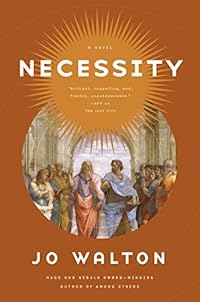
Necessity by Jo Walton
Posted in Fantasy, Reading Reviewed, Science Fiction at 12:00 on 1 May 2023
Tor, 2016, 332 p, including ii p Thanks.
This is the last of Walton’s “Thessaly” trilogy in which the author examines the ramifications of implementing Plato’s philosophy in a restricted setting. This is also a scenario in which the ancient Greek Gods are real and can interfere in human affairs. I reviewed the first volume, The Just City, here and the second The Philosopher Kings here.
Necessity takes place in the 26th century on the planet Plato to where Zeus removed the people of the Just City at the end of The Philosopher Kings. As in that second book there are twelve cities in all to cater for people’s various preferences. The climate on Plato is colder than the Greece from which most of the humans now living there were derived. Nevertheless their habitual attire is the kiton. As well as humans, the planet is home to some aliens known as Saeli who have immigrated there and are accepted as full members of society. Contact has also occurred with another set of aliens known as Amarathi. Many tasks on Plato, as in the Just City, are carried out by Workers, sentient robots accorded human rights. One of these, Crocus, has narration duties, as do the humans Jason and Marsilia and the god Apollo. Jason is a fisherman whose crew includes the Saeli, Hilfa, and the present consul Marsilia. He has an unrequited yen for Marsilia’s sister Thetis.
The book starts on the day when Pytheas, the human incarnation of Apollo and grandfather of one of our narrators, Marsilia, dies and a spaceship containing humans (from the planet Marhaba) arrives in orbit round Plato. This last, the reader might have thought, would provide the main thrust of the intrigue/plot but in fact not much is made of it. Instead the thread that is followed is a search for Apollo’s sister Athene who has ventured outside time, to study Necessity, and what Chaos is, and how time began. Necessity is later referred to as a great force that binds all thinking beings. Zeus, the father of both Apollo and Athene, would apparently be displeased if he knew Athene had done this – at least once his attention had been drawn to it – but despite him knowing everything no consequences will ensue if she can be brought back before it comes to his attention.
The human interactions are something of a sub-plot. Marsilia has an eight-year-old child, Alkippe, whom she had conceived with someone calling himself Panodorus. He appears at a gathering but does not recognise her and everyone else sees he is Apollo’s brother Hermes. (Yet even this is another disguise as he is in fact the Saeli god, Jathery.) His failure to recognise Marsilia is because in his time he has not yet met her. This is a potentially disastrous situation since if he does not step outside time then Alkippe may not ever have existed. Again, not as much is made of this situation as might be expected.
Walton it seems is more interested in philosophical speculation than interpersonal (or god to human) conflict. Her writing is fine, though – she can pull you along – and she brings out her characters’ attributes well, but in the end Necessity is a touch disappointing.
Pedant’s corner:- kiton (the spelling chiton displays its Greek origin more clearly,) “we were back on in the peaceful glade” (no need for the ‘on’,) “on a women’s body” (a woman’s.)