The Kif Strike Back by C J Cherryh
Posted in Reading Reviewed, Science Fiction at 12:00 on 28 October 2023
201 p, in The Chanur Saga, Daw Books, 2000, (which has an 11 p Appendix on Species of the Compact.) Originally published 1986.
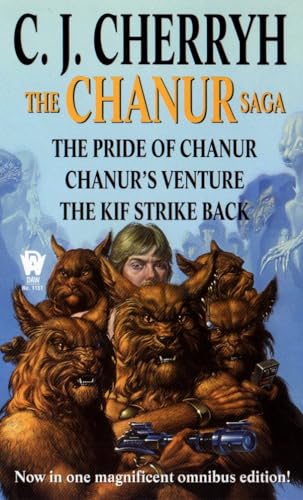 This is the third of Cherryh’s novels featuring Pyanfar Chanur, a hani from the planet Anuurn, itself a member of the interstellar trading system known as the Compact. For my thoughts on the earlier two instalments see here and here.
Pyanfar’s first task in this book is to gain the release of both her niece Hilfy and the human Tully from their captivity by the kif, Sikkukkut. For this she has travelled to the station of Mkks, which is under Sikkukkut’s control. The exchange involves her agreeing to an arrangement with Sikkukut to aid him in his contest with another kif, Akhtimakt, for supremacy among their kind. Part of this is a gift to her of Skukkuk, a kif whose presence on Payanfar’s ship The Pride of Chanur causes grave misgivings among her crew. An alliance such as this is also thought by other hani undesirable, even treasonous, and may have repercussions for Payanfar’s family back on Anuurn.
The agreement requires Pyanfar to journey deep inside kif territory to Kefk station, where most of the action takes place. The nature of kif beliefs and behaviour is emphasised by the entrance to Sikkukkut’s headquarters being flanked by his enemy’s heads on poles. So far, so mediæval. Pyanfar manages to bargain for the release of another hani ship’s crew from Sikkukkut’s custody but on the way back to the Pride they get caught up in the struggle between kif factions which provides the book’s only ‘battle’ scenes.
I note here that the kif language is heavy with (often doubled) percussive consonants and seems to lack the vowels a and e. Apart from Pyanfar’s hani, the only other language represented on the page in this volume is that of the tc’a, who communicate in cryptic seven by three matrices.
Though bearing in mind that hani are essentially lion-like (certainly in appearance, apart from what I assume – there being no indication to the contrary – is their bipedalism) Cherryh may have been making a comment on human affairs when in the context of hani social arrangements she tells us “Hilfy had known all her life that men were precious things; and their sanity precarious; and their tempers vast as their vanity.”
While all the action and intrigue Pyanfar witnesses and takes part in is going on a lot of stuff has been occurring in the background. Pyanfar’s mohendo’sat friend Goldtooth has, without Pyanfar’s knowledge, been manœuvring to leverage the impact of human accession to the Compact. Tully has less of a central role in this book than he had previously but he does let slip that human culture is more factional and complicated than the species of the Compact had perhaps assumed.
I suppose these books are technically space opera but their emphasis is less on spaceships battling each other than on political matters in the Compact, inside kifdom and amongst the hani. There is, too, frequent reference to domestic life on board the Pride. In this regard the procedures on board make the hani seem more human than leonine.
Pyanfar, Hilfy and even Sikkukkut have become more rounded the more the story develops and we also learn more of the other members of the crew than before.
Since there are five books in the overall Chanur story arc it is a little odd that this omnibus has cobbled together Books 2 and 3 with Book 1, which was more of a stand alone. Indeed Cherryh’s tale is by no means resolved by The Kif Strike Back’s end, which in a three book volume I would have thought the reader has a right to expect.
However, I found Pyanfar’s company (both that on her ship and in my head as I read) very congenial. I will look out for the next in the sequence.
Pedant’s corner:- “whether that this was a kif’s humour or…” (no ‘that’ required,) Mkks’ (several times, Mkks’,) “‘You sure about this’ Pyanfar said” (needs a question mark after ‘this’,) strategem (stratagem – used later,) asyet (as yet,) “which had shed their v and began a sedate return” (had shed their v and begun a sedate return,) focussed (x 2, focused.) “Smoke skirled and billowed in the shock” (smoke does not skirl, it might swirl but it doesn’t make a sound,) “undernHaral’s pushbutton command” (under Haral’s.)
