The Camomile: An Invention by Catherine Carswell
Posted in Reading Reviewed, Scottish Fiction at 12:00 on 15 March 2026
British Library, 2024, 203 p, plus i p Contents, ii p The 1920s, ii p about Catherine Carswell, ii p Preface by Helen Vincent, i p Publisher’s Note and vii p Afterword by Simon Thomas. First published 1922.
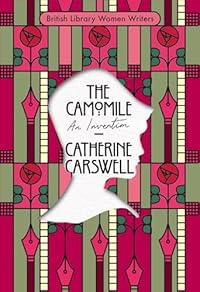
This is structured mainly as the journal entries of Ellen Carstairs, along with some letters – all addressed to her friend Ruby in Germany where Ellen spent some years studying music. Ellen lives with her brother and fiercely religious Aunt Harry in Glasgow. For income Ellen has taken pupils for piano lessons but she really wants to be a writer. Indeed, one of her schoolteachers is so disappointed that she has not so far pursued her true vocation that she refers to Ellen (publicly) as a prostitute for neglecting her talents. Not a description to be welcomed in the 1920s – or I suppose anytime.
In a prefiguring of Virginia Woolf’s famous essay Ellen is much delighted by renting a room where she can receive pupils and write. “I have a Room!” she tells Ruby. “A room all to myself and away from home.” Not that it is in any way salubrious. But she has the right to refuse any one entry. And it is an escape from Aunt Harry.
Ellen’s imagination is fired by meeting in the Mitchell Library an older man whom she calls Don John. His knowledge of literature and London publishers will provide her with a potential route into writing professionally.
It is he who recites to her the quote from Shakespeare that gives the book its title, “The camomile, the more it is trodden on, the faster it grows.” He is referring to Ellen’s writing but the sentence could also apply to Ellen herself.
Despite his learning and apparent gentility Don John turns out to be poor and prone to lapses into drink.
Ellen reflects on writing novels that, “It is hardly ever from likely touches, nearly always from unlikely ones, that the reader gets that sudden piercing sense of life in a good book. Yet at the same time it must never be an unlikeliness that is contrary to nature.”
The book is peppered with Ellen’s thoughts on women’s place in life and their likely prospects. She wonders about marriage and children but defers that expectation to the future. However, she betrays attitudes of the time – or perhaps in a preemptive strike against possible dismissal of her worth – with the thought, “when I’m reading anything serious, to know that the author is a woman who sat in her petticoats and her hairpins, leaving life aside to put words on paper, puts me off like anything.”
After returning from a trip to London, she tells Ruby (and us) she is engaged to a man named Duncan, home on a break from his civil service position in India. She toys with the idea of consummation but shies away from it despite thinking relations between the sexes ought to be freer. Duncan professes to admire her frame of mind but gradually it becomes clear that the conformities of life in India are uppermost in his thoughts, giving Ellen pause.
Though it starts falteringly, this reads like an accurate portrait of middle-class life in Scotland in the early part of the twentieth century.
Pedant’s corner:- “the Miss Clarks” (the Misses Clark,) a missing comma before a piece of direct speech, “the Miss McFies” (the Misses McFie,) “the Trosachs” (Trossachs.)
