Archives » Telemass Quartet

Exalted on Bellatrix 1 by Eric Brown

The Telemass Quartet Part Four, PS Publishing, 2017, 92 p.

In this conclusion to Brown’s Telemass Quartet, Matt Hendrick’s chase across the galaxy via different telemass stations in order rescue his daughter Samantha reaches its end on the titular planet, to where his wife Maatje has taken Samantha’s life-suspended body in an effort to be cured and possibly “exalted” by the indigenous Vhey.

We first, though, have a bit of misdirection when Hendrick learns of a cure for Samantha’s condition. It is however, prohibitively expensive, which leads him to take on a commission from the EU in effect to spy on the Vhey on its behalf and enable his travel there.

The Vhey are another example of Brown’s stable of enigmatic aliens, eminently nebulous in their motivations, almost incomprehensible in their actions. (The cover’s depiction of them is, though, somewhat at odds with their description in the text.) Other common Brown tropes to appear include an artist’s colony – though here this is pretty much incidental – and someone with a profound psychological disturbance. And, of course, there is telepathy, in the shape of Hendrick’s helpmeet, Mercury Velazquez. But all contribute to the plot.

There are the usual bumps and hollows and action incidents along the way but the spying element never really comes to much as the Vhey dispose of the means of surveillance very expeditiously. However, that is more than made up for when we finally witness an exaltation, the details of which are suitably horrific. It all rounds up the Quartet satisfactorily.

One quibble. The cover and title pages have Bellatrix 1 as the planet on which this is set. In the previous three Telemass novellas the planet’s number was expressed in Roman numerals (IV, III, II.) The reason why this one’s should contain the Arabic numeral 1 is obscure. Within the text the planet’s name is written as Bellatrix I so I assume the change wasn’t due to the author.

“Time interval” later count: 7. Pedant’s corner:- a missing full stop, “out offer” (our offer,) “the subjective interpretation of objective phenomenon” (either “objective phenomena”, or, “an objective phenomenon”) tae chi (tai chi,) “to affect change” (to effect change,) “when the might return” (they,) “they Vhey” (the Vhey.) “Its eyes nictitated slowly from side to side” (eyes don’t nictitate, eyelids or membranes do. Then again maybe in aliens eyes do nictitate,) “watch Sam grown up” (grow up would be a more usual expression. Though watching Sam grown up would be possible for him.)
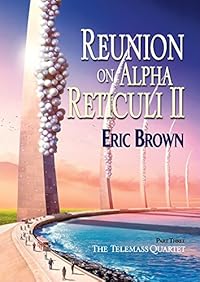

Reunion on Alpha Reticuli II by Eric Brown

Part Three: The Telemass Quartet, P S Publishing, 2016, 80 p.

 Reunion on Alpha Reticuli II cover

In this third instalment of Brown’s ‘Telemass Quartet’ Matt Hendrick is still following one step behind his ex-wife, Maatje, and the sleep pod containing his dead daughter Samantha, this time landing on the resort world of Tourmaline, now awaiting the imminent arrival of a starship despatched long before the days of telemass and whose inmates in suspended animation coldsleep are blissfully unaware of what will greet them. On landing he is rescued from the clutches of one (poor) telepath in Maatje’s employ by another (better) one not so encumbered. This is Mercury Velasquez, who volunteers her help in Hendrick’ s quest.

Unlike in the previous instalment the plot this time is more centred on Hendrick’s pursuit of his daughter. Maatje and her new lover Horvath have engaged the services of a Zuterainian effectuator. who may be able to restore Samantha to life. Velasquez’s telepathic ability reveals the dangers in the procedure. However, no full resolution is achieved (Part Four is still to come after all) and Maatje, Horvath and the insensate Samantha give him the slip again.

No weird religion this time but at least two types of strange alien to be going on with. If I have a criticism it is that the ending (involving arrival of the starship) is perhaps overly sentimental. But Brown has always emphasised human considerations.

Pedant’s corner:- In the cover – and internal – blurb; “all is not as it seems” (not all is as it seems.) Otherwise: “‘None of us like our private thoughts made public’” (ought to be “none of us likes”, but it was in dialogue, so may be true to the character,) an albino girl is described as having silver pupils (pupils? Not irises? And don’t albinos have pink irises anyway?) “‘pre-Telemass, pre-Expansion, prealmost everything we take for granted’” (to fit with the other two that should be pre-almost everything,) a missing comma at end of a speech quote, “‘Vizzek would have gone through the charade’” (through with the charade,) “‘Maatje’s might still be on’” (Maatje might still be on,) “‘I read you pain’” (your pain,) “Hendrick hitched himself onto high seat” (onto a high seat,) “him and his fellows humans” (him and his fellows; or, him and his fellow humans,) last line, difficultly (difficulty,) “he might have been able to accept it easier than” (‘he might have been able to accept it more easily than’ is the more natural form,) “Hendrick saw the saw the weapon” (only one ‘saw the’ needed,) “tears roll down her cheeks” (rolled.)
Time interval later count: 6 (though one was a sneaky “a little later”) plus one “minutes elapsed”.

Famadihana on Fomalhaut IV by Eric Brown

The Telemass Quartet 1, P S Publishing, 2014, 88 p

 Famadihana on Fomalhaut-IV cover

This is the first of four novellas presumably centred round the beam-me-across-space technology Brown has dubbed Telemass and which, as I recall, made its first appearance in the author’s Meridian Days many moons ago.

Here, Matt Hendrick, a detective from Amsterdam, arrives by Telemass on the planet Avoel (Fomalhaut-IV) to seek his wife and the daughter she took with her when she left him. Once there he becomes embroiled with Tiana Tiandra, a woman whose girlfriend Lalla has also disappeared into the interior. The events of the novella are related to the goings-on of a strange cult inspired by the indigenous Avoeli who have a ritual similar to the famadihana of Madagascar from where most of the humans on Avoel originally derived. This involves the apparently dead being brought back to life. The story is mostly told in third person but small fragments from Tiana’s viewpoint are rendered in italics.

Brown does this sort of thing so well. His readers will be familiar with a protagonist not in a relationship at the story’s start or else getting over a failed one, a religion with a degree of bizzarrerie, a lost spouse or family member, strange aliens and may even expect a love interest to be encountered along the way. The entertainment comes with the twists he applies to these building blocks. In this novella the Avoel are perhaps a little too undeveloped, Hendrick’s relationship with Tiana is a bit precipitate and the resolution also feels a trifle rushed. Yet the whole thing is engaging, if perhaps lacking some of the warmth of Brown’s previous quartet for PS, Starship Seasons. But we’re only one story in. Time enough.

Pedant’s corner:- is a valued members of my congregation (member,) attempting to keep the irritation from her voice” (his voice makes more sense,) peered around it mass (its mass,) bears a passing a passing resemblance, not to hate met (me,) “He heard her breathing at her side (his.) And a fair sprinkling of instances of “time interval” later.

free hit counter script