New Model Army by Adam Roberts
Posted in Science Fiction at 12:00 on 2 October 2012
Gollancz, 2010, 282p.
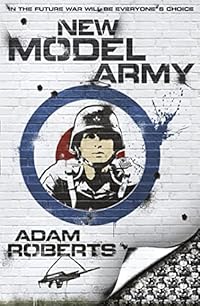
You know that you’re reading something a bit out of the ordinary when the first sentence of a novel is “I am not the hero of this story.” Whether or not this statement is reliable is a question that can only be answered by reading the whole but, coupled with the narrator’s knowingness about how a novel ought to be structured, shows a strong authorial awareness of his craft. It is a consciously literary sentence and the novel as a whole bears out its promise. I didn’t much take to Roberts’s 2011 novel By Light Alone but was more impressed by his much earlier Stone. A back cover quote on New Model Army from Kim Stanley Robinson says, “Roberts should have won the 2009 Booker Prize.” (That would have been for Roberts’s prior book Yellow Blue Tibia which I have yet to read. New Model Army has literary claims to have won it in 2010. I can see why it was not considered, though.)
The New Model Army of the title, whose members have named it Pantegral, is – like other NMAs of its sort – a truly democratic one. Enabled by the internet – its communications and information web is referred to as a “Wiki” throughout – to communicate and discuss in real time, they vote on proposals on tactical and strategic matters and act on the majority decision. This contrasts with the hierarchical, feudal structures of the traditional state army against which it fights – and repeatedly defeats.
The battle sequences are believably described though the background to the war that is taking place in a disintegrating UK is a trifle – if amusingly – far-fetched. In addition the ease with which the NMA’s members access advanced ordinance wasn’t fully obvious, the rest of life in England, which is where the first segment is set, seems little different from the present where such access is limited to say the least. (Or I hope it is.)
An echo of Stone is in the narration. Here the narrative is a kind of memoir addressed as if to a US colonel by whom Block is being interrogated and who wishes to use him as a weapon against NMAs. Unless we are to infer that later Block returns to the US this doesn’t quite work in the second long section when Block falls into the hands of an Alsatian NMA known as Schäferhund, nor in the very much shorter third segment.
New Model Army has important things to say about why wars occur and the nature of humanity – what we do in general and why we do it. Treating not only with the evolution of humanity beyond feudalism into the “giants” of the NMAs but also with the literary perennials of love and death, it packs a lot into its 282 pages.
(Unfortunately there was a span count of 3, though; plus 1 “lay.”)
