Archives » St Bernard’s

Dumbarton FC Strips

On display at the Dumbarton FC 150th anniversary Exhibition were the then current home and away strips which I featured here.

Home:-

Dumbarton FC 2022-23 Home Shirt

Away:-

Dumbarton FC 2022-23 Away Shirt

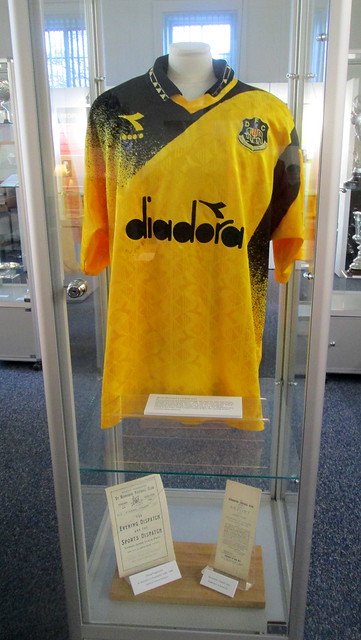
Murdo McLeod’s strip from when he was DFC’s player-manager. Plus a programme from a St Bernard’s vs Dumbarton match and a DFC statement of accounts:-

Murdo MacLeod's Shirt

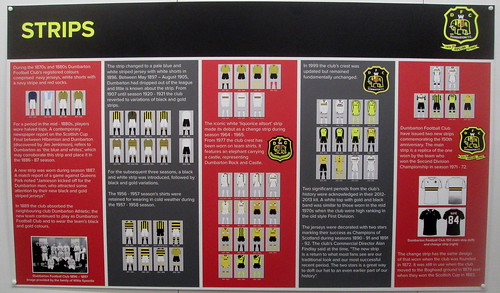
There was also a board displaying Sons’ strips from the club’s original blue and white through black and gold, a brief foray into black and white, before the restoration of black and gold (with occasional white) up to the present day.  These can also be seen on the historical football kits website:-

Dumbarton FC Historical Strips

Fixture flyer from 1984-1985, the club’s most recent season in Scottish football’s top flight, showing the nearly all-white strip worn then:-

Dumbarton FC 1984-5 Fixture Card

The Things You Miss When You’re Away

As I’ve been away I only caught up with the news of the demotion of East Stirlingshire from the SPFL late yesterday.

61 years in the SFL/SPFL gone in a flash. It’s sad for them but they’ve been living on fumes for seasons on end now. It was always most likely that it would be the Shire that would be the first to fall victim to the play-off system.

Congratulations, though, to Edinburgh City. The role of third (or fourth) largest football side in Edinburgh has been taken in the past by St Bernard’s (defunct since World War 2) and Leith Athletic (demised 1955, reconstituted 1996 and as a senior team in 2008.) As those statistics suggest, surviving in the shadow of Hearts and Hibs is not easy.

Then there is the case of Meadowbank Thistle (Ferranti Thistle as was) admitted to the Scottish Football League in 1974 but weren’t satisfied with the sizes of crowds they were attracting in the capital and decamped to Livingston in 1995.

Speaking of Hibs, I see they managed to muck things up again. Hibsing it indeed. Then again they’ll probably win the Cup Final now and so put to an end the longest running “will this be the year” saga in Scottish football.

Leicester City’s fairy tale first top level title made the news in The Netherlands – as elsewhere I suspect. There was a newspaper article there about the length of time previous winners of their country’s football championship had been waiting to win it again. Schalke 04 topped the list at well over 20,000 days with Tottenham Hotspur second (also over 20,000 days.) Liverpool were about eighth on the list. I can just about make out some Dutch but a list is no problem.

I also divined from a radio report on the way back up that Roberto Martinez had lost the Everton job, paying the price for not getting enough out of a talented group of players. (An alternative possibility is that those players aren’t quite as good as their reputations would have them.)

And then there was the Scottish Parliament election, where the SNP paid the price of winning too many constituency seats and Labour actually did come second in the percentage vote in that element but not in the regional lists. We had voted by post before we left.

Hello! Hello! We Are The Bully Boys

I heard Gordon Strachan on the news the other day referring to the Rangers situation. He said something along the lines of, “How can you let a club which all those players and managers have put so much into, with so much proud history, go to the wall? It wouldn’t be right.”

Well, Gordon. Airdrieonians were a club that players and managers had put a lot into and had a proud history – four Scottish Cup finals among that. They went to the wall.

The third Clydebank FC died as a result of Airdrieonians demise as they were taken over and moved to Airdrie to become Airdrie United. Lots of players and managers and maybe not so proud a history, but they did make it into the Premier Division and reached a Scottish Cup semi as a second tier team. Their fans were powerless to prevent the takeover but did set up a junior team.

Third Lanark were a club that players and managers had put a lot into and had an undeniably proud history – including a League Championship and two Scottish Cup wins. No one acted to save them.

Going further back St Bernard’s have a Scottish Cup win to their credit and ultimately went out of business due only to the untimely death of their main benefactor. No one helped them.

Was it right that these clubs were allowed to die, Gordon? Just because they were smaller clubs doesn’t mean their fans were any less passionate about them. Just because Rangers have a large following does not mean they should be extended concessions those clubs were not.

Gretna FC’s story is more akin to that of Rangers. Grossly overspending and over-reachinbg themselves they had to be bailed out to the end of their only SPL season and were then punted. They had a Scottish Cup final along the way, though, if that was something they could be proud of considering how they achieved it.

And as for Sandy Jardine’s vainglorious statement about Rangers fans taking action against other clubs this reminded me of the playground bully and is exactly the sort of thing we real football fans (as opposed to glory hunters) have come to expect from the institution that he is trying to defend. Sandy; you’ve done the crime, now do the time. Take your punishment like a man. At the least, this should mean expulsion from the SPL.

To those real fans of Rangers who recognise their club is in the wrong here and that its behaviour cannot be condoned nor encouraged in the future by any holding back of sanctions now, I offer my condolences and my apologies for the intemperate nature of the previous paragraph.

Prepare To Meet Thy Doom?

Take a look at these historical league tables (top four only) which show when Cowdenbeath FC has won the Scottish Second Division.

Scottish League Division Two 1913-14

1 Cowdenbeath P 22 pts 31
2 Albion Rovers P 22 pts 27
3 Dundee Hibernian P 22 pts 26
4 Dunfermline Ath P 22 pts 26

In those days promotion wasn’t automatic so Cowdenbeath were in Division Two the next year. Cowdenbeath were one of three teams on equal points at the top.

Scottish League Division Two 1914-15

1 Leith Athletic P 26 pts 37
2 St Bernards P 26 pts 37
3 Cowdenbeath P 26 pts 37
4 East Stirlingshire P 26 pts 31

A three-way play-off decided the league winners. Cowdenbeath defeated Leith Athletic at East End Park and St. Bernards at Easter Road to take the title.

Scottish League Division Two 1938-39

1 Cowdenbeath P 34 pts 60
2 Alloa Athletic P 34 pts 48
3 East Fife P 34 pts 48
4 Airdrieonians P 34 pts 47

Cowdenbeath’s only other Championship was in Div 3 in 2006. Their other promotions came as runners-up, through play-offs or as a result of another club’s financial problems leading to a readjustment in the leagues.

So does anyone spot something here?

Well, I notice that every time Cowdenbeath have been Champions of a Division 2 in Scotland the UK has been involved in a major (world) war the next September.

Now take a gander at the present position in the SFL Div 2 (as of 7/2/12) :-

1 Cowdenbeath P 20 pts 41
2 Arbroath P 20 pts 39
3 Stenhousemuir P 20 pts 31
4 Dumbarton P 19 pts 28

Gulp!

Come on Arbroath!!! (And the Sons, obviously.)

A Stroll Through The Eccentric Names Of Scottish Football Teams.

Last week I watched a TV programme fronted by Jonathan Meades which was an annotated travelogue through post-industrial Scotland. Meades’€™s starting point was the almost poetic litany of the names of Scottish football clubs as heard in the results on Saturday afternoons.

Unlike those from England, very few of whom have names that are geographically indeterminate, at least at first glance* (the exceptions are Arsenal, Aston Villa, Everton, Queen’s Park Rangers, Port Vale, Tranmere Rovers; at a pinch Crystal Palace) and most of which are relatively prosaic (Swindon Town, Derby County, Bristol City) – only Nottingham Forest, Sheffield Wednesday, Plymouth Argyle and Crewe Alexandra have any rhetorical flourish €“- a disturbingly large number of Scottish teams’€™ names give no clue to their geographical location.

*I know Arsenal were once Woolwich Arsenal and that Everton is a district of Liverpool – as Tranmere is of Birkenhead – but Port Vale (the club plays in Burslem) isn’€™t on maps any more – if it ever was – and the Crystal Palace is long gone: which just leaves QPR and Villa – which may well be a Birmingham geographical locator of which I am ignorant.

The list of obscurely named Scottish clubs is much longer.

I have already, of course, mentioned Kirkcaldy’€™s finest, Raith Rovers (dancing in the streets of Raith.) There are two Saints – of Mirren and Johnstone (and until World War 2 there was a third; of Bernard’€™s) – a Clyde, a Hibernian, two Queens, Queen’€™s Park and Queen Of The South – famously the only football team mentioned in the Bible – an Albion Rovers and two Easts, of Fife and Stirlingshire, which could be located anywhere in their respective counties. In the case of East Stirlingshire their peregrinations actually took them as far west as Clydebank for a season before returning to their Firs Park home in Falkirk, which they have now had to leave; renting space at Stenhousemuir’s ground nearby.

In this context Rangers and Celtic do not count as their full names include the prefix Glasgow. Similarly it is Greenock Morton. While Midlothian as a county no longer exists, Heart Of Midlothian – the actual heart of the county is in the centre of Edinburgh, not off Gorgie Road; and there is a mosaic over the spot which is supposed to confer luck if you spit into it (Edinburgh is not quite the douce place you might take it for) – are named for a Walter Scott novel, apparently via a local dance hall. Likewise the County of Ross is no more; in any case the eponymous club plays out of Dingwall. Was there ever a county of Stockport by the way? Yes, and no. A county borough apparently.

There is a Raith estate in Kirkcaldy – and a former Raith cinema – so the name makes some sense; but it’€™s not on any maps of Scotland. Clyde are somewhat disappointingly so called because they first played by the banks of that river, though they now rent a ground in Cumbernauld from the local council.

The Paisley club St Mirren are named after the local Saint, Mirin; St Johnstone from Saint John’s town (of Perth,) and the now long defunct St Bernard’s after a local well by the Water of Leith.

East Fife are located in Methil in – err – east Fife. Like (Glasgow) Celtic, Hibernian FC’s name reflects the Irish roots of its founders but otherwise has no relevance to Edinburgh, or Leith if you must, where they are domiciled.

Albion Rovers play home games in Coatbridge and were formed from a merger between teams called, rather prosaically, Albion and Rovers.

Queen’s Park is obvious but its city isn’€™t. (Compare Queen’€™s Park Rangers.) There was, too, once a King’s Park club, but that was in Stirling. Queen Of The South is an epithet given to the town of Dumfries by the poet David Dunbar. The club which took the name amalgamated in 1919 from other teams in the area including 5th Kircudbrightshire Rifle Volunteers and 5th King’s Own Scottish Borderers. In this regard the former Third Lanark team (based in Glasgow, not Lanark) were also geographically obscure, and were again derived from a military source, the Third Lanarkshire Rifle Volunteers.

Historical teams in this vein are Northern, whose ground was in Springburn in Glasgow, and Thistle who also played in Glasgow at Braehead. This last is not to be confused with Partick Thistle whose ground is actually in the Maryhill district of Glasgow and not in Partick itself. Other former Scottish League clubs Solway Star, Nithsdale Wanderers and Mid-Annandale (originally Vale Of Dryfe!) had, though, some geographical pointer in their names, albeit to a wide area.

The daddy of all such non-geographically named teams is Royal Albert, for two and a half years in the 1920s members of the Scottish League. Based in Larkhall, they now play junior football. The name comes from a ship their founder also owned. They apparently bear a relationship to the Hawick team, Hawick Royal Albert, who were founded by a man from Larkhall.

I hope all is clear now.

free hit counter script