Archives » Spanish Fiction

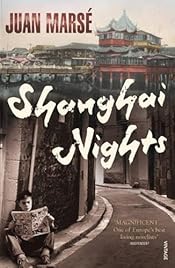
Shanghai Nights by Juan Marsé

Vintage, 2007, 202 p. Translated from the Spanish El embrujo de Shanghai (Plaza & Janés, 1993,) by Nick Caistor.
There is a certain quality to translated fiction – or at least to the best translated fiction – which marks it out. That sense of subtle strangeness, other ways of seeing, perhaps even other ways of being, and yet, reading it, the essential qualities of human interactions still shine through.

Shanghai Nights is set in Barcelona in the immediate aftermath of the Second World War and both that conflict, and more importantly the then also recent Spanish Civil War, hang over the book, an understated but permeating presence.

Narrator Daniel is a young adolescent whose father never returned from that Civil War, and several of the characters are subsumed by it, most obviously Captain Blay – called the Invisible Man for the bandages he wears to conceal his wounds but also Nandu Forcat, on whose initial furtive appearances everyone expects to be arrested at any moment. How much more so for those characters who are, or have been, in exile in France, at least one of whom is exiled permanently.

Blay is obsessed by a smell he attributes to a gas leak underneath a local pavement and ropes Daniel in to help him canvas for signatures on appetition against the leak and a chimney which spouts noxious smoke. Blay’s ineffectiveness is such that only about 14 people ever sign up.

Daniel falls into the orbit of Señora Anita’s daughter Susana, a consumptive (Marsé makes frequent mention of the Koch bacillus) girl whom Blay wants Daniel to draw as a victim of the smoke from that chimney but whom Daniel sees in a different light. She is the daughter of Joaquim (Kim) Franch, one of those exiles.

Forcat worms his way into Señora Anita’s graces and apparently has some sort of healing/heating powers. He begins to tell Susanna and Daniel a tale of her father’s adventures in the Far East, sent to Shanghai by the exiles to kill a man suspected of being a German Colonel guilty of war crimes in France and to retrieve a book with yellow covers, a book with revealing secrets. This is a lurid tale of unlikely encounters and an attractive Chinese woman named Chen Jing. It is sometimes couched in racial terms, (lousy chink, slant-eyed, a blackamoor) and clichés (dresses slit to the waist.)

Doubt is cast on this story by the appearance of Luis Deniso Mascaró (‘Denis’) a returned exile who has a grievance against Kim and whose revelations and influence alter Susana’s life.

This is a fraction of the contents of a book full of vivid characters such as the above as well as Blay’s wife, Doña Conxa, and the Chacón brothers, and which builds to a climax which is at once sordid but touched with nobility, and entirely true to its essence.

In it we read “everything passes, and it is all exactly the same, masks and the faces beneath, sleep and waking” and “however much we grow and look towards the future, in fact we are reaching back towards our past, in search perhaps of our first moment of awareness.”


Pedant’s corner:- “vocal chords” (vocal cords,) focused (focused,) “‘Denis’s’ parents’ home” (several times the possessive of ‘Denis’ appeared as ‘Denis’s’, surely it must be ‘Denis’’s,) “the waitress’ skirt” (waitress’s skirt,) “to smoothe down” (x 2, smooth down,) “fo’castle” (either ‘forecastle’ or ‘fo’c’sle’, not fo’castle,) “you’ll know you seen so much” (you’ve seen so much,) (Captain Tu Szu’s words” (elsewhere the Captain is always Su Tzu,) “to traffick arms” (to traffic arms,) “shammy leather” (technically it’s chamois leather.) “He was in the Peace Hotel can remember” (He was in the Peace Hotel and can remember.) “It is true then that …….. betrayal?) (Is it true then that …….?) “Contrary my mother’s expectations” (Contrary to my mother’s expectations.)

 

Lizard Tails by Juan Marsé

Vintage, 2000, 235 p. Translated by Nick Caistor from the Spanish Rabos de lagartija.

This is a striking novel. It is told from the viewpoint of an unborn child (though as if being remembered from enough years later for that child to be able to write.) Any objections to such an unlikely story teller are forestalled by the sentence, “It’s precisely because I didn’t see it that I can imagine it much better than you.” (Imagining it is, after all, what novelists do all the time.) Scenes and times shift abruptly but always comprehensibly. Later events (even those subsequent to the narrative) are treated proleptically, but then again, to the narrator they will already have taken place. There are conversations – envisioned or hallucinated – between characters who have not met, the contents of which are not given quotation marks.

The present tense of the book is set in an area of Barcelona just after the Hiroshima bomb. The main protagonist is David Bartra, the brother of our child narrator, but the plot centres round his pregnant mother, Rosa, whose hair colour means she is most often referred to as the red-head.

David’s peculiar pastime is cutting off the tails of lizards to present to his friend Paulino Bartolet. The lizards’ diminished bodies keep on going, (which reads as a metaphor for Franco’s Spain.) David is plagued by a continual hissing noise in his ears and has conversations in his head with not only his father and our unnamed narrator but also an RAF pilot, Flight Lieutenant Bryan O’Flynn – of Irish descent via Australia – depicted surrendering (but in David’s mind maybe about to be shot) in a page from a German propaganda magazine, a photo displayed on David’s wall. O’Flynn spent a lot of time in the Bartra household and, by implication, as it is never fully spelled out, he and Rosa became close. The reader is left to conclude of this situation whatever he or she wishes.

The Bartras live in the abandoned surgery of Doctor P J Rosón-Ansio, one of whose rooms has a giant poster of an ear, which David thinks of as always eavesdropping on his conversations; an entirely understandable belief in an authoritarian state. (Big Brother is not only watching you but also listening.)

Rosa has been left behind by her husband, Victor, most likely because he was an opponent of Franco. Victor had to make his escape by sliding down a gully near the Bartra house; an escapade in which he ripped his trousers and buttocks on a piece of broken glass. In David’s (and our narrator’s) imagination he always appears with a bloodied handkerchief attempting to bandage the cut. As a result of his activities – which included helping smuggle Allied POWs out of France during the war, one of whom was that same RAF pilot who later returned to duty only to be shot down and captured again (hence the photo) the Bartra household has received the attentions of Police Inspector Galván.

The Inspector begins to ply Rosa with gifts either because he is trying to suborn her for information about Victor’s whereabouts or has really formed an affection for her. But he is a nasty piece of work as two incidents reveal. In his conversations with him, David, under the influence of films he has seen, usually calls the Inspector bwana or sahib.

David resents Galván’s attentions to his mother and his adoption of an old dog provides another source of conflict with the Inspector, who maintains the dog should be put down.

Added to all this is Paulino’s relationship with his abusive uncle and an illustration of police immunity from redress when an officer takes advantage of a girl who is trying to help David get Galván into trouble.

Lizard Tails is an example of a certain sort of literature which emanates from totalitarian societies, stories in which everything seems to be said obliquely but is all the more powerful for it.

Pedant’s corner:- smoothe/smoothes (several times; ‘smooth/smooths’,) an unnecessary line break after ‘hand’ in ‘with a hand on my backside’. There was space left on the line for ‘on my’,) atomical (just ‘atomic’,) Morris’ (Morris’s,) “Captain Vickers’ sure shot” (Vickers’s,) “‘A 12-cylinder Rolls Royce Marlin 61 engine’” (Spitfire engines were Rolls Royce Merlin ones,) “as the suns starts to set” (sun,) lungeing (lunging,) “the clothes line” (clothes’ line?) staunch (stanch,) “Señora Vergés’ backside” (Vergés’s.)

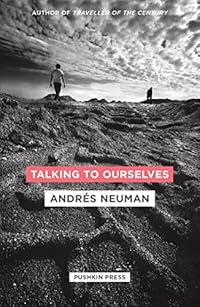
Talking to Ourselves by Andrés Neuman

Pushkin Press, 2014, 153 p. Translated from the Spanish Hablar Solos by Nick Caistor and Lorenza Garcia.

Neuman’s Traveller of the Century was one of the best books I read in 2015. In the last ten years in fact. While that novel concentrated more on love, Talking to Ourselves is more concerned with the other two of literature’s three perennial concerns, sex and death. That may seem to be an odd thing to say about a book where one of its three narrators is seven-year old boy, Lito. The others are his mother Elena and his father Mario. Lito thinks he can change the weather by thinking about it. Elena has a penchant for quoting from other authors’ works. Mario has a terminal illness, which he and Elena are trying to keep from Lito, and his narration is by way of the contents of an account he is dictating into a recording machine. For much of the time scale covered by the novel Mario and Lito are on a last road trip together in a camper van they call Pedro. All three viewpoints are distinctive and convincing with Lito’s exactly as a young boy’s would be.

While Lito and Mario are away Elena embarks on an affair with Mario’s doctor, Ezequiel Escalante. When he suggests acting out his less conservative sexual desires they are at first outrageous to her but soon she finds them overwhelming and experiences intense orgasms from “different places.” She is at once repelled by her behaviour but also compelled to it. The affair seems to be a way of distracting herself from her situation but may be a means to connect her through the “little death” to the bigger one. This brings her to ruminate on desire, “pleasure brings hope. Maybe that is why so many men leave us dissatisfied: their desire holds no promise. They are wary when they get into bed. As though they were already leaving before they have arrived. We women, even if only for a moment, even if we aspire to nothing more, tend to give ourselves completely, out of instinct or habit.”

At one point she lists for Ezequiel all the verbs different Spanish speaking traditions use to describe an orgasm, meaning variously to draw near, to run, to end, to arrive, to give it, to go, to finish, to cross over. These seem masculine to her and she wonders if there are words for female orgasms, drowning, dissolving, unravelling, irradiating.

Only a few stabs of lightness break the intensity. Elena recounts, “I remembered once, during a dinner, a man asked my sister if she lived alone. In a rare show of humour, my sister replied; Yes, I’m married.” Of attracting younger people’s attention she says, “Any woman who thinks this is a problem strictly to men, very well: she is probably naïve, a coward, or a hypocrite. I have women friends who fall into all three categories. Until, one day, when they least expect it, they leave their bald husbands for some other man.” She herself is “starting to mistake beauty for youth.”

On her mother’s statement that things are fine when Lito has gone to his grandparents’ while Mario dies Elena says, “When things are going fine, I think they are about to get worse and I feel even more scared.” In the hospital ward she tells us “I have the impression that families, and doctors, too, perhaps, soothe the sick in order to protect themselves from their agony. As a buffer against the excessive, unbearable disorder which the ugliness of another’s death creates in the midst of one’s own life.”

Then there is the aftermath, with its unwanted urgencies. “Buying the coffin and dictating the death notice. No one teaches you these things.” She laments the varying charges different funeral directors put on their services, the necessity to choose. On the death notice itself she notes that “grammar doesn’t believe in reincarnation. Literature does,” but, “There isn’t time to start reinventing the format.”

In the days of mourning she finds “All the books in the world, whatever they are about, spoke to me of death.” She reflects that since death interrupts all dialogues then it is natural to write posthumous letters, that maybe all writing is letters to the one who is no longer there.

Talking to Ourselves is a superb piece of writing, germane to those who are still here.

Pedant’s corner:- venirse (lower down the page this is rendered venirme but this may be a difference in the Spanish usage,) question marks ae always followed immediately by another punctuation mark, either comma or full stop, “sawed in half” (sawn.) “‘They hurt bad’” (USian usage. The correct adverb is ‘badly’,)

Traveller of the Century by Andrés Neuman

Pushkin Press 2013, 592 p. Translated from the Spanish El viajero del siglo by Nick Caistor and Lorenza García.

 Traveller of the Century cover

Traveller of the Century is the first novel by Argentinian born though long time Spanish resident Andrés Neuman to be translated into English.

Its protagonist, Hans, arrives by coach in the city of Wandernburg, somewhere on the borders of Prussia and Saxony, fully intending not to stay long. The city is strange, though. Apart from the constant changing between which of the two countries it belongs to (the setting is post-Napoleonic, there is a lot of moaning by the characters about the baleful influence of Metternich) its streets and buildings seem to realign themselves every night. So once again I find myself reading about a weird city (The City and the City, Pfitz) or altered borders (Europe in Autumn.) Neuman does not overplay this aspect of his novel however. The shifting topography is mere background, the city as it is. Hans finds himself lingering in Wandernburg (it is a difficult city to shake off) and becomes drawn into the lives of its characters; especially the literary salon held every Friday by Sophie Gottlieb and her father. The best friend he makes in the city is a lowly organ-grinder (who sadly does not have a monkey but rather a dog) living in a cave two miles outside the city. And there is a masked man who is attacking women at night.

Barring one two-line exchange on page 569 the dialogue isn’t marked out from the rest of the text in any way – neither by quotation marks nor by dashes – but rather is embedded within it (characters talking across or interrupting each other is rendered in parentheses, as are any actions of the speaker.) This idiosyncrasy does take some getting used to and, coupled with the lengthy discussions of philosophy, politics, economics, the merits or otherwise of Walter Scott’s novels, poetry etc in the scenes taking place in the salon, is one of the reasons it took me a while to settle to the book. Once in its stride however, the thrust of the story won me over. The love affair which we always know is inevitable between Hans and Sophie – despite her engagement to the wealthy Rudi von Wilderhaus – has a slow build up but gives Neuman ample scope to deal with two of the eternal literary concerns, love and sex. Sophie is a determined woman, opinionated in the salon, standing up to both father and fiancé in the matter of assisting Hans in his works of translation (a great excuse for the two to meet in Hans’s room at the inn,) and, a fact naturally kept concealed from father and fiancé but of course impossible to hide from Hans, sexually experienced to boot, an attribute which Hans rather appreciates.

There is a hint of mystery to Hans beyond his status as a traveller. He has books that look old but bear recent publication dates. It is only one of the many intriguing aspects of the book that his origins remain an enigma to the end.

In the salon we hear of Adam Smith that his “theories are capable of enriching a state and impoverishing its workers,” a fact proved many times over in the past two centuries, also – in a comment emblematic of the author’s referential approach – “These Argentinians are very restless, they are everywhere at the moment. They have a penchant for Europe and seem to speak several languages. They talk incessantly about their own country but never stay there.” Of Hans and his friend Álvaro we are told, “They spoke in a manner two men rarely succeeded in doing – without interrupting or competing with one another.” The novel might have been designed to test the statement that, “There are two types of people. Those who always leave and those who always stay put,” while Hans says to Sophie, “I feel as if time has stopped, but at the same time I’m aware of how fast it is going. Is that what being in love is?”

Not that it’s all serious stuff. We encounter a pair of semi-comical police officers, Lieutenants Gluck and Gluck (father and son,) tasked with finding the attacker. And what are we to make of the names thrown in as if at random of those incidental characters, Rummenigge, Klinsman and Voeller? I doubt it is laziness on Neumann’s part, as if he has only a limited knowledge of German names and merely utilised those he had heard elsewhere. Is it a subtly sardonic allusion, a joke at the expense of any highbrow readers, who will eagerly latch on to the salon discussions but perhaps miss this reference to German former footballers – and strikers at that?

Whatever my misgivings to begin with, Traveller of the Century is a novel not frightened of demanding effort from its readers but worth that effort just the same, one of those works that will stay with me for a long time.

Pleasingly, the translation seemed to be into British English but there were still a few entrants to Pedant’s Corner:- “And, yes, be able” (to be able,) there’s no need be so formal, the only thing he kept up all evening were…. (was,) neither of us like to waste time (likes,) from her there to her navel (from there to her navel,) laid for lay, do you take me for fool (a fool,) medieval, running towards to them, knelt down next to straw pallet.
I looked up Braille and water closet in case of anachronism. The first just about fits; however the second term wasn’t used in English till 1870. But the book is set in Germany and written in Spanish, perhaps the description was in earlier use in those two languages.

free hit counter script