Smallworld by Dominic Green. (Fingerpress, 2010)
Posted in My Interzone Reviews, Reviews published in Interzone at 13:00 on 19 March 2012
Published in Interzone 234, May-June 2011.
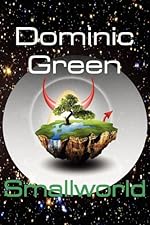
The Smallworld of the title, known as Mount Ararat, has come about as the result of the merging of two separate planetoids under the influence of an extremely dense neutronium sphere, now at its heart. It orbits within the rings of Naphil, a Jovian world in the solar system of a red giant star, 23 Kranii. Mount Ararat has at most a few hundred inhabitants but the book concentrates on the Reborn-in-Jesus family (yes, really) and their protector, an armed robot they know as the Devil. In accord with all these biblical resonances the extended familyâs children have names such as Testament, Measure, Apostle, Godâs Wound, Beguiled-Of-The-Serpent, Only-God-Is-Perfect and Be-Not-Near-Unto-Man-In-Thy-Time-Of-Uncleanness. Yes. Really.
Described on the credits page as a novel, Smallworld is in fact a series of shorter pieces related only in the sense that they all feature members of the Reborn-in-Jesus family and take place in the same setting. The resultant lack of narrative flow, of an overall arc, its stop-start nature, compromises the book as a coherent whole. The five, or seven, stories (the last has three sub sections) relate the familyâs encounters with various incomers whose appearances can be unexplained. The tone is kept deliberately light throughout, and thus runs into a further problem.
With very few exceptions Science Fiction and comedy do not make comfortable bedfellows. Too often the comedy unbalances the SF or else is not comic enough. The most successful mix the two seamlessly, embed them in each other, as in Eric Frank Russellâs Next of Kin, and the result can still be a cogent comment on human – or alien – affairs. The SF must also stand on its own merits and not be entirely derivative. Unfortunately, in Smallworld, Green does not always successfully manage to avoid the pitfalls inherent in the form.
The bookâs fundamental lack of seriousness is deleterious. Its targets for satire are either too easy or too pat – jailbirds, space pirates, tax collectors â and its references scattershot (Santa Claus/Father Christmas and the first three of the Twelve Days of Christmas in the titles of the last story, Helen of Troy, a plethora of biblical allusions over and above the manifold Reborn-In-Jesuses as well as casual allusions to 21st century ephemera of which the inhabitants of Mount Ararat would most likely be totally ignorant – though we, of course, are not.) The ramifications for daily life of the structure of a small world as described here are for the most part unexplored.
In addition, the cosmology of the book is unconvincing, the Physics and Chemistry of dubious lineage and accuracy. (An example. Sulphur dioxide, while noxious, does not smell of rotten eggs: that is hydrogen sulphide.) Small errors such as this can fatally undermine confidence in the author and in the tales he or she is trying to tell.
At the level of the fiction, rather than experiencing background as the stories unfold, we find prodigious information dumping and paragraphs of expository dialogue. With sufficient guile this can be a strength and elsewhere has been made into a feature of the comedy (galactic encyclopaedia anyone?) but no such approach is adopted here.
There is too the lurking sense that Green has not lavished care on his characters, who are unconvincing, barely more than ciphers, present only to progress the plot(s) and voice the jokes, hence failing to engage empathy. Quite apart from the family other names can be over elaborate, some characters being known mainly by their job descriptions â Optometrist Wong, Social Correctness Officer Asahara. Others, for no obvious reason, âspeakâ in CAPITALS. This hostage to fortune invites invidious comparisons with a previous purveyor of comedic SF/fantasy.
If your tastes lean towards comedy with not too much rigour this may be for you. If your preference is for strongly drawn, nuanced characters reacting to and combatting lifeâs vicissitudes, then maybe not.
