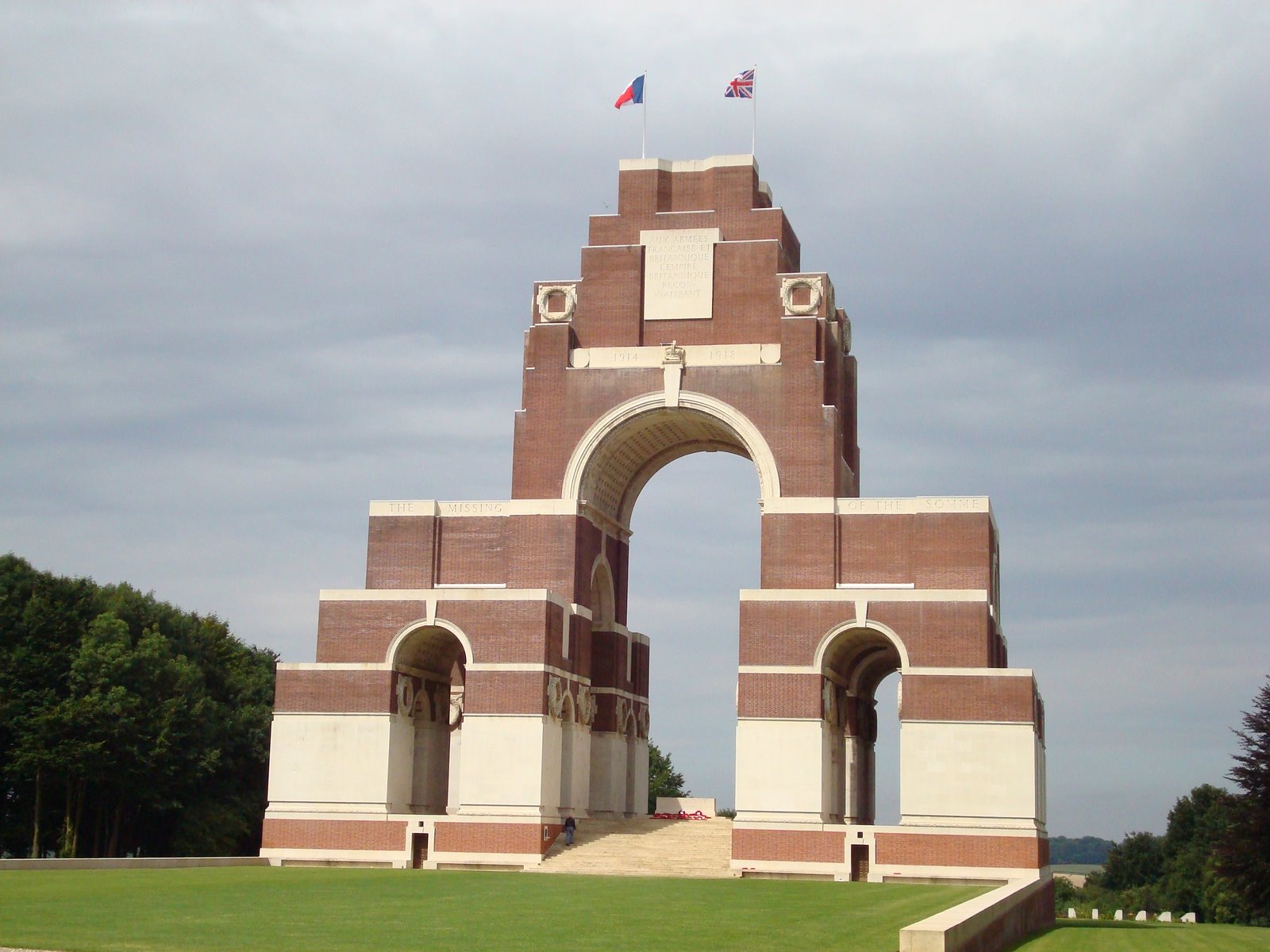
The Battle of the Somme began 100 years ago today. That first day saw the British Army suffer 57,470 casualties, its greatest ever one day loss in battle.* 19,240 of these were killed. Overall the battle (really a series of battles) lasted for four and a half months and resulted in 1.120-1.215 million casualties over both sides. Only the Russian Front battles of the Second World War were bloodier.
Like the Ypres Salient, the countryside where the battle(s) took place is dotted with Commonwealth War Cemeteries.
There is a particularly striking memorial at Newfoundland Memorial Park, Beaumont Hamel, in the form of a caribou.
The names of the British army dead who remained missing are engraved on the walls of the towering Memorial at Thiepval.
Visiting Thiepval is as sobering an experience as the Menin Gate.
The bagpipe tune below was composed by William Laurie who fought at the Somme. He was Pipe Major of the 8th Argyllshire Battalion of the Argyll and Sutherland Higlanders. He became ill as a result of trench conditions and died on Nov 28th 1916.
To all who fought:-
The Battle of the Somme
*More personnel (80,000) were lost by surrender at the Fall of Singapore in 1942.
Bert Trautmann, one of the icons of post Second World War British goalkeeping (ironic since he was a German,) has died.
His signing by Manchester City in 1949 upset quite a few people who so soon after the war felt insulted that a German should take up such a high profile position.
His war record is astonishing. Like most of his generation he was under the influence of Nazism, joining the Jungvolk. When the war came he joined the Luftwaffe as a radio operator before volunteering to become a paratrooper. He was posted to the Russian front and won an Iron Cross First Class. At one point he was captured but a German counter-attack freed him. In Russia his unit suffered 70% casualties. He was transferred to the West where he was captured twice more, with two more escapes, before jumping over a fence and landing at the feet of a British soldier who said, “Hello Fritz, fancy a cup of tea?” He spent time as a POW, refused repatriation when it was offered after the war, going back to Germany a year or so later but decided he preferred Britain.
His most famous accomplishment in football was finishing the 1956 FA Cup final after sustaining a broken neck. He knew he was injured but its serious extent did not become known till three days later after the X-rays.
It was several incidents like this in FA Cup finals around that time that eventually saw the goalkeeper afforded more protection in Britain.
Bernhard Carl Trautmann: 22/10/1923-19/07/2013. So it goes.