The Persistence of Scott
Posted in Dumbarton, Edinburgh, Nostalgia, Scottish Fiction, Scottish Literature at 12:00 on 31 July 2016
My previous post’s title was of course a reference to the alternative title of Sir Walter Scott’s first novel Waverley otherwise known as Tis Sixty Years Since.
I am of course reading that author’s The Heart of Mid-Lothian at the moment which means he has been on my mind.
Scott’s influence continued to be felt long after his death. Edinburgh’s main railway station is named Waverley in his honour and there is of course the huge monument to his memory on Princes Street.

On seeing this Belgian author George Simenon is supposed to have asked, “You mean they erected that for one of us?” then added, “Well, why not. He invented us all.”
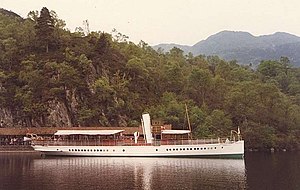
Also named after him is the main steamer on Loch Katrine in the Trossachs, the SS Sir Walter Scott, which was built by Denny’s of Dumbarton, dismantled, its pieces numbered, then the whole transported by horse cart to Stronachlachar on Loch Katrine where it was reassembled.
SS Sir Walter Scott
She is by no means the only ship with a Scott connection which I have sailed on.
The Heart of Mid-Lothian‘s main female character is named Jeanie Deans, a name previously familiar to me – at least in her second steamship incarnation – from several of those trips “Doon the Watter” that used to be so much a part of a West of Scotland childhood.
PS Jeanie Deans
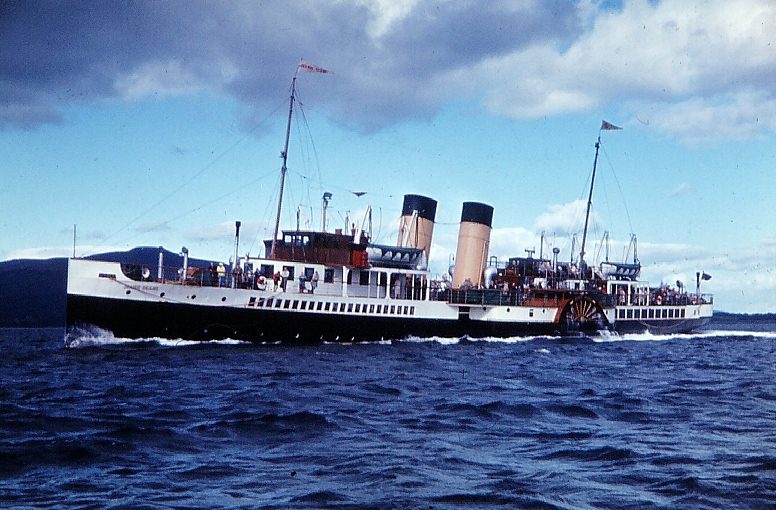
There was a short branch line (now long gone) off the main-line station at Craigendoran (about 8 miles from Dumbarton) which took trains right up to a platform on the pier where the ship would be waiting for its passengers to detrain and embark – usually for Rothesay. I believe something similar pertained at Wemyss Bay.
One of the delights of the trip was to descend into the lower parts of the ship to see the engines; mesmerising visions of gleaming, oiled steel and brass, powerful flywheels spinning, pistons thundering, regulators twirling. “Taking a look at the engines” was also used as a euphemism by those suitably aged gentlemen patrons who wished to avail themselves of the licensed facilities on board.
There was also an earlier PS Jeanie Deans. Indeed the North British Packet Steam Company and North British Railway seem to have named their ships almost exclusively after Scott characters. Have a look at this list of their ships, some of which were transferred to later operators.
Only one of these floating mini-palaces still exists. The second PS Waverley (built in 1949) is now the sole ocean-going paddle steamer left in the world and still carries out excursions from its base on the Clyde near Glasgow Science Centre, in the Bristol Channel, from London, the South Coast and Wales under the auspices of the Paddle Steamer Preservation Society.
PS Waverley at Ilfracombe

If you can avail yourself of the opportunity to take a trip on the Waverley (or indeed the SS Sir Walter Scott, though she is much smaller and does not quite afford the full experience) I would urge you to do so.