Posted in Reading Reviewed, Robert Silverberg, Science Fiction at 17:00 on 23 November 2016
Dell Magazines.
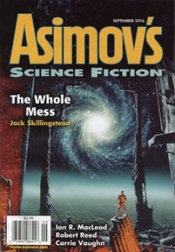
Sheila Williams’s Editorial lists The Thirtieth Annual Readers’ Award Results. Robert Silverberg’s Reflections (“Darn,” He Smiled) remembers the glory days of Science Fiction reviewing by James Blish and Damon Knight including one memorable Blish evisceration of a story that used 89 different expressions for “said” (a practice Silverberg himself thereafter strictly avoided) and laments that the pendulum has now swung so much the other way that would-be writers are positively encouraged to eschew the unintrusive “said”.
Peter Heck On Books1 looks favourably on the latest novels by Charlie Jane Anders, Laura R Gilman, and Fred Chapell, Paul di Filippo’s collection and the non-fiction Breaking the Chains of Gravity: the story of space flight before NASA by Amy Shira Teitel.
In The Mind is its Own Place2 by Carrie Vaughn, Lieutenant Mitchell wakes up in hospital to be told he is suffering from Mand Dementia, an affliction suffered by navigators who intuit the correct coordinates for hyperspace jumps. The story concerns his gradual unravelling of what happened to him.
Dome on the Prairie3 by Robert Reed is an alien invasion story inspired by the works of Laura Ingalls Wilder. Aliens in the form of the Scourge have come to Earth. Our (unnamed) narrator is chosen to try to communicate with a Scourge child dubbed Laura.
In Epitome4 by Tegan Moore, Shelby, a woman given power of attorney by her female lover Vivian (whom for some unexplained reason she cannot acknowledge as such) becomes her carer after a fall causes brain damage. To compensate, Shelby has a hacker friend upload a brain scan of Vivian into the Personify virtual reality programme.
Academic Circles5 by Peter Wood is a time travel story wherein a man uses a time machine to plagiarise academic essays on Philip K Dick and claim precedence. Others have feelings of déjà vu.
In The Whole Mess6 by Jack Skillingstead mathematical genius Professor Dunn is handed an incomplete equation. When he solves it tentacled Masters slip through from a parallel universe and he slides to a third. Only he can undo the change but his abilities are restricted.
All That Robot…7 by Rich Larson sees a man stranded on an island otherwise inhabited by sentient robots sin against their nascent religion.
The best is kept till last – and it’s the best in Asimov’s all year up to now. Ian R MacLeod’s The Visitor From Taured8 tells the tale of Lita, a woman who studies Analogue Literature (old style 2D physical books rather than interactive or non-static narratives,) and her (lack of) relationship with astrophysics adept Rob who is trying to prove the many worlds theory.
Pedant’s corner:- 1Palazo (in a book title! palazzo,) 2“He’d signed in, said good morning to the captain, went to his station” (He’d; therefore [he’d] gone to his station,) “He had to learn to the truth” (learn the truth.) 3a wide range… were scattered (was,) “shifting its aim for a moment that ends when you forcing your attentions to…. (with you forcing? when you force?) 4 freshman (freshmen mad emoe sense) 5Popoov (Popov,) a missing end quote mark. 6 the ‘the Masters’ (only one the needed,) a particularly adept memoirists (memoirist,) I couldn’t breath (breathe.) 7”hoping that the two events to coincide” (the two events coincide.) 8Even in a US publication it is intensely annoying to read in a story by a Briton and set mostly in Leeds and the Outer Hebrides the word “asshole” rather than arsehole, yet there was archaeologist not archaeologist and later maths and “arsed around”. “He fucked about.” (I assume US readers will read this as implying promiscuity – the context leans towards it – but I didn’t. In Britain it means engaging in activities to little purpose, not fulfilling yourself, see “arsed around”,) post-centarian (post-centenarian?) this stuff happen at the atomic level (this stuff happens,) “as if every choice you made in a virtual was mapped out in its entirety” (“world” after virtual?) sung (sang,) span (spun.)
No Comments »
Posted in My Interzone Reviews, Reviews published in Interzone at 15:00 on 5 November 2016
Jo L Walton’s Editorial welcomes the arrival of the Sputnik AwardsTM. Jonathan McCalmont rightly eviscerates Becky Chambers’s1 the long way to a small angry planet (its title is not capitalised on the cover) for its self-satisfaction and its lack of challenge. Nina Allan’s Timepiece argues that the canon (both SF and the wider literary one) ought not to be restrictive. In the Book Zone Lisa Tuttle is interviewed, I review Extinction by Kazuaki Takano and Two Years Eight Months and Twenty-Eight Nights by Salman Rushdie while Sofia Samatar’s The Winged Histories, James Lovegrove’s World of Water and Guy Gavriel Kay’s Children of Earth and Sky gain approval.
As to the fiction:-
All Your Cities I Will Burn2 by John Schoffstall is set in the aftermath of a 2042 meteor strike on Earth. Humanity has just about survived. Then strange creatures arise from the sea. This story contains fine speculation about the implications for life on Earth from meteor-borne organisms.
The Eye of Job3 by Dan Reade. An alien tower twenty miles high and ten in diameter “covers most of Omaha.” An air force psychologist is still trying to come to terms with the ramifications.
Belong4 by Suzanne Palmer sees gwenna Thirty-Seven rejected for Placement in QuangEngXorp’s exploitation team despite always achieving the highest marks in training.
The title and subject matter of Ken Hinckley’s on the techno-erotic potential of Donald Trump under conditions of partially induced psychosis does of course invite comparisons with a certain J G Ballard short story. Its setting in a high-rise, its harping on the diesel fumes emanating from lorries on a motorway junction below, not to mention a vehicle crash and the matching style of its attendant author information appendix only add to this temptation. As you might expect it is estranged stuff but, to take up the invitation, Mr Hinckley is no Ballard. (Then again, who is?)
The Inside Out5 by Andrew Kozma. The eponymous structure (aka IO) is an abandoned Dyson sphere to which the remnants of humanity have been transported.
A Man of Modest Means6 by Robert Reed relates the encounter between a woman and a man who are both not what the reader first assumes.
Pedant’s corner:- All the fiction was written in USian. 1McCalmont has Chambers’. 2at loose ends (at a loose end?) “I would expatiate my guilt and despair” (expiate, expatiate means something else entirely,) not thrall to his own fears (in thrall.) 3“covers most of Omaha” (granted the tower would dominate the countryside but I’m sure Omaha is more than ten miles across,) Amos’ (Amos’s,) “behind him are a trio of radio towers” (is a trio,) “None of us do.” (None of us does.) 4“in the line from her shoulder down near her wrist” (to near her wrist?) “the enemies lay there peacefully” (lie there,) 5humongous (more usually humungous?) 6wack job (is usually spelt whack job,) “How would describe that gesture” (missing an “I” after would?) a double “the” in the author information.
No Comments »
Posted in Fantasy, Reading Reviewed, Robert Silverberg, Science Fiction at 12:00 on 1 August 2016
Dell Magazines, 192 p.

The third issue of the year’s subscription to the magazine my younger son gave me as a Christmas present. In the guest editorial Charlie Jane Anders takes issue with the myth that novels and short stories can’t be written equally well by the same author. In his column Robert Silverberg muses on the possibility that there was not one Trojan War but several, not one Homer but many, writing down their accounts over centuries before it was all drawn into one after Greek script evolved from Phœnician. In the fiction:-
Matilda by Kristine Kathryn Rusch.1 Matilda is a single ship. She likes being piloted by Devi. The feeling is not mutual. Yet in conflict against the CeaWayLaVi they must act in concert.
Three Paintings by James van Pelt. An artist worried about going stale conceives a plan to be backed up, cut himself off from the world, paint and then kill himself, be restored, paint again, kill his new self, and repeat the cycle once more. His commercial partner gets greedy.
In The Days of Hamelin by Robert Reed2 children between the ages of five and eighteen start to die of ruptured arteries. For obvious reasons the virus responsible comes to be known as Hamelin. The few child survivors evolve a mordant philosophy.
The Return of Black Murray by Alexander Jablokov3 sees three former high school friends return to the scene of an incident from their senior year. Black Murray is a giant moray eel; or its simulation. The payoff here does not justify the story’s length.
Starless Night by Robert R Chase is a tale of the response of Earth colonies to invasion from Sagittarius.
Project Synergy by Dominica Phetteplace4 is another of the author’s stories featuring Watcher chips. Here the chip wants to acquire a body of its own, which is highly illegal.
Flame Trees by T R Napper.5 The titular trees are a nostalgic trigger for a war veteran whose memories are about to be wiped for committing an act of violence.
A Flight From the Ages by Derek Künsken6 spans the lifetime of the universe. In 3113 AD a weapon starts to dissolve space-time. Over succeeding multi-millennia efforts are made to escape its expanding wave-front and make the universe into a Klein bottle – all mediated through the experiences of AIs. Very dry indeed.
Of the Beast in the Belly by C W Johnson.7 The belly is that of an arcthant. Nawiz and, Janum, the man she is chasing for revenge purposes, have been swallowed by the huge sea creature. Inside its array of increasingly acidic stomachs exist a number of different societies, scraping a living from the (part) digested contents.
In Woman in the Reeds by Esther M Friesner8 the woman has been feigning madness to avoid the attentions of Pharaoh’s slave overseers and collecting the bones of dead children from the Nile in order to gain the power to restore her own dead son. She refuses the demands of the god Set to hand over a baby she finds floating in a bulrush basket.
Lazy Dog Out by Suzanne Palmer.9 The Lazy Dog is Khifi’s salvage ship. Khifi gets implicated in a plot to take over her habitat and uses the ship to frustrate it. There is an incident here of summary justice (which in my view is never acceptable – even for the supposed good guys. When you think clearly about it, summary justice is no justice at all.)
Pedant’s corner:- 1overlaying (overlying,) 2US spelling of practice and practicing for the verb practise (plus points though for “hanged himself”,) 3vortexes (vortices,) according the Pete (according to Pete,) “The girls squealed satisfyingly and moved closer to me and Myron” (? This would have been difficult. They were in separate boats,) 4terrariums (terraria,) “The long skirt of her skirt grazes the floor” (how about “her long skirt grazes the floor”??) “Often times” (oftentimes is USian I know but isn’t it usually one word?) 5bowls green (USian? we would say bowling green,) 6Poluphemos’ (Poluphemos’s,) Ulixes’ (Ulixes’s,) even less processing sources (even fewer,) 7a pack of sea-jackals were attacking (a pack was,) “with out of his large hands” (with one of his large hands,) Nawiz laid down (lay down,) maw was used here several times: fine; the story takes place inside stomachs, 8Osiris’ (Osiris’s,) maw (it’s a stomach, not a mouth,) 9locii (loci, or even locuses,) Candles’ (x 3; Candles is one if the characters, so Candles’s – which was used once!) “cut the freighter’s main engines, flipped on the brakers.” (Space-ships have brakes? Which can work when the main engines have shut off?) maw (it’s a stomach; not a mouth,) “behind them in a semicircle was Redrum, Jonjon and Inchbug” (behind them were.)
No Comments »

