Asimov’s Science Fiction, March 2016
Posted in Fantasy, Reading Reviewed, Robert Silverberg, Science Fiction at 12:00 on 17 July 2016
Dell Magazines, 112 p.
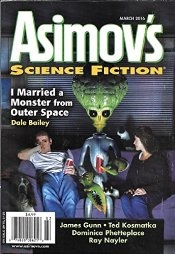
The second issue of the year’s subscription to the magazine my younger son gave me as a Christmas present. Robert Silverberg describes how Walter de la Mare’s story The Three Mulla-Mulgars, read in his youth and many times since, inspired him and fed into his fiction. James Patrick Kelly’s internet overview discusses the pros and cons of reading and writing a series of books.1 In the fiction:-
The Bewilderness of Lions by Ted Kosmatka.2 A data cruncher who can predict scandals goes to work for a politician. Then she is contacted by the people who really run things. Another story which panders to the secret-conspiracy-that-rules-the-world tendency.
The Ship Whisperer by Julie Novakova. An expedition to a black dwarf (which shouldn’t exist) discovers a device that can alter the rate of change of time. The titular character can “talk” to quantum computers, enabling the story’s resolution.
A Partial List of Lists I Have Lost Over Time by Sunil Patel is a series of listicles. I believe it is supposed to be humorous. The author seems to have a particular thing about kale.
Project Empathy by Dominica Phetteplace is about trends, moving elsewhere then finding the norms are different, plus there are Watcher chips inside people’s heads.
Do Not Forget Me by Ray Nayler3 is a story in the Eastern tradition, of tales within the tale – four embedded narratives here – the central one being about a man who doesn’t age. There is nothing really noteworthy here though.
A Little Bigotry by R Neube.4 An ex-soldier down on her uppers is reduced to accepting a contract to be an escort to a former enemy. A fine enough story but reminiscent of Barry B Longyear’s Enemy Mine. Then again, I suppose the point about enemies being worthy of understanding always bears repeating.
New Earth by James Gunn.5 A colony ship from a more-or-less destroyed Erath has reached a new planetary home. Choices and dangers must be faced.
I Married a Monster from Outer Space by Dale Bailey6 is narrated by a woman who takes home an alien who came into the Walmart she works in. This at first unpromising – clichéd even – scenario is, though, only scaffolding over what eventually becomes an affecting tale of love, loss and redemption. I note the references by Bailey – via the narrator’s surname (Sheldon,) her dead daughter Alice and her comment on her status as an invisible woman – to the career of James Tiptree Jr.
Pedant’s corner:- In the editorial; definine (define,) chose (choose,) Lawrence Watt Evans tale (Evans’s,) 1 ambiance (ambience,) 2 she could feel it siding in her fingers (sliding makes more sense,) lobyists (lobbyists,) 3 lay about (lie about.) 4 license (licence,) maw used for mouth (maw means stomach,) accurst (accursed,) 5mentions trees that are not-quite-trees but one of the characters says multi-cellular life hasn’t evolved there. Trees are multi-cellular; the fern-like structures subsequently described would be also. 6Bug-Eyes’ (it’s singular; so Bug-Eyes’s,) Hastings’ (Hastings’s,) laying (lying; plus lay for lie,) breath in (breathe in.) In Paul di Filippo’s book reviews; stefnal to mean science-fictional, a usage I had not come across before, whereas sfnal I was familiar with.

