Archives » Plato

Necessity by Jo Walton

Tor, 2016, 332 p, including ii p Thanks.
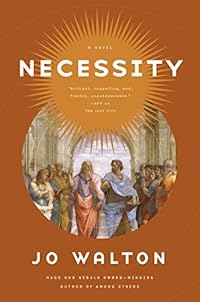
This is the last of Walton’s “Thessaly” trilogy in which the author examines the ramifications of implementing Plato’s philosophy in a restricted setting. This is also a scenario in which the ancient Greek Gods are real and can interfere in human affairs. I reviewed the first volume, The Just City, here and the second The Philosopher Kings here.

Necessity takes place in the 26th century on the planet Plato to where Zeus removed the people of the Just City at the end of The Philosopher Kings. As in that second book there are twelve cities in all to cater for people’s various preferences. The climate on Plato is colder than the Greece from which most of the humans now living there were derived. Nevertheless their habitual attire is the kiton. As well as humans, the planet is home to some aliens known as Saeli who have immigrated there and are accepted as full members of society. Contact has also occurred with another set of aliens known as Amarathi. Many tasks on Plato, as in the Just City, are carried out by Workers, sentient robots accorded human rights. One of these, Crocus, has narration duties, as do the humans Jason and Marsilia and the god Apollo. Jason is a fisherman whose crew includes the Saeli, Hilfa, and the present consul Marsilia. He has an unrequited yen for Marsilia’s sister Thetis.

The book starts on the day when Pytheas, the human incarnation of Apollo and grandfather of one of our narrators, Marsilia, dies and a spaceship containing humans (from the planet Marhaba) arrives in orbit round Plato. This last, the reader might have thought, would provide the main thrust of the intrigue/plot but in fact not much is made of it. Instead the thread that is followed is a search for Apollo’s sister Athene who has ventured outside time, to study Necessity, and what Chaos is, and how time began. Necessity is later referred to as a great force that binds all thinking beings. Zeus, the father of both Apollo and Athene, would apparently be displeased if he knew Athene had done this – at least once his attention had been drawn to it – but despite him knowing everything no consequences will ensue if she can be brought back before it comes to his attention.

The human interactions are something of a sub-plot. Marsilia has an eight-year-old child, Alkippe, whom she had conceived with someone calling himself Panodorus. He appears at a gathering but does not recognise her and everyone else sees he is Apollo’s brother Hermes. (Yet even this is another disguise as he is in fact the Saeli god, Jathery.) His failure to recognise Marsilia is because in his time he has not yet met her. This is a potentially disastrous situation since if he does not step outside time then Alkippe may not ever have existed. Again, not as much is made of this situation as might be expected.

Walton it seems is more interested in philosophical speculation than interpersonal (or god to human) conflict. Her writing is fine, though – she can pull you along – and she brings out her characters’ attributes well, but in the end Necessity is a touch disappointing.

Pedant’s corner:- kiton (the spelling chiton displays its Greek origin more clearly,) “we were back on in the peaceful glade” (no need for the ‘on’,) “on a women’s body” (a woman’s.)

Among Others by Jo Walton

Corsair, 2013, 408 p.

 Among Others cover

How does a reviewer describe this odd but delightful concoction? A coming of age story? No; the critical event of the narrator’s life so far has occurred before the time at which all but the initial chapter is set. A tale of adolescent awakening? Yes to that one. A fairy story? That first chapter invites us to consider it so but it does not begin with “once upon a time” nor end with “they lived happily ever after” and is in any case written in a realistic register. Then again it does have fairies in it. An orphan’s tale? Not quite, the narrator has run away from her mother and ended up in the care of a father – and his overbearing three sisters – whom she had previously never known. A boarding school story? In part. (You could well lose count of the number of ways in which our narrator is “among others”.) A primer on Science Fiction and Fantasy? Undoubtedly. It is almost perfectly calibrated to appeal to those with a love for the genre, especially for those books of the 1960s and 1970s people of a certain age will remember with great affection. Yet it doesn’t neglect the wider world of letters either. In particular it shows the interest in Plato Walton would later indulge in her Thessaly trilogy.

As a novel the story is couched in the form of almost daily diary entries – covering the six months from September 1979 to February 1980 – by one Morganna Rachel Phelps Markova, many of which display her love of books and of SF/Fantasy in particular. She can also see and talk to fairies and practices magic – but only in a benign way. Morganna’s voice is pitch perfect. This is how we feel a sometimes confused but opinionated girl of fifteen might write about herself. With a gammy leg due to an incident in which her twin sister was killed while they thwarted an attempt by their witch mother to destroy the world in some (unspecified) way she has difficulty with mobility. In memoriam she seems to have taken her dead sister’s name, Morwenna. One of the diary entries is signed as Morganna, letting us know this.

Walton has some fun delineating the antipathies of the Welsh towards the English (and the condescension from the other direction,) the snobbery endemic in a boarding school, “Class is entirely intangible, and the way it affects things isn’t subject to scientific analysis, and it’s not supposed to be real but it’s pervasive and powerful. See; just like magic,” and the oddities of adolescent behaviours in general. Her injuries actually are an aid as her bookishness would have set her even further apart from her boarding school peers. As it is she is excused games and haunts the school library, “Interlibrary loans are a wonder of the world and a glory of civilisation.” Her mother is an intermittent looming menace throughout the book and this is the major weak point as all the confrontations with her mother are curiously muted and of course the major one took place outside the novel’s confines. The final confrontation is somewhat anti-climactic, and over too quickly.

Apart from that Among Others is, to use Morganna/Morwenna’s word, brill.

Pedant’s corner:- chemistry (as a school subject it’s Chemistry; ditto Biology for biology – both French and Latin were capitalised; however, Physics, Economics, History and Music were not,) who everyone loves (whom,) “I bought four honey buns to go” (Morganna is supposed to be Welsh, not USian; the British usage is “to take away”,) someone is described as a fly half for the house hockey team; fly half is [or was] a position in Rugby Union, not, as far as I know, in hockey,) Morganna quotes a song’s lyric as, “‘Over the hills to Abergavenny, hoping the weather’ll be fine.’” (The actual lyric is, ‘Taking a trip up to Abergavenny, Hoping the weather is fine’,) “where we brush our teeth, and our hair” (the comma is unnecessary. Or is it?) “How much more likely resurrection if the dead process through the valley” (likely is resurrection,) “to which it is intended” (“for which” is more usual,) fit as a past tense (is USian, a Welsh girl would write fitted,) “everyone one always talks at the top of their voice” (at the tops of their voices,) “an explosion at a paint factory” (it’s usually “an explosion in a paint factory”,) a whole scrum were milling about (a scrum was,) “I think he deserves the benefit of the doubt?” (is not a question,) “Though I think ‘Etruscan Sea’ scans better?” (ditto; there were four more instances of such non-questions appended with a question mark,) “I don’t have maths brain” (a maths brain; or, a brain for maths,) “Burnham Wood coming to Dunsinane” (Birnam Wood.)

The Just City by Jo Walton

Corsair, 2015, 368 p including iv p Thanks and Notes.

 The Just City cover

The God Apollo cannot understand why Daphne prayed to Artemis to turn her into a tree rather than mate with him. As a result he resolves to become mortal for a while in order to learn about volition and equal significance (ie according to others their right to self-determination.) His half-sister Athene suggests he go to Kallisti, the part of the Mediterranean island of Thera which will be destroyed when the volcano erupts, where some people are attempting to set up a society based on Plato’s Republic. Here, overseen by masters (Plato-loving scholars drawn from throughout human history – not all of whom are men, despite their title) are brought ten-year old children bought from slave markets to be moulded by Plato’s rules with the intent that they strive to be their best selves and so produce philosopher kings – people who truly understand the truth, agree on what it is, and pursue it – either of the children themselves, from whom the contents of the Republic are to be withheld until they are fifty, or their offspring. Robots from our future do all the work of maintenance and food production. All the children and most masters have their original names replaced, even Cicero. Into this so called Just City after five years comes Sokrates – the only master there who had not in some way requested it. He, of course, questions everything, including the robots.

The narrative is divided into three viewpoints: that of Apollo, incarnated on Kallisti as Pytheas; a slave girl, Simmea; and Maia, a woman born in nineteenth century Harrogate. Between the three this gives Walton the opportunity to discuss not only Plato’s ideas but also issues of free will, the rights of individuals and the nature of sentience. In the midst of this she has Sokrates inquire, “‘If you pursue happiness….. do you get closer to it or further away?’” and Athene, in human form as Septima, “‘most women might as well not exist for all the contribution most of us get to make to history.’”

When the children reach the age of sixteen a system of temporary marriages, whose participants should appear to be randomly selected for each other but really to ensure only the most fit reproduce, is instituted. Human nature being what it is, some couples pair up outside this system, against the rules, and sneak off to do what couples do. Simmea adheres strictly to the rules but Pythea, who is attracted by her mind (she is flat-faced, flat chested and buck-toothed) in the end wants her for himself, as does Kebes, who resents the whole process in Kallisti as being no better than the slavery the children were removed from.

Walton also portrays incidents which underline the thrust of her novel and the arguments it makes. Some of these are perhaps just a little too programmatic. For example, Maia is raped by Ikaros, though he doesn’t understand his actions as rape. Plato wrote that defective babies or those of defective parents should be exposed – a common practice in the classical world. Despite her misgivings, Maia does expose a hare-lipped child.

The Just City is interesting, thought-stirring stuff. Unfortunately, after a public dialogue between Sokrates and Athene, the novel stops rather than concludes. There is a sequel though, The Philosopher Kings, which I shall search out.

Pedant’s corner:- there were a whole host of reasons (there was a host,) the Tech Committee have decided (has decided,) a full stop at the end of a question, to extend this out to everyone (no “out”,) somebody who had never showed cowardice (shown,) said as got dressed (as he got dressed,) Creusa (Kreusa,) ‘we can fix it would be much better’ (fix it it would be,) had rarely seem him (seen,) the crowd were making (the crowd was.)
Walton employs k where c is usually written in English for Greek names, hence Patroklus and Sokrates, but still uses the c in the phrase Socratic dialogues, she also in her note on pronunciation at the end says “ch” is a hard sound as in Bach or loch; in my experience Scots do not pronounce loch – nor Bach come to that – in such a way.

free hit counter script