All Those Vanished Engines by Paul Park
Posted in Altered History, Reading Reviewed, Science Fiction at 12:00 on 2 July 2026
Tor, 2014, 264 p.
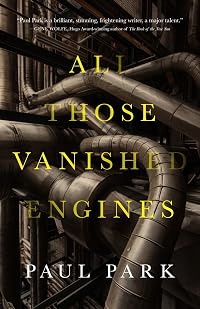
This is a strange concoction, part SF (with more than a touch of Altered History,) part history of the author’s family – including the mystical implications of being born in a caul – part disquisition on the art of fiction.
The first section seems to be from the viewpoint of a child living in a post US Civil War era where the North is ruled by a queen and there are Martians apparently threatening Earth. (Or is that bit an extract from the SF novel being discussed?) The second revolves around a Second World War secret endeavour. The third is less clear cut, with the narrator (or Park himself) looking into an incident in his family’s past that may, or may not, have involved aliens.
The later sections refer to and turn back on the earlier ones, with characters appearing again in different guises, or are the same but in a different situation, all mixed in with the author’s family’s convoluted history. This metafictional aspect of the book does make it slightly less than a straightforward read. And hence difficult to sum up succinctly.
At one point we read, “It’s all metafiction, all the time.” Being told this doesn’t make it any easier on the reader, who, in any case, has already worked out this is metafiction.
A recurring theme is the Battle of the Crater at the Siege of Petersburg, about which I had some previous knowledge but Park subverts that when at one point, in an Altered History twist, instead of a mine exploding, the crater is said to have been created by the explosion of a locomotive on lines dug under the entrenchments to provide swift access to the city when the projected attack is to take place. (Or is this some sort of joke about the Underground Railroad?)
Park does present some aperçus. “One of the interesting things about autistic people is the insight they provide into ourselves. We all have strategies to distract ourselves from what we cannot bear.”
In his capacity as a tutor of writing, our narrator – we are again perhaps intended to assume this is Park himself – says, “I always warned students against complexity for its own sake, and to consider the virtues of the simple story, simply told.” Park is poking fun at himself here, I suppose, for All Those Vanished Engines is very far from a simple story, simply told.
Pedant’s corner:- “The tiny incised pattern on the plates …. were not identical” (The tiny patterns….,) “I went upstairs and smote for a while, trying to get Captain Lukas to finally make a stand” (‘smote’ here does not seem to be the past tense of smite,) “the kaiser’s government” (the Kaiser’s,) “a font of the kind of wisdom” (the phrase is ‘a fount of wisdom’,) “Burnsides’s Corps” (the general was called Burnside; so ‘Burnside’s Corps’.) “I shined the light” (shone, please.)

