Archives » Patrick Edwards

Ruin’s Wake by Patrick Edwards

Titan Books, 2019, 413 p.

It is the year of the Quincentennnial of the Hegemony, an authoritarian state set up by The Seeker after a civilisational collapse known as the Ruin, a society where everyone knows the sun (called Ras) orbits the Earth as the true cosmology of the heavens has been lost even the word ‘planet’ has been lost; but some tech is still left over from the old time.

In the wintry wilds of the north Professor Sulara Song is investigating an archaeological site that may contain an artefact from before the Ruin; at a strip mine on a frozen steppe a man called Cale receives bad news about his son, Bowden; in the city, Kelbee, sold by her father to be the wife of a defender of the Hegemony known to the reader only as the Major (but after a promotion as the Lance-Colonel,) is little but a drudge and sex-slave, allowed outside the house only to work at the lowest grade in a garment factory.

Song’s experiences are given us in the form of journal she writes – and hers is a voice that is wry and compelling – Cale’s and Kelbee’s stories are told in the third person and their personalities therefore come across less sharply. All are actual or potential foes of the Hegemony; Song since the artefact threatens to undermine its foundation myth, Cale as a former comrade of the revolutionary known as Brennev, Kelbee through her growing connection with Nebn who befriends her one day when he comes to the factory to repair a piece of equipment.

The revelation of the underground artefact’s capabilities reads, though, like an interpolation from a different book. (Then again, after regression followed by five hundred years of stagnation any sufficiently advanced technology would seem like magic.) Even knowledge of its facilities represents a threat to the Hegemony’s belief systems and therefore its control of the populace. For unlike the citizens of the Hegemony, kept separate, individualised yet subject to group orthodoxy (as is the ideal for all dictatorships,) “Our ancestors had tinkered with themselves, with the brain itself, back before the Ruin. Every new-born child inherited its parents’ ability to connect with the data corpus, not limited by proximity.”

Perhaps because it was his first novel Edwards is not quite as in control of his prose as he is in his second book, the excellent Echo Cycle, which I reviewed for Interzone, nor is his focus as tight. There is a sense here – especially in the hierarchy of the Hegemony (its head Fulvia arc Borunmer, though the first woman in that post “since… well, ever” is a typical vengeful dictator,) even the existence of the ‘Free City,’ Aspedair, supposedly the only entity on the planet that is not under the Hegemony’s sway, is not an entirely original concept – that he is feeling his way into writing, exploring other people’s scenarios than his own, conforming to a template, that he has not yet found his own voice.

Ruin’s Wake is still very readable though, and Edwards’s portrayal of human relationships and interactions is convincing.

Pedant’s corner:- Time interval later/within time interval count: 17. Otherwise; maw (it’s not a mouth,) sprung (sprang,) “the situation appeared to be diffused” (the situation was not spread out, it was resolved; defused,) “the thick pile of blankets that served as a bed” (earlier on there had been a mattress in the room,) “the light coming under the jamb” (this use of ‘jamb’ appears twice; a door’s jamb is at its side, not its bottom-most part,) snuck under the door jambs (sneaked, and see previous comment,) “the volume of the whole chamber 1,985 metres cubed and the surface area 947 metres squared” (1,985 cubic metres and the surface area 947 square metres. I didn’t bother checking the figures,) “Syn grabbed length of rope” (a length of rope,) sat (x2, sitting,) “the music swelled to a crescendo” (no it didn’t; it swelled [crescendoed] to a climax.) “Which was the truth she wondered” (is a question, so needs a question mark.) “Where would those boys would be now” (remove the second ‘would’,) dove (dived,) “a deep sob wracked her body” (racked.) “None of the people … were armed” (none … was armed,) “darkened by oxidisation” (the verb is ‘oxidise’ the noun is ‘oxidation’,) “it fit snug” (it fitted snugly,) “What struck her most were the looks on the aces” (what struck her most was …..) “He was stood in the wrong place” (standing in the wrong place.) “None of the guns were trained on him” (None … was.) “He was stood in front of her” (standing.)
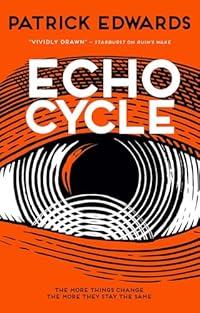
Echo Cycle by Patrick Edwards

Titan Books, 2020, 333p. Published in Interzone 287, May-Jun 2020.

 Echo Cycle cover

Just before Britain finally locked itself off from the continent, congratulating itself on escaping from incipient chaos, Winston Monk and Lindon Banks were on a school trip to Rome. Monk, a homosexual, had long suffered persecution at the hands of his school year’s bully, Tobias Easter (who in that Public School way is usually referred to only by his surname.) Having just received news he has failed to get into a Cambridge College, Monk snaps under another of Easter’s provocations and almost kills him before fleeing into the Rome night, to vanish.

Twenty years later, in 2070, Britain is much diminished, women are of little account and same-sex marriage utterly out of the question, with such relationships long since criminalised and persecuted, and the Royal Family mostly holed up behind protective barbed wire in Windsor. But in a sudden change of foreign policy, Banks has been chosen as part of a delegation headed by Easter, now a top Government official, to re-establish contact, diplomatic relations and trade with a recently ascendant European Confederacy, whose official language is a carefully chosen resurgent Latin, its centre of gravity switched to southern Europe, and Rome a gleaming, ultra-modern architectural wonder. In this world the US has collapsed after the Yellowstone super-volcano erupted, its citizens desperately seeking refuge in the countries to north and south, besieging the walls they had previously striven so hard to erect. Japan is in recovery after a seemingly unprovoked Chinese immolation of Tokyo.

On the swift train journey south through France Banks feels the contrast between his homeland where cars run on dung, there are riots in the streets and something grim though unspecified has happened in Scotland, and the prosperous, far from gloomy countryside outside. He also misses his deceased wife Elanor, and feels protective of his daughter Sara, sent to a boarding school in his absence. At times he hears his old schoolmaster, Orkney, speaking in his head, bemoaning his follies. In Rome, the British delegation is at pains to refuse all forms of Euro tech, including the near-ubiquitous but expensive translation devices most Europeans carry.

After his flight from the consequences of his attack on Easter, Monk fell through time. No concrete mechanism is presented for this, it has to be accepted for the purposes of story. He came to consciousness in 68 CE, the year of the four Emperors, Nero, Galba, Vitellius and Vespasian, just in time to witness the first’s death. From then on Monk’s fate is closely linked to the fortunes of Nero’s close companion, the androgynous Sporus, which rise and fall according to whoever the new First Man is.

Enslaved, branded, made to clean out latrines by hand – Edwards spares us no gritty detail – plucked by Sporus from utter servitude to become a scribe only to be finally despatched to a gladiatorial ludus, Monk resigns himself to death yet, despite receiving only rudimentary training, in his first arena combat he discovers he has a talent for it and eventually wins his freedom thereby, whiling out the years with a successful scribing business.

This story of his time-slip and sojourn in the past is addressed to an at first anonymous reader (but who we learn soon enough is Banks,) and in the novel is interlaced with Banks’s own first-person account of events in 2070, where he has made a connection with Mariko, a half-Japanese European functionary. This tentative association is tainted (both in Monk’s mind and his superiors’) by suspicion of diplomatic underhandedness. On leaving a restaurant one night the pair literally bump into a dishevelled, disorientated vagrant, who turns out to be Monk, returned from 96 CE.

Despite Monk appearing fairly early in the 2070 narrative the balance between the two strands is handled delicately by Edwards. The tone of both accounts is pitch perfect, encapsulating their narrators’ characters, the Roman set passages seem convincing, the dystopian Britain all-too plausible. The characterisation is adept, though Easter is perhaps a bit too relentlessly crass. But then again he is a bully, and an authoritarian. The author’s verb choices are considered, he has a subtle touch with information dumping and a good eye for description.

The denouement, where the importance of Sporus to the overall design becomes clear, is only slightly marred by tipping over into a thriller type plot which also puts Sara into danger – marvellously readable at the time but in retrospect a touch disappointing. Edwards is a talent though.

The following did not appear in the published review.

Pedant’s corner:- Despite the book having an overwhelmingly English sensibility there are USianisms in the text, snuck (x 2, sneaked,) fit (fitted,) parking lot (car park,) rowboat (rowing boat,) outside of (outside,) to visit with (to visit.) Otherwise; “it was every man for themselves” (for himself, surely?) “less fumes” (fewer fumes,) missing commas before pieces of direct speech, “The intoxicating flash of tomorrows were twisted” (the flash … was twisted,) Antinous’ (Antinous’s; every name ending with an ‘s’ here is treated as regards apostrophes as if it were plural – except we had one ‘Charteris’s’,) “none of us were surprised” (was surprised,) “The only reminder of the tons of water above my head were the small bronzed drains” (the only reminders were, or, the only reminder was,) “to the half-dozen or so people sat facing the stage” (seated, or, sitting,) “and Sporus, her of the large eyes” (she of the large eyes,) “I think I’d already be shaken” (been shaken,) “Didn’t mean the everyday citizen wanted their children to come home speaking another language” (citizens would be more grammatical,) “capacity or compartmentalisation” (for compartmentalisation,) sprung (sprang,) “a sword a foot-long and double-bladed,” (a foot long,) “that held giant, pulsating pupa” (Pupae,) lay (lie,) staunch (stanch,) “and the guttering torchlight fell revealed him there” (fell and revealed him? fell revealing him?) “seeing …. the certainty of death hove in on them” (‘hove’ is past tense, ‘seeing the certainty … heave in.)

Issue 287 of Interzone

The latest issue of Interzone arrived today. Number 287. It has a great wraparound cover:-

Interzone 287 cover

This is the one which contains my reviews of The City We Became by N K Jemisin and Echo Cycle by Patrick Edwards.

I note that one story inside is titled Make America Great Again. Hmmm.

Two More From Interzone

 Echo Cycle cover
 The City We Became   cover

Thursday’s post brought two more goodies from Interzone. (Well I hope they’re goodies.)

The first was The City We Became by N K Jemisin. Jemisin won the Hugo Award for best novel three times in a row with the components of her Broken Earth series of books.

The second is from a writer new to me, Patrick Edwards. His novel is titled Echo Cycle. The reviews ought to appear in issue 287.

free hit counter script