Archives » Odysseus

A Thousand Ships by Natalie Haynes

Mantle, 2019, 348 p plus 5 p List of characters, 5p Afterword and 2 p Acknowledgements.
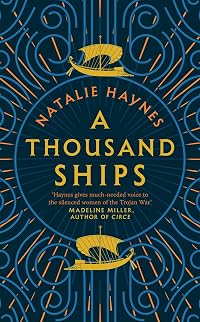
This novel’s title is not particularly apposite – though it does allude to its subject, those Greek tales of the Trojan War – as it barely mentions the legendary ships at all. Instead, its focus is on the women caught up in that conflict and more or less sidelined in all the years since they were first written about. And not simply, like Pat Barker’s Women of Troy sequence, on the Trojan women, but also on the those the Greeks left behind and the Muses and Goddesses said to have influenced affairs.

Thus we have the muse Calliope irritated by the importunings of “the poet” for her to sing for him of the events he wishes to describe (Haynes thereby echoing the usual translation of the Iliad’s opening line, “Sing, Muse, of the wrath of Achilles.”) Creusa, woken by the tumult of the city’s fall, fearing for her five-year-old son and wondering where her husband Aeneas has got to. The captured Trojan women on the shore by the Greek camp, their travails only beginning but intermittently returned to through the narrative. Penthesilea the Amazon, fighting for Troy against the Greeks to atone for being responsible for the death of her sister. Penelope, writing increasingly tetchy letters to her husband Odysseus as his long absence is exacerbated by failure to return promptly on the war’s end and then prolonged on – and on and on – (the poet’s missives suggesting he will use any excuse not to come home.) Chryseis, the daughter of Apollo’s priest, who is befriended by Briseis in shared adversity. The sea-nymph Thetis, mother of Achilles, bemoaning her forced marriage to a mortal and her son’s own mortality. Laodamia begging her husband Protesilaus not to be the first onto the beach at Troy, though she knew he would be. Iphigenia, tricked by her father Agamemnon’s promise of marriage to Achilles into being sacrificed for a favourable wind to set sail for Troy. Aphrodite, Hera and Athene using wiles and false promises to trick Paris into his famous judgement. Oenone, who rescued Paris as a baby after he was abandoned due to the prophecy that he would cause Troy’s downfall. Eris, goddess of strife, setting up the business with the golden apple. Hecabe, Queen of Troy, struggling to accept her new diminished status but still able to revenge at least one of her dead sons. Her daughter Polyxena, accepting her fate with stoic dignity. Cassandra, cursed to see the future as the present and not to have her visions believed. The goddess Gaia resenting the ravages humans wreak on the Earth. Clytemnestra nursing her fury at Iphigenia’s death and preparing her vengeance for it for ten long years. The three Fates spinning the threads of mortals’ lives. Andromache slowly coming to terms with her new life as a slave.

Not a straightforward linear narrative, then, and the many viewpoints and scenes mean the whole thing comes across as fractured and a bit scattershot. This stands in contrast to Haynes’s previous novel The Children of Jocasta which was more tightly focused. The lack of linearity of the storyline works, though, and Haynes clearly has a deep knowledge of her source material.

Her main point, that the sufferings and endurance of the women of these wars (and by extension the women of any war) are as – or even more – heroic than any acts carried out by warriors is certainly worth considering.

Pedant’s corner:- “Odysseus’ nurse” (Odysseus’s,) “Aeneas’ heart” (Aeneas’s,) Briseis’ back” (Briseis’s,) Chryses’ character (Chryses’s,) all names ending in ‘s’ are given s’ rather than s’s for their possessives, “to staunch your bleeding” (stanch,) “each head will open its gaping maw” (stomachs are not usually located on heads,) “‘that Hector deserved to die.’ she said” (‘that Hector deserved to die,’ she said’,) “not known to have expressed regret for any cruelty he had perpetuated against anyone” (he had perpetrated against anyone.)

The Song of Achilles by Madeline Miller

Bloomsbury, 2012. 352p plus acknowledgements.

 The Song of Achilles cover

I would not normally have read this perhaps but the good lady had just finished it and I caught Natalie Haynes, when reviewing the Orange Prize nominees on BBC 2’s Review on 11/5/12 saying it had made her cry!

Well there were no tears from me but I must say the book is very well written. In many ways it is a standard historical novel such as has been written about Roman emperors or Julius Caesar but what marks it out as slightly different is the viewpoint. The narrator, Patroclus, is not a warrior, nor a great shaker; he is not an attendant, nor a scribe. Though he is present at the crucial events – including the fateful occasion when all suitors agree to abide by her decision and to combine against anyone who tries to overturn it as Helen chooses Menelaus for her husband – he is a bystander, powerless to affect them. But then, that is by and large the human condition; even Achilles, half-human son of the sea goddess Thetis – a pale, chilling presence throughout the novel – is unable to change his own fate. Her antipathy to Patroclus is not merely because he is Achilles’s lover but that it makes her son vulnerable. (Miller would have written – Achilles’ lover, why she attributes plural characteristics to singular nouns whose spelling ends in “s” escapes me.)

We do of course encounter characters such as Agamemnon, Menelaus, Ajax, Odysseus. These are figures of myth, or if not they may as well be. Some of them claim descent from the great god, Zeus. Fair enough if the Greeks thought so. To render them human rather than plot enablers is one of Miller’s accomplishments. But when it comes to centaurs (Achilles and Patroclus are trained by one) we have strayed firmly into fantasy territory, hence my categorisation above.

Yet did the ancient Greeks really believe these tales they told themselves? There is an uneasy match here between their apparent acceptance of the living presence of gods, their literal presence as forebears and as agents in the story, and the necessity of their propitiation, which perhaps makes the latter more urgent.

Patroclus has what feels like an anachronistic anti-war sensibility but he is given a rationale for it; when young he accidentally killed another boy and, despite being a prince, was disgraced and exiled for it. Thereafter he has an aversion to the spilling of blood. In illustration of his compassion he even becomes a medic as the Trojan War drags on. It doesn’t stop him, though, from donning Achilles’s armour and joining battle to save his lover’s honour after Achilles has a disagreement with Agamemnon.

There are a few other niggles.

The Achilles at the start of this story has not been in battle, not killed anyone, yet his reputation as the best of the Greeks precedes him. He is sought out by the Greek army, greeted by the Myrmidons as an all-conquering hero. And he has done nothing to justify this. We, as readers, know his legend; they could not. Would they have set quite such store by prophecy? (And would these mythical creatures really call a midday meal lunch?)

It wasn’t at all Miller’s focus as, paradoxically you might think, the Trojan War was mainly in the background but the mechanics of this conflict nagged at me. In the book it lasts ten years! All that time with men being killed left, right and centre. The Trojans are reinforced from their Anatolian hinterland – but in that case the Greeks weren’t making a good fist of their siege. The logistics of it all are troublesome. How were the Greeks reinforced and resupplied? How were they fed? From where would they have found the hundreds of sheep and cattle for the necessary sacrifices to the gods when things did not go well? The surrounding farms would have been stripped bare rapidly.

This is by the by and a problem with the source material, not its treatment. The novel is excellent – though structurally a bit off-kilter in its flits between past and present tense narration; and the final chapters do strain somewhat against suspension of disbelief. Despite its mythic connotations it is rooted in human concerns; the love of Achilles and Patroclus for each other, the ties that bind, the actions they drive us to. About life, in other words. And of course, death.

free hit counter script