Noonday by Pat Barker
Posted in Other fiction, Reading Reviewed at 12:00 on 26 January 2026
Penguin, 2016, 263 p.
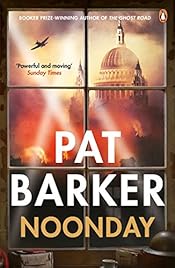
This is the final book in Barker’s Brooke family trilogy which started with Life Class and continued in Toby’s Room. In this one we have moved on to World War 2, Elinor Brooke and Paul Tarrant are long married and volunteering during the London Blitz; she as an ambulance driver, he as an ARP warden. Their lives are still entwined with that of Kit Neville who is also a volunteer. All three still paint whenever they can.
Paul wishes Elinor to remain in the country in her childhood home where the family has taken in an evacuee called Kenny who keeps getting let down by his mother’s failures to visit. Elinor’s mother is on her death bed but still has enough recall to reveal she knew how close Elinor and brother Toby had been. Kenny eventually disappears off back to London where his family is bombed out and finds shelter in a school, which is later the scene of a tragedy underreported for morale reasons. Paul bears a residual guilt about guiding them there.
The scenes of danger during bombing raids in London and their aftermaths of damage and destruction are well described, if a little familiar from documentaries and histories. Throughout we track the gradual erosion of Elinor and Paul’s marriage.
A curious interpolation is that of a medium (I nearly typed fraudulent medium; as if there were any other kind) – named somewhat oddly as Bertha Mason and who, like the first Mrs Rochester, lives in an attic – but who doesn’t seem to fulfil any narrative purpose apart from to discomfit Paul.
Elinor is asked by Kenneth Clark, head of the War Artists’ Advisory Committee, to contribute to its collection, but only with portrayals of women and children. Elinor has other ideas but suspects they won’t be accepted.
As a conclusion to the trilogy this lacks the impact which the Great War had on the characters’ lives in the previous books and stands in contrast to it. It is, though, a reminder that in the midst of war people’s lives still carry on, with all their imperfections and resiliences. Plus it ends on a slightly hopeful note.
Pedant’s corner:- “just now give her” (just now gave her,) “stood there” (standing there.) “She was sat” (she was sitting,) fetid (foetid; even better fœtid,) “a plastic bag” (plastic? In 1940?) “twenty foot deep” (‘twenty feet deep’ please,) “‘His majesty’s ship Repulse is at the bottom of the sea’” (Repulse was sunk in December 1941, well after the blitz waned,) an extraneous quotation mark, “hadn’t showed up” (hadn’t shown up,) a missing full stop.
