Trail of Lightning by Rebecca Roanhorse
Posted in Fantasy, Reading Reviewed, Science Fiction at 12:00 on 15 February 2020
Hodder, 2019, 292 p.
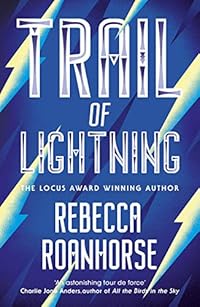
Roanhorse is something of a rarity as an SF author. She may not be the first writer of Native American heritage to write SF and Fantasy but I confess if she isn’t I can’t recall reading any others. That heritage infuses Trail of Lightning, the first in a series of tales.
Narrator Maggie Hoskie is a Navajo, or Diné as they call themselves. Their former reservation is now a bastion against an outside world devastated by an environmental catastrophe referred to as the Big Water. Known to its inhabitants as Dinétah, the Diné’s land is protected by a Wall and there are few incomers. Despite the outer world being largely drowned, Dinétah is suffering from a prolonged drought. Water is one of the many scarcities, coffee an almost impossible luxury.
We first meet Maggie when her help is enlisted by a family whose daughter has been abducted by a monster. Somewhat reluctantly, Maggie, who has what the book calls clan powers – one of hers is to be taken over at times of stress by K’aahanáanii, a source of speed in movement, liable to be useful in a fight – takes on the task of finding the abducted girl. She reaches her too late, though, as she has already been infected by the monster and cannot be returned to her parents intact. The killings of the monster and the girl are only the first of many in the book.
Maggie’s training in the ways of her powers had been undertaken by a man called Neizghání, said to be an immortal (as opposed to the ‘five-fingered’ normal humans.) Maggie may still be in love with him. She is certainly tormented by his disappearance after an earlier incident.
Maggie’s only other friend, a medicine man called Tah, introduces her to his grandson, Kai Arviso, (who is Big Medicine, with healing powers – and silvery eyes.) Reluctantly Maggie takes him along on her quest to defeat the monsters and find Neizghání. Along the way we are treated to what is in effect a supercharged cage fight – to the death.
One of the story’s fantastical apparitions, Coyote, is a familiar figure in Native American folklore. He met Maggie, “before the end of the Fifth World, when my kind still lived mostly in the dreams of the five-fingered people,” and persists in annoying her by calling her Magdalena. Always dressed like one of those be-suited gents in cowboy films, Coyote is one of the book’s more intriguing, if elusive, characters but his interest in Maggie is for purposes of his own.
Some authorial hand-waving is evident when Coyote, also known to the Diné as Ma’ii, at one point says, “This last flood, the one you call the Big Water, ended the Fifth World and began the Sixth. It opened the passage for those like myself to return to the world.” Any rationale for monsters and clan powers is otherwise absent but it is The Sixth World which gives Roanhorse’s sequence of novels its overall title.
While the Native American background makes for an unusual and welcome twist on the norm of SF and fantasy the novel’s apparent relish in weaponry and killing is more by the book and sadly typical of many practitioners of the form.
Roanhorse can write though and, relish in weaponry aside, Maggie is an engaging enough narrator.
Pedant’s corner:- there were several instances of the formulation “time interval” later. Othewise; a missing comma before a piece of direct speech (many times,) “that soak up the hot” (the heat,) “the evil deeds every man and woman leaves behind” (leave.) “All that ugly, the sickness, the loss and unhappiness” (is missing a noun after ugly it would seem.) “Viscera pools at his feet” (viscera pool,) “it will portent something bad” (portent is a noun, the verb is portend.) “His smiles fades” (fade,) diced chiles (chilis,) later we had ‘chilé’ (again, chili.) “None of them even look back” (None of them even looks back,) “and set in on the bar” (set it on the bar,) chamisa (chamiso.)
 Editorial: Our Slightly Spooky Issue Asimov’s1 by Sheila Williams reminisces about all the issues of Asimov’s tinged with the uncanny which she has published around Halloween time.