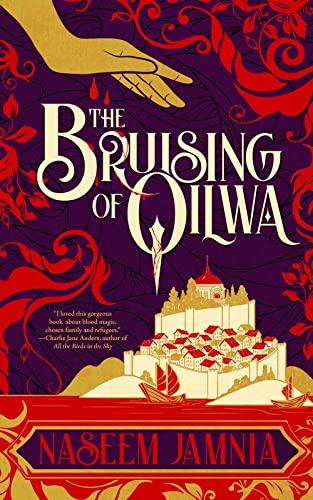
The Bruising of Qilwa by Naseem Jamnia
Posted in Fantasy, My ParSec reviews, Reviews published in ParSec at 12:00 on 24 June 2023
Tachyon, 2022, 177 p, plus 5 p Afterword and 4 p Acknowledgements. $15.95. Reviewed for ParSec 5.
 Qilwa is an island lately having become independent of the mainland Queendom of Dilmun after previously being conquered by Sassanid, which in its turn was taken over by Dilmun. A plague has been raging through Qilwa, blamed unofficially (but with nods and winks from the authorities) on an influx of refugees of Sassanian heritage from Dilmun, fleeing both from the depredations of the sky-borne Homa bird and the fear by Qilmunis of Sassanian blood magic. The flight has been such that during the novel the last Sassanian people that were left in Dilmun arrive in Qilwa.
Viewpoint character Firuz-e Jafari, a user of blood magic, has not been in Qilwa long and still cannot get used to the local failure to designate chosen pronouns on being introduced to someone. When meeting a local healer, Kofi Nadifa, a man who is also able to control breezes, he says, “I’m they-Firuz” and throughout the book is described by the pronouns they, them and themself. When Firuz rescues another Sassanian, she introduces herself to them as she-Afsoneh. We never see other characters, like Firuz’s brother Parviz, and his friend Ahmed, or indeed any Dilmunis, barring Kofi, introduced. Except for the occasional other pronouns such as zhe, zher and hu, usually used for incidental characters, those whom Firuz interacts with are designated either by name or the more traditional singular pronouns.
In Dilmun, Sassanians are definitely second-class citizens, kept more or less segregated. In this fantasy world, as in the real, colonialism exerts a dark shadow. Kofi tells Firuz, “It’s said when your people took ours over they made a pact with a dark god to gain powers over life,” a phrase which has echoes of the blood libel. Firuz’s family at first had to live in an area known as the Underdock before his work at Kofi’s clinic allows them to move to a slightly better neighbourhood and such is the fear in which blood magic is held that Firuz has to keep their abilities secret. They worry in particular about Afsoneh, who has an innate facility for blood magic but is totally untrained and thus a danger not only to anyone she might try to heal but to herself and her associates. Firuz agrees to train her and says, “‘Really all magic works on this principle, pulling energy from a source in order to manipulate it. But for us, for blood magic users, we have to pull from our own life force.’” Blood magic users are practiced in the science, those in training or without the control are adepts.
Some healing magic is acceptable in Dilmun, though. Environmental magic involves equivalent exchange (akin to the First Law of Thermodynamics,) and structural magic uses runes or words to channel energy.
When cases of blood-bruising begin to arise, brought to their clinic’s attention by a local undertaker showing them bodies strangely preserved after death, Firuz is at first baffled by the phenomenon but its possible ramifications for Sassanians in Qilmun after the only recently subsided plague are not lost on them. It takes a while for them to work out its possible cause, bone marrow increasing its output of blood cells to an unsustainable level. This faulty blood, leading to lack of clotting and subsequent bruising, its lack of oxygen carrying capacity giving unwarranted fatigue, is redolent of someone searching for blood that attacks illness and wipes it out without a trace by magical means instead of natural. Firuz’s suspicions initially fall on Afsoneh who is covertly attempting to carry out an alignment, a redistribution of tissue to other areas or a breakdown of tissue for the body to repurpose, on Parviz before Firuz prevails on her to stop. The true culprit for the altered blood is more surprising.
The background colouring to the story (the author is the child of Persians who emigrated to the US) is out of the ordinary for modern fantasy but not too unfamiliar historically. However, this is Jamnia’s first novel and sometimes that shows. Relationships tend to be sketched rather than fleshed out, the concept of the Homa bird is sorely underdeveloped and the climactic scene feels rushed. Then there is the use of the somewhat coy “muck” or “mud” as expletives. The prejudice in Qilwan society is mostly mentioned rather than shown and sits a little uneasily with the book’s other elements. In scenes where more than one person is present that usage of plural pronouns for Firuz is liable to be misread.
Twice it is emphasised that “Magic is mostly a working of the will.” Jamnia’s will is strong but perhaps their magic isn’t quite fully controlled as yet. Overall, though, The Bruising of Qilwa is an interesting read.
Pedant’s corner:- Afosneh (elsewhere Afsoneh.) “It annoyed Firuz to no end” (no, it did not annoy Firuz ‘for no purpose,’ it annoyed Firuz no end, ie it annoyed Firuz immensely, “the warm towel with the runes sewn into them” (sewn into it.) “Had he been in a chair, Ahmed would have likely sunk into it. As it were, he cradled his head in his hands.” (As it was, he cradled,) “the minutia of the shifts” (this read as plural, minutiae,) “on the governor’s behest” (at the governor’s behest,) sunk (sank.) “This would make the day to day of running of the clinic” (no need for the ‘of’.) “It was so nice someone around their age to talk with” (so nice to have someone,) sprung (sprang.) “a density separator” (a centrifuge to give it its proper name,) “a yellowish-clear layer” (implies a yellow liquid cannot be clear; it can: ‘a clear [pale?] yellow layer’,) “Afsoneh squirmed of reach” (out of reach.) In the Afterword; “the storming of the White House” (the Capitol,) “to use my background a scientist” (as a scientist,) “the people from whom my parents came from” (has one ‘from’ too many.)