Mr Standfast by John Buchan
Posted in Reading Reviewed, Scottish Fiction at 12:00 on 1 February 2026
Polygon, 2010, 342 p, plus vi p Introduction by Hew Strachan. First published in 1919.
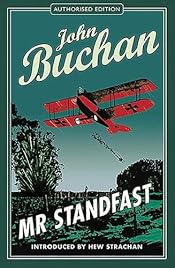
In this third of Buchan’s Richard Hannay novels our hero has been pulled from his General’s post on the Western Front to visit Fosse Manor in the Cotswolds where he is to pose as a pacifist. Among the mostly harmless people he meets there is, however, a Mr Moxon Ivery who will turn out to be more dangerous. Part of the party is Miss Mary Lamington with whom Hannay is very taken and who is the agent from whom he is to accept his further orders. Their mutual knowledge of the Pilgrim’s Progress is to be used as a kind of code book to convey and hide messages (the origin of Mr Standfast’s title.)
Mary’s instructions take Hannay to Glasgow to make himself known in the pacifist working men’s associations and then on to Skye. These northern regions of the country were apparently subject to strict travel restrictions which, as a pseudonymous agent, he has to circumvent. Several escapades among the heather later he has discovered a German spy ring working as the Wild Birds and heard the name Bommaerts.
He relays his information to the authorities in London before being returned to his battalion in Belgium.
Meanwhile his friend Peter Pienaar has joined the Royal Flying Corps and struck up a rivalry with the German air ace named Lensch, who Pienaar says is better than Richthofen. (This gives the excuse for the otherwise not too apposite cover picture.) Pienaar is eventually shot down and badly wounded. Hannay’s other companion in the Erzerum affair in Greenmantle the US citizen, Blenkiron, also makes an appearance. He makes the observation, “There’s something comic in the rough about all Germans, before you’ve civilized them.”
In Belgium Hannay has enough downtime from his front-line duties to go ferreting about a nearby chateau in search of the mysterious Bommaerts, who captures him and boasts of his superior abilities and the devastating blow the Germans will soon strike. Bommaerts, Ivery and a journalist called Clarence Donne who had managed to hoodwink Blenkiron turn out to be one and the same man, the Graf von Schwabing.
Hannay escapes in a very ‘with one bound he was free’ type of way and makes a foray into Switzerland to try to thwart von Schwabing’s designs, making an arduous passage on foot over the Swiss mountains in attempting this.
On his return once more to army duty we are given some fairly detailed descriptions of the German spring offensive of 1918 and, by Buchan’s account, how close it came to complete success. From the point of view of the British Tommy it must indeed have seemed a desperate situation.
Mr Standfast is a Boys’ Own Adventure kind of enterprise. Plot here is everything, characterisation a secondary concern – if a concern at all. The most engaging character – Mary Lammington is inserted only to give Hannay a love interest but is barely memorable – is a true pacifist who has been inducted into the Labour corps and finds fulfillment there.
Sensitivity note. The book is of its time in its off-hand racist comments. “There are some things that no one has a right to ask of any white man,” “‘a great big buck nigger,’” “‘like a bankrupt Dago railway,’” “a droop like a Polish Jew’s,” “a face like a Portuguese Jew’s,” – this otherwise nameless character is referred to thereafter as the Portuguese Jew – “a Paris Jew-banker,” “he was an Austrian Jew,” “all breeds of Dago and Chinaman, and some of your own South African blacks.” “‘He is a white man, that one,’” is said by Pienaar of his air adversary Lensch.
Pedant’s corner:- Afrikander (nowadays spelled Afrikaner,) “the Coolin” (several times; nowadays usually spelled, as in Gaelic, Cuillin.) “It seemed to more a stone and to replace it” (to move a stone makes more sense,) “shinning up a rain-pipe” (downpipe is more usual, and the Scottish term is roan pipe; alternatively, rone,) a missing comma before a piece of direct speech, “‘and most of my tactics. I had to invent myself.’” (no need for that full stop ‘and most of my tactics I had to invent myself.’) “In the press of a fight once scarcely realizes death” (In the press of a fight one scarcely realizes death.)
