The Book of Fathers by Miklós Vámos
Posted in Other fiction, Reading Reviewed at 12:00 on 8 December 2020
Abacus, 2009, 476 p. Translated from the Hungarian, Apák könyve, by Peter Sherwood
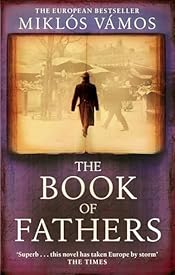
Tinged with a dash of magic realism and told episodically this is a chronicle of the first born sons of the Csillag family (later Sternovszky, later still Stern and then Csillag once more,) beginning with Kornél Csillag in 1705, who starts writing down his experiences in a notebook which his descendants refer to as the Book of Fathers and to which each makes his own additions in due time. More uncommonly, since Kornél took possession of a small globe which enclosed a watch, each of them – bar the penultimate Csillag, after the device has been discarded in a latrine – has access to the memories of his forebears and can seem preternaturally mature and knowledgeable. The title is a slight misnomer – the novel could be entitled “The Book of Sons” after all – as there is not just one notebook since the first becomes filled relatively quickly and others are purchased to continue the tradition.
Each descendant has his own chapter in The Book of Fathers we are reading, relating the significant events of the life of its subject, but too often we are told of them more than shown them. Sometimes too we see the same event from a different viewpoint in succeeding chapters – the father’s (sometimes the grandfather’s) and the son’s. It would be unkind to call the novel a family saga but it shares that enterprise’s lineaments. However, while the bulk of a chapter may be full of incident it sometimes seems as if Vámos lost interest in that particular life as there can be what seems an unseemly rush to its finish and the character is dispatched within a sentence or three.
All of life is here, though; along with those perennial concerns of the novel as a form – love, sex and death – but love is never a main focus here (and relationships between the generations are frequently strained) while there is no emphasis on sex. Death, though, is a necessary component of a book with this one’s premise. One of the family line converts to Judaism in order to marry (thereby upsetting both families involved) but the lives of his descendants allow Vámos to throw light on the status of middle-European Jewry as the years unfold. Then of course, as it approaches the mid-point of the twentieth century, the reader’s sense of foreboding heightens, but arbitrary deaths were no stranger earlier and occur later too.
That early convert is taught by Rabbi Ben Loew of Prague and expresses his confusion about Jewish teachings and his new co-religionists’ place in the world. “‘Everyone is a stranger in this world,’ said the Rabbi. ‘Above all the Jews. The pharaohs drove them from their ancient homeland,* they dispersed to all points of the compass. They are to this day not allowed to buy land in many places.’” Yet for most of the time the family members live lives undisturbed by prejudiced undercurrents, only subject to those political incidents endemic to any country’s history. As such the book is a kind of primer on Hungarian identity and the country’s struggle for independence.
The peculiar nature of the Csillag/Sternovszky/Stern/Csillag line is alluded to when one reflects, “He to whom is given the gift of seeing into the past does not choose what he sees.” As well as the past, some of them can see into the future – but only indistinctly, on occasion Delphically, often with tragical outcomes. A later thought that “whatever happens in this world it all ends in the crying of women” is of universal resonance.
The writing has a similar sensibility to that evident in Czech literature or from the former Yugoslavia: an exercise of imagination, a kind of heightened realism or exaggeration largely absent from Anglophone literature.
Pedant’s corner:- caftan (usually kaftan.) *It was the Romans, not the pharaohs, who were the dominant power when the Jewish diaspora began, “the Book of the Fathers” (usually written as ‘the Book of Fathers’, three times that extra ‘the’ is inserted,) “horses’ hoofs” (in my time they were always hooves,) extra points for ‘stanch’, “only his father’s and grandfather’s exact moment of birth was known to him” (…. moments of birth were known to him.) “‘In Budapest the best streets have had electric light since 1873’” (electricity first came to Humgary in 1884.) “The Csillag side of the family were not in the least happy with Ilse” (the … side …. was not in the least,) churns (churns,) sunk (sank,) “he had simply sawed a hole” (sawn a hole,) a missing comma before a piece of direct speech, “preserved on the black and white snapshots” (‘preserved in’ sounds more natural,) Csilla (Csillag,) “suspecting nought” (nought = the number 0; ‘suspecting naught’.)
