Posted in Ken MacLeod, Reading Reviewed, Science Fiction at 21:00 on 1 February 2010
Orbit, 2009, 368p
 With The Night Sessions Ken MacLeod strides firmly onto SF detective territory and adds his own unique twist. Following on from The Execution Channel (to which it is not a sequel) it is the second of Ken Macleod’s forays into near (well, nearish) future thrillerdom and features acts of terrorism and the police efforts to solve them. It could also be firmly described as Scottish SF as it is set almost wholly in Scotland.
[Aside: Even since before I started this blog I have been pondering writing a piece about Scottish SF. With this book as a spur I may inflict it on you soon.]
There are excursions into New Zealand, though, while solettas - which reduce global warming by directly screening the sun – and a couple of space elevators provide Science Fictional colouring. Another important element is the inclusion of robots/AIs. The police have robot assistants called lekis which, while large, seem to be spider-like, or tentacular at any rate, as well as a collection of smaller bug-like machinery which can infiltrate small places and provide points of view linked in to the police communications system. Other robots are revealed to be useful in construction in space.
The events of the book take part in a world where wars over oil (aka the Faith Wars) have defeated the forces of organised religion – at Armageddon/Megiddo no less – and made these organisations marginal at best, if not quite underground operations. The first terrorist victim is a Catholic priest, the second, in an echo of Covenanting times, an Episcopalian Bishop of St Andrews.
The plot concerns the getting of religion by a group of robots, given the word by a Presbyterian in New Zealand whose sermons - a neat play on the word sessions by MacLeod here - are relayed in real time to members of a sect (of the Third Covenant) in Linlithgow.
As is to be expected given the subject matter, MacLeod’s knowledge of biblical texts is to the fore. There are also some SF in-jokes which the casual reader (if there is such a beast) may miss.
The Night Sessions is a fine blend of the SF and thriller genres. The writing flows, the clues are placed where they are needed and (spoiler alert?) the denouement depends on one of the SF elements. MacLeod could obviously handle a straight detective novel with no difficulty but doing so would perhaps not have allowed him to explore the theme of religion in quite the same way.
No Comments »
Posted in Ken MacLeod, Reading Reviewed, Science Fiction at 21:12 on 29 December 2008
Orbit, 2007
Ken MacLeod won instant critical praise and readership with The Star Fraction and the remainder of The Fall Revolution series of space opera type novels. He followed those with the equally celebrated Engines Of Light trilogy. All these books were noteworthy in that they had overtly political overtones of a type not often seen in SF, which is to say they engaged with left leaning perspectives. Lately he has moved away from series to stand-alone novels exploring other tropes from the SF firmament, in Newtonâs Wake and the excellent Learning The World – where MacLeod gave us a generation starship and first contact novel all in one.
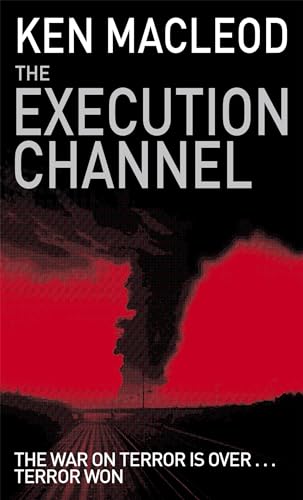
The Execution Channel, which is not done many favours by the somewhat misleading though enticing strapline on the cover, is another change of tack, an intricately plotted, tightly written near future type thriller involving bloggers, conspiracy theorists, MI5, the CIA, the French secret service etc. in an alternative world where Gore won in 2000 but 9/11, Iraq and Afghanistan still happened â and, in contrast to our world (so far,) so too has Iran. Unlike End Of The World Blues, here the SF elements of the story – there is mention of Planck anomalies and Heim Theory spaceships – are integral to the plot and denouement.
The air bases at Leuchars and Lossiemouth have been given over to US forces. A peace-type camp monitors events at Leuchars. After a camp member, Roisin Travis, receives a cryptic message from her brother, a British soldier in Afghanistan, and she witnesses the arrival of a strange object, the campers leave hurriedly and attempt to send out the pictures she has taken to newspapers and other interested parties worldwide. An unconventional explosion producing a mushroom cloud then destroys the base and they become subject to a manhunt by the security forces.
In the meantime she has warned her father, an IT expert whose company has done work for the government, and who is now travelling to meet her at a prearranged rendezvous. Both get caught up in a ramping up of the emergency – motorway flyovers brought down, Grangemouth Oil refinery blowing up, aircraft flying into terminal buildings, with Travis senior also helping to deflect backlash attacks on Muslims, scapegoats for these attacks, along his way. In the course of this one wonders how much spy fiction MacLeod has read, or spooks he has spoken to, as his descriptions of tradecraft read well.
The convolutions of the plot are admirably worked out, the characters engaging and the SF twist came as an agreeable (if partially breaking suspension of disbelief) surprise.
The Execution Channel in the book is the product of a kind of spy software in CCTV cameras feeding captured images of pain and death through secret conduits in widely disseminated relay satellites to the eponymous broadcasting outlet. The concept – while an intriguing comment on ârealityâ TV trends in our world – is neither overplayed nor gratuitous. At one point it serves a plot function.
There is an âExtrasâ section at the end of this paperback edition, missing from the hardback I note, which includes an interview with Ken Macleod – no problem with that – but also an entirely superfluous extract from a book by a different author entirely. (I know publishers want to promote their books but this is simply an annoying way to go about it.)
Ignore that though. This book is in my top three reads of this year.
No Comments »
