Posted in Reading Reviewed, Robert Silverberg, Science Fiction at 20:00 on 18 December 2016
Special Slightly Spooky Issue. Dell Magazines.
 Editorial: Our Slightly Spooky Issue Asimov’s1 by Sheila Williams reminisces about all the issues of Asimov’s tinged with the uncanny which she has published around Halloween time.
Reflections: Magical Thinking by Robert Silverberg considers Lynn Thorndike’s “magisterial” A History of Magic and Experimental Science “an extraordinary treasurehouse of human thought in all its folly and grandeur.”
On the NET: Welcome Our Robot Overlords!2 by James Patrick Kelly examines the state of AI development.
In an excellent On Books:3 Norman Spinrad, for the first time in his reviewing career at Asimov’s dealing with short story collections/anthologies, notes the tendency for works of fantasy to dominate SF awards (and outlets,) in effect the colonisation of SF by “literary” craftspeople looking for a market (all but the only market,) and the necessity for story and style to be combined to make any fictional work outstanding. He decries the necessity for an author to have a “voice” as the style a tale is told in ought to serve the story, not the ego of its author.
In the fiction, Alexander Jablokov’s The Forgotten Taste of Honey4 sees viewpoint character Tromvi have to take a corpse back to the land it came from in order to please the gods. A transfer of memories from the corpse to Tromvi via the honey from a hive inside the body thwarts the man who tries to prevent him.
In Eating Science with Ghosts by Octavia Cade our unnamed narrator goes about eating and drinking with the ghosts of scientists and explorers, ghosts only she can see.
The People in the Building5 by Sandra McDonald describes the occupants of said building – including the interplanetary rescue service on the third floor which has unwisely as it turns out revived an ancient god from a nearby swamp.
Wretched the Romantic by Michael Libling is narrated by Richard, a loser who takes up scattering ashes as a scam once he discovers he has taken on the attributes of the deceased after accidentally inhaling them.
Water Scorpions6 by Rich Larson is set in the aftermath of the crash of an alien spaceship in the Sahara. One of their offspring, genetically modified to make them more human-like, is taken into the family of an ethnobiologist.
In The Leaning Lincoln7 by Will Ludwigstein, said figure is a toy made from a lead ingot salvaged from the shore. It has baleful properties.
Lucite8 by Susan Palwick sees a visitor to an attraction based on Dante’s Inferno take home a dead person’s soul in a lucite box.
Project Entropy9 by Dominica Phetteplace is another in the author’s series on AIs in San Francisco. My heart has begun to sink when I see her name on Asimov’s cover.
When Grandfather Returns10 by S N Dyer is a tale of the appearance among the Navaho of Cabeza De Vaca and his followers and their displacement to the present day.
In Choose Poison, Choose Life11 by Michael Blumlein a woman who has an unfortunate taste in men is variously, and in various guises, saved from, or saves herself from, suicide.
Pedant’s corner:- 1Joel Richards’ (Richards’s.) 2easily your best source the very latest news (of the latest news,) 3Henry James’ (James’s,) a epiphany climax (an,) Gunther Grass’ (Grass’s,) “what the differences between the two, are and stronger “ (between the two are, and stronger.) 4an ewer (I suppose since ewer starts with a vowel this is technically correct, but… It is sounded as a consonant so “a ewer” would be fine by me,) “maw” used for part of a ruminant’s stomach (hurray!) 5new emotions arrives (arrive.) 6sked (seems to be a USian abbreviation for schedule. I was of course thoroughly confused as I pronounce schedule as “shed-yule”.) 7Tutankhamen, (Tutankhamun.) 8McManus’ (McManus’s.) 9negress (we’re back to using n-words now?) 10Thunder Cries’ (Thunder Cries’s,) Rabbit Smile’s (name was previously Rabbit Smiles: the later Rabbit Smiles’ should be Rabbit Smiles’s,) 11to portage the water (“portage”? What on Earth is wrong with “carry”?)
No Comments »
Posted in Reading Reviewed, Robert Silverberg, Science Fiction at 12:00 on 13 August 2016
Dell Magazines.
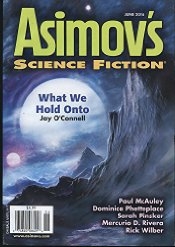
The fourth issue of this year’s subscription. In the editorial Sheila Williams introduces the magazine’s background staff. Robert Silverberg’s column describes his discovery of the utility of a smartphone. (He still doesn’t own one though.) In On the NET James Patrick Kelly discusses the back and present catalogue of stories set on Mars in the light of encouraging real space missions. Norman Spinrad’s excellent Book Review essay reflects on the difficulties of representing quantum reality (his preferred term for quantum mechanics) in fictional form and the necessity to treat the reader fairly vis-à-vis recent developments in astronomy.
As for the fiction:-
Clearance by Sarah Pinsker sees a tooth gel saleswoman discover the delights of holidays in different realities.
In Unreeled by Mercurio D Rivera the husband of a streamer (people whose consciousnesses are beamed across the universe then brought back again) finds his wife’s behaviour has altered as a result of a trip to a black hole. The denouement seemed a trifle rushed.
Rambunctious by Rick Wilber is a tale of an overly-gifted young girl whose family harbours a secret. I was reminded (a bit) of Zenna Henderson’s stories of The People.
Project Symmetry by Dominica Phetteplace sees a woman’s Watcher chip help her to come to terms with her life. This story didn’t really add much to what we already knew about the author’s fictional universe.
In Rats Dream of the Future by Paul McAuley a researcher tries to get rats to predict the future in order to make stock market killings.
What We Hold Onto by Jay O’Connell is set in a climate changed world where some cities have been inundated. A woman enlists a Nomad (a group of stateless licensed helpers) to deal with her dying mother’s estate. In essence an extended love story.
Pedant’s corner:- phase (I prefer faze for this sense, though apparently phase is an acceptable US usage,) laying down with (lying down with,) flack (flak,) patinaed (patinated,) Chthulu (Cthulhu,) sat (sitting; or seated,) Nils Bor (Nils Bohr,) a “neither…. or” rather than neither … nor, “summarizing .. for or readers” (omit “or”,) daring-do (this is the first time I have seen this formulation but it is indeed the original which was mistaken as a noun in itself and so has long been rendered as derring-do,) charactarogical (characterogical, surely?)
No Comments »
Posted in Fantasy, Reading Reviewed, Robert Silverberg, Science Fiction at 12:00 on 17 July 2016
Dell Magazines, 112 p.
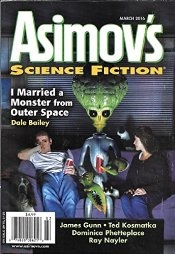
The second issue of the year’s subscription to the magazine my younger son gave me as a Christmas present. Robert Silverberg describes how Walter de la Mare’s story The Three Mulla-Mulgars, read in his youth and many times since, inspired him and fed into his fiction. James Patrick Kelly’s internet overview discusses the pros and cons of reading and writing a series of books.1 In the fiction:-
The Bewilderness of Lions by Ted Kosmatka.2 A data cruncher who can predict scandals goes to work for a politician. Then she is contacted by the people who really run things. Another story which panders to the secret-conspiracy-that-rules-the-world tendency.
The Ship Whisperer by Julie Novakova. An expedition to a black dwarf (which shouldn’t exist) discovers a device that can alter the rate of change of time. The titular character can “talk” to quantum computers, enabling the story’s resolution.
A Partial List of Lists I Have Lost Over Time by Sunil Patel is a series of listicles. I believe it is supposed to be humorous. The author seems to have a particular thing about kale.
Project Empathy by Dominica Phetteplace is about trends, moving elsewhere then finding the norms are different, plus there are Watcher chips inside people’s heads.
Do Not Forget Me by Ray Nayler3 is a story in the Eastern tradition, of tales within the tale – four embedded narratives here – the central one being about a man who doesn’t age. There is nothing really noteworthy here though.
A Little Bigotry by R Neube.4 An ex-soldier down on her uppers is reduced to accepting a contract to be an escort to a former enemy. A fine enough story but reminiscent of Barry B Longyear’s Enemy Mine. Then again, I suppose the point about enemies being worthy of understanding always bears repeating.
New Earth by James Gunn.5 A colony ship from a more-or-less destroyed Erath has reached a new planetary home. Choices and dangers must be faced.
I Married a Monster from Outer Space by Dale Bailey6 is narrated by a woman who takes home an alien who came into the Walmart she works in. This at first unpromising – clichéd even – scenario is, though, only scaffolding over what eventually becomes an affecting tale of love, loss and redemption. I note the references by Bailey – via the narrator’s surname (Sheldon,) her dead daughter Alice and her comment on her status as an invisible woman – to the career of James Tiptree Jr.
Pedant’s corner:- In the editorial; definine (define,) chose (choose,) Lawrence Watt Evans tale (Evans’s,) 1 ambiance (ambience,) 2 she could feel it siding in her fingers (sliding makes more sense,) lobyists (lobbyists,) 3 lay about (lie about.) 4 license (licence,) maw used for mouth (maw means stomach,) accurst (accursed,) 5mentions trees that are not-quite-trees but one of the characters says multi-cellular life hasn’t evolved there. Trees are multi-cellular; the fern-like structures subsequently described would be also. 6Bug-Eyes’ (it’s singular; so Bug-Eyes’s,) Hastings’ (Hastings’s,) laying (lying; plus lay for lie,) breath in (breathe in.) In Paul di Filippo’s book reviews; stefnal to mean science-fictional, a usage I had not come across before, whereas sfnal I was familiar with.
No Comments »