Asimov’s Science Fiction Sep 2016
Posted in Reading Reviewed, Robert Silverberg, Science Fiction at 17:00 on 23 November 2016
Dell Magazines.
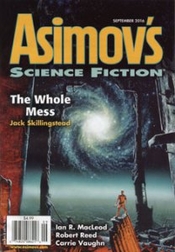
Sheila Williams’s Editorial lists The Thirtieth Annual Readers’ Award Results. Robert Silverberg’s Reflections (“Darn,” He Smiled) remembers the glory days of Science Fiction reviewing by James Blish and Damon Knight including one memorable Blish evisceration of a story that used 89 different expressions for “said” (a practice Silverberg himself thereafter strictly avoided) and laments that the pendulum has now swung so much the other way that would-be writers are positively encouraged to eschew the unintrusive “said”.
Peter Heck On Books1 looks favourably on the latest novels by Charlie Jane Anders, Laura R Gilman, and Fred Chapell, Paul di Filippo’s collection and the non-fiction Breaking the Chains of Gravity: the story of space flight before NASA by Amy Shira Teitel.
In The Mind is its Own Place2 by Carrie Vaughn, Lieutenant Mitchell wakes up in hospital to be told he is suffering from Mand Dementia, an affliction suffered by navigators who intuit the correct coordinates for hyperspace jumps. The story concerns his gradual unravelling of what happened to him.
Dome on the Prairie3 by Robert Reed is an alien invasion story inspired by the works of Laura Ingalls Wilder. Aliens in the form of the Scourge have come to Earth. Our (unnamed) narrator is chosen to try to communicate with a Scourge child dubbed Laura.
In Epitome4 by Tegan Moore, Shelby, a woman given power of attorney by her female lover Vivian (whom for some unexplained reason she cannot acknowledge as such) becomes her carer after a fall causes brain damage. To compensate, Shelby has a hacker friend upload a brain scan of Vivian into the Personify virtual reality programme.
Academic Circles5 by Peter Wood is a time travel story wherein a man uses a time machine to plagiarise academic essays on Philip K Dick and claim precedence. Others have feelings of déjà vu.
In The Whole Mess6 by Jack Skillingstead mathematical genius Professor Dunn is handed an incomplete equation. When he solves it tentacled Masters slip through from a parallel universe and he slides to a third. Only he can undo the change but his abilities are restricted.
All That Robot…7 by Rich Larson sees a man stranded on an island otherwise inhabited by sentient robots sin against their nascent religion.
The best is kept till last – and it’s the best in Asimov’s all year up to now. Ian R MacLeod’s The Visitor From Taured8 tells the tale of Lita, a woman who studies Analogue Literature (old style 2D physical books rather than interactive or non-static narratives,) and her (lack of) relationship with astrophysics adept Rob who is trying to prove the many worlds theory.
Pedant’s corner:- 1Palazo (in a book title! palazzo,) 2“He’d signed in, said good morning to the captain, went to his station” (He’d; therefore [he’d] gone to his station,) “He had to learn to the truth” (learn the truth.) 3a wide range… were scattered (was,) “shifting its aim for a moment that ends when you forcing your attentions to…. (with you forcing? when you force?) 4 freshman (freshmen mad emoe sense) 5Popoov (Popov,) a missing end quote mark. 6 the ‘the Masters’ (only one the needed,) a particularly adept memoirists (memoirist,) I couldn’t breath (breathe.) 7”hoping that the two events to coincide” (the two events coincide.) 8Even in a US publication it is intensely annoying to read in a story by a Briton and set mostly in Leeds and the Outer Hebrides the word “asshole” rather than arsehole, yet there was archaeologist not archaeologist and later maths and “arsed around”. “He fucked about.” (I assume US readers will read this as implying promiscuity – the context leans towards it – but I didn’t. In Britain it means engaging in activities to little purpose, not fulfilling yourself, see “arsed around”,) post-centarian (post-centenarian?) this stuff happen at the atomic level (this stuff happens,) “as if every choice you made in a virtual was mapped out in its entirety” (“world” after virtual?) sung (sang,) span (spun.)

