Archives » J L Carr

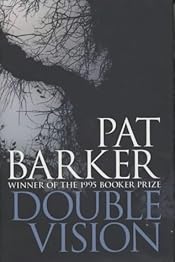
Double Vision by Pat Barker

Hamish Hamilton, 2003, 314 p

Artist Kate Frobisher, whose war photographer husband, Ben, was not long ago shot in Afghanistan, is driving home one winter’s night when her car skids on black ice and comes off the road. Her injuries mean she will need help to complete the commission of a sculpture of Jesus for the local church. The vicar suggests Peter Wingrave, a handyman currently unemployed. Meanwhile foreign correspondent Stephen Sharkey, Ben’s colleague, has split up with his wife and comes to live in a cottage owned by his brother in the same village.

The set-up reminded me a bit of J L Carr’s A Month in the Country, which featured an incomer haunted by war experiences (in his case The Great War) uncovering a mural in a rural church. Barker’s book is longer, though, and a trifle more complicated.

Wingrave turns out to have a peculiar interest in the sculpture and a past which includes something dark plus a relationship with the vicar’s nineteen-year-old daughter, Justine. Stephen and Justine, who is having a pre-University gap year enforced by illness and looks after his autistic nephew when the parents are at work, soon start seeing each other despite their age difference.

Stephen is haunted by his memories – especially that of a dead woman in Sarajevo – yet he is intent on writing a book about them using Ben’s photographs as illustrations. He reflects on the responsibility of being a witness, “There’s always this tension between wanting to show the truth, and yet being sceptical about what the effects of showing it are going to be,” a tension which the artist Goya also felt. Goya, he knows, “visited circuses, fiestas, fairs, freak shows, street markets, acrobatic displays, lunatic asylums, bear fights, public executions, any spectacle strong enough to still the shouting of the demons in his ears.”

The background of the aftermath of the foot and mouth epidemic is well drawn but despite seeming foreshadowings like that, events do not take the course they would normally imply. Barker handles her characters well enough, these people feel individual (even if the affair between Stephen and Justine is problematic. Is taking up with a much younger woman really a suitable salve for a troubled mind?) The connections between the lives of the protagonists of the two main strands, Kate and Stephen, are not really present, though. Only Wingrave provides any overlap between them, and that is tangential – not to mention a little forced what with his being Justine’s former lover.

Pedant’s corner:- “iced-covered” (‘iced-over’ or ‘ice-covered’ not ‘iced-covered’,) a north-east of England local refers to ‘the haar’ being what a ‘cartload of southern poofs’ would call a sea-fret (haar is in fact the word used in Scotland – especially east Scotland – for that meteorological phenomenon.)

How Steeple Sinderby Wanderers Won the FA Cup by J L Carr

The Quince Tree Press, 129 p. First published in 1975 but this edition is from 1992 as it has a cyclostyled letter from the author on page 1, signed J L Carr, 1992. The book’s Wiki page tells us that The Quince Tree Press is the author’s own imprint.

This is, of course, a fantasy. A mere glance at the title tells you that. That a village team would win the FA Cup could not have happened at the time it was written and certainly could not happen now. But that is, I suppose, still the abiding dream of any small club and its supporters, that a “mob of milkmen, farmers, the parson and a job lot of pitmen” could match “Big Business whose performers cost the Mint.” Yet, despite protestations in Part One that this novel is about football, it really isn’t. There are few descriptions of games and those are fairly cursory. What it is about is the dynamics of village life and the triumph of hope over expectation. And how fleeting it all is. I suppose it might be termed a comic novel though there isn’t anything laugh out loud in it.

The text is a curious mixture of the personal recollections of Steeple Sinderby Wanderers committee member Joe Gidner, minutes of committee meetings, absurdly purple-prosed local newspaper accounts of matches penned by Ginchy Trigger “who did funerals, inquests, weddings, council meetings and all sport” for the East Barset Weekly Messenger and even an excerpt from Hansard. There are also six black and white illustrations, a prefatory one of the author’s football team when he played for South Milford White Rose for one season as an eighteen year-old, 4 postcards displaying Steeple Sinderby landmarks, one (uncaptioned) photograph of a woman – perhaps Ginchy Trigger – and one sketch of the Fangfoss household.

Mr Arthur Fangfoss is Chairman of the Wanderers because he was chairman of everything in Steeple Sinderby. He has an unusual household arrangement, living with his wife and her sister, whose roles are commonly held to be reversed. The team has two ex-professionals, Alex Slingsby, retired from football to look after his wife after she suffered a catastrophic accident and Sid Swift, a one-season goalscoring wonder who overnight lost all confidence in his purpose in life but has been restored to vitality by the vicar’s formidable proselytising sister Biddy. The team’s playing philosophy is a bit like total football but underscored by local Hungarian refugee from the Nazis, Dr Kossuth, and his Seven Postulations (though I only recall six being written down here) – produced after watching a couple of Wanderers games and one at Leicester City. Principally these are: have a good goalkeeper, everyone except the goalie must contribute to all aspects of the game, make the most of home advantage (Wanderers adopt a highly sloping patch of ground for the new season) but when away make yourself feel at home and the opposition feel away, and avoid high balls for the most part as professionals control headers much better than amateurs.

When the decision to enter the FA Cup is made one committee member says, incidentally highlighting the fantasy inherent in the author’s conceit, how hard it will be to progress, “‘particularly this year, when the top Scottish clubs are coming in for the first time.’” There is a historical inaccuracy here (perhaps Carr’s oversight): some Scottish clubs played in the FA Cup in its early days in the nineteenth century.

Despite using the dread word “soccer” (but then, he was English) Carr does appear to know his football, “by and large, football supporters are not creatures of intellect but of emotion.” The home crowd at Tambling, “bellowed disbelief at incompetence, cried scornfully to the grey heavens in god-like despair, clamoured angrily for revenge.” That is a football crowd for you. “For 20p. they did all this and were not called to account.” Well, they think that if they’ve paid to watch, it’s their right to dish out abuse. (But 20p! Time has flown – and prices flown even higher.)

Carr also has part narrator Gidner assert that, “Since all Anglicans know theirs is the true faith, they don’t go around stuffing it down other people’s throats.” (Try telling that to folk in the former colonies.) About village life he says, “in rural England, people live wrapped in a tight cocoon” communicating “as their fathers did by a flick of the eyeballs, passing down grudges either improved upon or, at very least, in mint condition from generation to generation.”

The Cup Final was in the old English tradition – “Abide with me” and all – despite Steeple Sinderby’s opponents being Glasgow Rangers. (The singing of religious songs at games involving Scottish clubs has never been the custom – for obvious reasons. Surely Carr cannot have been unaware of this state of affairs?)

I don’t suppose this can be counted as great literature but it is entertaining and likely to be so both for those who like football and those who don’t.

Pedant’s corner:- a missing comma before a piece of direct speech (x 2,) “Antarex skirt and trench coat” (Antartex?) crutch (crotch,) elegaic (elegiac,) Tokio (Tokyo,) “McBain shipping line” (the real one is MacBrayne’s,) “I was stood there” (standing.)

A Month in the Country by J L Carr

Penguin, 2000, 89 p, plus vii p Introduction by Penelope Fitzgerald and i p Foreword by the author. First published 1980.

A Month in the Country cover

In the aftermath of the Great War, Tom Birkin, a veteran with a facial twitch as a result of it, takes on the task of uncovering a mediæval mural from the wall of a church in the village of Oxgodby in Yorkshire. The first person narrative of this slim but well-formed volume is in the form of recollections by Birkin in his old age and relates his interactions with the family of the Wesleyan local station master, the vicar Rev Leach (not at all keen on the disturbance and the potential effect on his flock of a vibrant painting on the wall of his church,) Leach’s wife, and a fellow war veteran Mr Moon, an archæologist hired to try to find the tomb of a mediæval ancestor of the Miss Hebron who has funded both projects via a bequest. As he works on uncovering the mural and gets to know the locals Tom attains a kind of contentment.

A Month in the Country is no more than a novella but Carr packs a lot into it. Like Nan Shepherd’s, it is something of a quiet work, no pyrotechnics, no big issues addressed (except the aftermath of war.) It is also an addition to the literature of the ‘path not taken’.

Pedant’s corner:- As noted in the Introduction the local minister Arthur Leach is also referred to as Revd J G Leach – but Carr admitted to being a reckless proofreader. Elsewhere: mugsfull (mugsful?) a missing comma before a piece of direct speech, “‘Low, He comes with clouds descending.’” (Lo! He comes with…,) Mr moon (Mr Moon.)

free hit counter script