Archives » Italy

Euro 2012

I’ve not posted about Euro 2012 yet because I’ve not seen many whole games.

I did catch all of the England – Ukraine game last night, though. If Ukraine had had a striker they’d have won this. England rode their luck and not just with the ball over the line incident.

I take issue with the commmentators over that. In real time I couldn’t tell if the ball was over the line or not. Even with the benefit of the replay using the along the line view I couldn’t tell that the whole ball had crossed the line when John Terry kicked it out. Neither could the fifth official be sure. And he has to be sure to give the goal. It was only when Terry was stripped from the picture and the frame was frozen that I could tell – and how was I to know what other manipulation may have been done to the image? The line official didn’t have that luxury.

Still, roll on goal line technology.

It must be said Uefa haven’t exactly covered themselves in glory over the Niklas Bendtner fine and ban for ambush marketing vivs-a-vis racist chanting and inappropriate banners.

As to possible winners; who knows?

Spain look get-at-able at the back. If it weren’t for Iker Casillas they would have been going home early: both Italy and Croatia would have beaten them. They also seem to have developed this novel way of trying to win football games. It involves not trying to score goals. (To be fair Dumbarton have been using that system for donkey’s years; but not deliberately.)

Against Croatia the Italians did that Italian thing of taking a lead and trying to hold it. The only thing is their defence isn’t good enough these days to sustain it. Had they gone for the second they might have saved themselves a fraught third game. They looked good going forward against Spain though.

Greece? Not likely, but we’ve thought that before.

Germany look impressive and Mario Gomez has morphed from being the German Luca Toni and suddenly found goal scoring form in a tournament.

Czech Republic? I doubt they’ll have enough to beat Portugal who were too fragile at the back against Denmark. But do the Portuguese have enough striking options beyond Ronaldo to get to the final?

France were shown up against Sweden and must play Spain.

England are teed up to lose to a Mario Balotelli goal. They have exceeded their usual Euro performance in getting to the quarter-final, after all.

At this stage it looks like the Germans.
Socrates

I was sad to hear of the death of Brazilian footballer Socrates. He was a member of that second most entertaining of Brazil teams: the one that lost to Italy (well, to Paolo Rossi) in the second stage of the 1982 World Cup tournament. His goal in that game was sublime as he appeared to ghost past an Italian defender and then comprehensively beat Dino Zoff (Dino Zoff!) at his near post. He also had an idiosyncratic way with penalty kicks – which he would take with absolutely no run-up.

In his non-footballing life he was a medic, qualifying as a doctor before taking up professional football.

I remember from TV reports of the Brazil camp in 1982 he could play guitar and hold a tune. He was a smoker, though, and also, it seems, overindulged in drink.

Sad to see him go.

Sócrates Brasileiro Sampaio de Souza Vieira de Oliveira (aren’t those Brazilian names wonderful?)
19/2/1954-4/12/2011. So it goes.

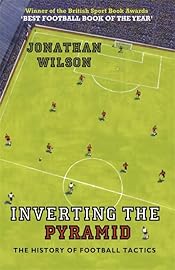
Inverting The Pyramid by Jonathan Wilson

The History of Football Tactics, Orion, 2008, 356p.

This book does exactly what it sets out to, describing the evolution of football tactics from their formless beginnings when everybody on the pitch, apart from the goalkeeper, dribbled towards the opponents’€™ goal with team mates ‘€œbacking up’€ in case the ball was lost, through the invention of passing (or, as it was delightfully phrased, combination play; I like that, let’€™s bring it back) in Scotland, the first real formation of 2-3-5 – one of whose pioneers was my beloved Dumbarton – mentioned on page 23 but not, alas, in the index – in winning their sole Scottish Cup in 1800 and long time ago, 1883 to be precise: its gradual stalemating till the offside law was changed in the 1920s to allow only two defenders between ball and goal line which in turn led to the withdrawal of the centre half into the back line of a 3-2-5 and the ‘€œclassic’€ three defender, two half back, two inside forward, plus centre forward line-up of the W-M or W-W. The later adaptations of this formation (in some cases, as in Great Britain, very much later) via the diagonal, through the deep lying centre forward, 4-2-4, 4-4-2, 4-3-3 and 3-5-2, by which time the pyramid of the book’€™s title had been inverted, leading on to 4-5-1, even 4-6-0, plus the variations of all of these and the pressing game, are given their place and their innovators due recognition.

In particular the histories of football in various countries, Brazil, Argentina, Italy, Austria, Hungary, the USSR, the Netherlands, England, even a foray into the Scandinavian experience, and the life histories of the various coaches concerned, are admirably laid out as is the tension between attack and defence, creativity and negativity, craft and effort. Through it all the importance of system is a given. A well-organised and drilled side will always beat a disorganised one, or one following too rigid a previous template, provided the system is understood and adhered to.

The tendency for any innovations to be imitated at first mainly in a defensive sense is noted and in passing the notions of Charles Reep and Charles Hughes of direct football being particularly effective is knocked on the head, even on statistical grounds. In some cases it can be, as can any system, but against good players who can keep possession directness will fall down.

Whether football’s evolution has ended is a moot point but in the modern world with global TV coverage and worldwide scouting it is unlikely any team will be able to spring a truly revolutionary tactical surprise. But then again before that offside law alteration there had been little or no tactical change for around thirty years. In Britain, the W-M then held sway for another forty or so.

But the centre half disappeared as a half back, wingers disappeared, full backs became wing backs, wing halves and inside forwards turned into central defenders or midfielders, who evolved into holding players or playmakers; and the playmaker has all but disappeared. The centre forward may go the same way. (I would say that, arguably, with Barcelona, he already has. Messi is not a centre forward, Villa and Pedro tend not to play up the middle.)

In modern football flexibility within a system is a key ingredient, and fluidity. Modern players at the top level are no longer specialists in the way they were. Everyone is an attacker and defender at the same time. (However some will always remain more gifted and more general than others. At the level I watch football the demarcation of roles is still pronounced. I doubt that will change soon.) Football is actually a game played with space – or denying it – and not really with the ball. But, as Barcelona demonstrate, possession, keeping it and regaining it, certainly helps.

The book has occasional infelicities of the sprung for sprang type and a few typos but for all those interested in football and how it came to be the way it is this is a wonderful, informative and illuminating read. I thank my younger son for lending it to me.

Denmark 1-3 Japan

Royal Bafokeng Stadium, Rustenburg, 24/6/10

A thoroughly deserved win for Japan. Denmark were turgid, uncreative and pedestrian. The Japanese were quick, bright and incisive, passing the ball delightfully, and in Keisuke Honda had the best player on the pitch – though some of the other Japanese ran him close. If it weren’t likely to be construed as politically incorrect I’d have said the Japanese were nippy. The Danes weren’t at the races.

Their first two were magnificent strikes (goalkeeping aberrations accepted) but Japan’s third goal was a thing of beauty, Honda turning the Danish defender inside out and giving Thomas Sorensen the eyes before laying it on a plate for Okazaki.

(Speaking of un-PC-ness, what was it with the Germans and that black outfit in the Ghana game? I know it’s one of the colours on their flag but a black uniform on Germans has unfortunate resonances. What was wrong with their traditional green second strip?)

And what odds could I have got on New Zealand going through their group unbeaten?

As I thought in game 1, Italy were vulnerable at the back. Buffon’s absence probably didn’t help them. At least they weren’t wearing that sky blue effort – not to mention the brown shorts – they had at the Confederations Cup.

And France went out early as I expected.

More 1966-all-over-again nonsense to endure from the commentariat.

At least until Sunday.

Italy 1-1 Paraguay

Green Point Stadium, Cape Town, 14/6/10

Contrary to the TV panellists I thought Paraguay were worth their lead at half time as a couple of times their front two looked on the verge of opening up a ponderous looking Italian central defence.

Yet had Italy gone about the game in the first half as they did in the second they would surely have won it. Why do they only start playing when they are a goal down?

Both goals showed up the truth of the assertion that a team scores only when their opponents make a mistake.

Poor Italian marking at a corner is a phrase I never thought I’d type.

And another goalkeeping howler. Again not due to the ball.

If the ball is having an effect it’s that players are over-hitting it – especially on long passes or crosses.

There hasn’t been a classic so far; but first games in a group rarely produce one.

Confederations Cup (3) Egypt 0 USA 3: Italy 0 Brazil 3

Royal Bafokeng Stadium, Rustenburg: Loftus Versfeld Stadium, Tshwane, Pretoria

In the words of Sir Alex, “Football. Bloody hell!”

A six goal swing is beyond remarkable.

I spent the night game-hopping and managed to catch four of the goals live and the other two on the first replay.

Italy did not defend like Italy. On the other hand Brazil attacked like Brazil. Italy reverting to white shorts and socks improved neither their luck nor their performance. Buffon was in brown, though; it really is very strange.

Egypt’s goalkeeper El Hadary saved them from a worse defeat even if he made a mistake for the first USA goal.

A Spain vs Brazil final could be tasty.

Confederations Cup (2) Egypt 1 Italy 0

Ellis Park Stadium, Johannesburg

Italy looked tired to me. They do have an ageing team and it was only two days since their last game. They did have a few chances to score but couldn’t convert.

Egypt were right on it, though. Their goalkeeper, Al Hadary, had a couple of good saves. Egypt took the one clear chance they had – more what Italian teams are supposed to do.

The commentators, though!

How much more patronising can you get?

Is it really a surprise that Egypt won this? They gave Brazil a fright, after all.

Confederations Cup (1) USA 1 Italy 3

Loftus Versfeld Stadium, Tshwane, Pretoria

Last night I watched the Confederations Cup game between the USA and Italy.

I know it’s a nothing tournament dreamed up by FIFA to justify the organisation’s existence but my excuse is it’s the close season and I also have to practice for the World Cup next year.

I thought the USA didn’t keep the ball well enough even before they had the man sent off. Nevertheless they were worth their half-time lead. Italy looked disjointed but they’re Italy. Somehow it was always going to be them winning.

But quite apart from the new lighter shade of blue of their jerseys Italy sported an outfit that completely gives the lie to tales of Italian snappy dressing.

Their shorts and socks were brown.

What on Earth was that all about?

(Spanking first goal from Giuseppe Rossi, though. His other finish was a peach too.)

free hit counter script