Hold up the Sky by Cixin Liu
Posted in My Interzone Reviews, Reading Reviewed, Reviews published in Interzone, Science Fiction at 12:00 on 16 September 2021
Head of Zeus, 2020, 333 p.
撑起天空, variously translated from Chinese by John Chu, Carmen Yiling Yan, Joel Martinsen, and Adam Lamphier. Reviewed for Interzone 289, Nov-Dec 2020.
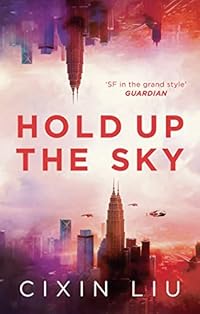
In his foreword to this collection Liu says that until recently SF had been foreign to China, peripheral to the sweep of its history but the changes in the country have made the future ever more apparent and pressing, thereby creating more interest in the genre. The question he is most asked is what makes Chinese SF Chinese in nature, but he does not consider his writing to be about anything other than humanity as a whole. Which would be, of course, what makes it widely readable.
Liu’s stories here (spanning publication from 1985 to 2014) usually have echoes of Wells and Stapledon in displaying temporal or cosmological grandeur. He has no lack of ambition in his speculative ideas but sometimes that detracts from the capacity for emotional engagement with them. He has a fondness for portraying big (though not necessarily dumb) objects, but also a tendency (see *) to inelegant nomenclature – which may be a problem of translation of course – and a slight awkwardness with structure. Almost without exception, though, his stories deal with mind-expanding concepts.
Still, the leading one, The Village Teacher, (乡村教师,) appears strangely old-fashioned to Anglophone eyes and the contrast between the tale of the dying title character inculcating Newton’s three laws in his pupils and its intersection with a millenia-old galactic war between the forces of the Federation of Carbon-Based Life* and those of the Silicon-Based Empire* is fairly stark.
To alleviate environmental and population pressures The Time Migration, (时间移民,) is carried out using cryogenics. Stops at 120, 620 and 1,000 years hence proving unsuitable for various reasons, sights are set for 11,000.
In 2018-04-01, (2018年4月1日, – a future date when Liu wrote it) Gene Extension – which actually cuts out the bits that cause ageing rather than inserting anything – is possible but expensive. Our narrator is triggered by an April Fool joke involving digital nations to commit the fraud that will ensure he has the means to benefit.
Fire in the Earth, (地火,) is about the first project to gasify coal underground for use as an oil substitute and the disaster attendant on that endeavour. The story would work without its coda but arguably that’s the only thing that makes it SF.
In Contraction, ( 西洋,) Professor Ding Yi has constructed a unified field theory which predicts the imminent moment when the universe’s expansion will stop and its collapse begin, but only he truly understands the implications. The premise is far from new (Philip K Dick’s Counterclock World springs to mind) but the story ends with a neat, if obvious, typographical way to illustrate it.
Mirror, (镜子,) postulates the invention of the superstring computer – of infinite capacity. This has allowed simulations of evolutions of universes from different Big Bangs to take place, including of course our own. Liu lays out the implications of such knowledge for human relationships.
Despite its subtitle (An alternate history of the sophon,) Ode To Joy, (欢乐颂 ,) does not mention that concept, familiar from Liu’s Remembrance of Earth’s Past trilogy, at all. Instead a huge ultra-thin mirror appears in Earth’s sky on the day the UN is to be closed for good: a mirror that can turn radiation from nearby novae into music.
Full-Spectrum Barrage Jamming, (全频带阻塞干扰,) is set during a war between a Russia newly returned to Communism and NATO (a war whose cause seems relatively trifling but has to be accepted for story purposes.) NATO’s electronic warfare capability outmatches the Russians who have to resort to the full-spectrum barrage jamming of the title. Depletion of the jamming network leads to a desperate measure in response.
Sea of Dreams, (梦之海,) is almost emblematic of Liu’s style. An ice-ball dubbed the low-temperature artist* arrives on Earth professing interest only in art and proceeds to convert the planet’s oceans into ice-cubes, which it suspends in a ring surrounding the planet (the titular Sea) before leaving humans to deal with their altered world.
Cloud of Poems, (诗云,) has faint echoes of Clarke’s The Nine Billion Names of God in its account of a human telling what is effectively a god that its poetry will never surpass that of the human Li Bai. Its attempt to do so involves programming every possible permutation of the formal rules of Chinese poetry composition and constructing them in a 100 AU diameter model of the Milky Way.
The last story, The Thinker, (思想者,) is the most successful here at integrating the science and speculation behind it with the experiences of its characters and making the reader feel them. A male brain surgeon and a female astronomer meet by chance at an observatory where she is studying the energy fluctuations from stars. Over the years that follow they, almost by accident, make a discovery about interstellar communication.
The following did not appear in the published review.
Pedant’s corner:- “in a pinch” (at a pinch,) “smoking sulfuric acid,” (the technical term is ‘fuming’ sulphuric acid, Liu also describes the smoke as yellow; that sounds more like fuming nitric acid,) “Order of Victories are worth the most” (should be “Orders of Victory are worth the most” but that was in dialogue,) however ‘Order of Suvorovs’ wasn’t, (Orders of Suvorov,) “gunpowder smoke” (gunpowder? From modern munitions?) “lakes of mercury” (on Mercury the planet. Yet the surface temperature is stated to be 1,800 degrees Celsius. The element mercury evaporates at 0C at 1 atmosphere pressure. In a vacuum – or near vacuum such as exists on the planet Mercury’s surface – and specifically mentioned in the text – that would occur at a much lower temperature,) Comanches (is the helicopter’s name spelled differently to the First Nation tribe’s? Commanche,) “1.0 gees” (1.0 gee, or, better, 1.0 G. It would still be ‘gee’ even if its value was greater than 1, since a measurement’s abbreviation subsumes its plural, eg 6 A, or 20 N or 3 m,) “changing from the dark red to orange” (no need for that ‘the’.)



 </center