Archives » Interzone 282

Beneath the World, A Sea by Chris Beckett

Corvus, 2019, 283 p. Published in Interzone 282, Jul-Aug 2019.
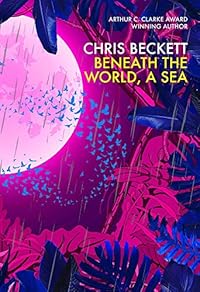
 Beneath the World, A Sea cover

“The ground of one world is the sky of the world below” runs one of the myths and legends of the Submundo Delta, the most inaccessible place on Earth, the Delta Beneath the World. A place of magenta trees with spiral leaves and flowers with bright pink mouths, overhung by a huge sun and moon as if inside a magnifying bubble, and not really below the outside world, it can be accessed only from South America via a long boat trip on the (perhaps too obviously named) River Lethe, passing through the Zona de Ovido, the Zone of Forgetfulness, all memories of which disappear the moment you leave it. The Delta has no radio communication with elsewhere, aeroplanes which try to penetrate its airspace all crash.

Such a cut-off world is a staple of fantastical fiction of course – fairyland, hollow hills, parallel worlds, alien planets and so on – but Beckett’s vision is a fresh take on the sub-genre even if the Delta is a slightly recycled though embellished version of the Caramel Forest of the planet Lutania in the same author’s collection The Peacock Cloak.

The Delta’s local human inhabitants are called Mundinos, and are descended from a group tricked into going there by a Baron Valente in the semi-distant past, long enough ago for them to have developed their own gods in the benign Iya, whose idol adorns every Mundino household, and the less indulgent Boca. More recent incomers are scientists and adventurers or hippie types plus the odd business man on the lookout for profitable exploitation.

Following a UN decree that a Delta life-form known as duendes, grey long-limbed, frog-like flaccid creatures with black button eyes, (somewhat reminiscent of the goblins of Lutania’s Caramel Forest) and which may be the offspring of trees – with which they perhaps form a single dimorphic species – are ‘persons’ entitled to the protection of the law, police Inspector Ben Ronson has been delegated from London to investigate their endemic killing by Mundinos. Duendes can project settlers’ thoughts back into human minds, “‘Things already inside your head ….. become as powerful as things you normally choose to focus on,’” and build enigmatic structures called castelos. Despite their persecution the duendes keep intruding on Mundinos’ space.

What makes all this SF rather than fantasy is the attempt at scientific rationale. “‘There’s no DNA equivalent. No ‘animals’ or ‘plants’ in the delta,’” Ronson is told. “It seemed to him that it was just about possible to imagine that a completely different form of life might not only have a different chemistry and different anatomy, but might even involve the mind-stuff itself being configured in some manner unfamiliar to human beings,” while, “‘the trees and the harts and the duendes and so on aren’t competing against each other … any more than our blood cells are competing against our bone cells,’” but quite why the story is set in nineteen ninety is not clear. The Delta is obviously not quite of this world, making the tale an alternative history does not add to that.

Beckett also undercuts expectations. Despite the set-up what we have here is not a police procedural, nor a straightforward crime novel with a clear-cut resolution, nor indeed an action adventure. The author is more interested in the psychological aspects of isolation, the effect a strange environment has on human behaviour and particularly the influence the Zona might have on motivations and actions. Ronson is almost paralysed by the thought of what he might have done during those four days he cannot remember but is reluctant to consult the notebooks he compiled while in transit.

There are faint echoes here of other odd worlds, perhaps even a nod to Conrad’s Heart of Darkness, there is a touch of Ballard in the detachment of many of the characters. We do not have the complete isolation that applied to the inhabitants of Beckett’s Dark Eden, nor the genetic paucity of that environment, and the existence of the duendes adds a distinctive flavour but at the end the nature of the enigma they represent is not unravelled. Perhaps Beckett intends to return to the Delta.

That might be a misstep, though. Beneath the World, A Sea is not really concerned with its backdrop. Instead it uses that backdrop to question how much a person can know of him- or her- self. While not in the highest rank – the characters indulge in too much self-examination for that – like all the best fiction it explores the nature of humanity.

The following did not appear in the published review.

Pedant’s corner:- “whose contents, she learnt, turned yellow and shrank as it dried” (as they dried.) “Their only child, wherever she went inside the house, she was surrounded by” (that second comma distorts the meaning and should be removed,) outside of (outside, just outside, no ‘of’,) “before continuing towards to the west” (either “towards” or “to”, not both,) “a posse of men and woman” (it’s possible only one woman was involved but it reads oddly,) “for hundreds of millions of year” (years,) automatons (automata,) “‘take it out in the duendes’” (on the duendes,) ambiance (ambience,) a tendency to use ‘her’ and ‘him’ where ‘she’ and ‘he’ are more grammatical, “for goodness’ sake” (if the apostrophe is there it ought to be goodness’s, best to leave it out altogether,) “‘she’ll always being able to support herself’” (always be able.) “There were also a number of” (there was a number,) “all the holes on the ground” (in the ground,) “‘a range of tawdry attractions are duly provided for them’” (a range of tawdry attractions is duly provided,) epicentre (centre,) “cheer fully” (was split over two lines without the necessary hyphen when “cheerfully” was meant,) “‘to see if Rico’s turned up If you run into him’” (needs a full stop after “up,”) “three young woman were smoking” (women,) engrained (ingrained.) “He had a mango in there He’d bought at the last village” (No capital H after “there”, ‘he’d bought’.)
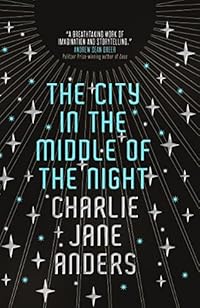

The City in the Middle of the Night by Charlie Jane Anders

Titan Books, 2019 , 485 p. Published in Interzone 282, May-Jun 2019.

 The City in the Middle of the Night cover

We start with a “Translator’s Note” telling us terms have been rendered into Peak English. This both frames the narrative and explains the use of “archaic Earth terms” for alien creatures and the recognisability of characters’ names.

The story itself takes place on January, a planet tide-locked to its star. Its human occupants, who still regard the arrangements on the Mother Ship that brought them there as significant, inhabit the narrow band between scorching Day and freezing Night (wherein monsters lurk.) The ship’s technology that at first sustained them has long been failing though and there are signs the environment is beginning to collapse – corrosive alkaline rain, sudden tornados. The novel’s events are situated mainly in Xiosphant – a repressive rules-based city, “nothing in this city is ever supposed to change” – and Argelo, which is much looser in organization and attitudes (“the city that never sleeps,”) with some scenes in the wildernesses between. Within the book’s seven parts alternate chapters see events from the first person, present tense viewpoint of Sophie, a would-be revolutionary in Xiosphant, and the third person, past tense perspective of Mouth, who thinks she is the last survivor of a society of Travellers known as the Citizens and is lately a member of a band of smugglers calling themselves the Resourceful Couriers, so knows the ways between the cities.

Sophie takes the blame for a theft by Bianca, her friend for whom it is obvious to the reader (though not spelled out in the narrative till near the end) she has deep feelings. As punishment, Xiosphant’s Police Force ejects Sophie from the city into the night to die. A strange encounter with a creature known to January’s humans as a crocodile (though its physical characteristics are very different from that Earth animal) saves her. During this she is somehow enabled to see the creature’s memories, including one of a complex city situated somewhere out in the night.

Mouth is exercised by the destruction of the Citizens, which she witnessed from a distance, especially since it was before they could bestow a name on her. Her attempt to secure their book of customs from Xiosphant’s Palace coincides with the failure of the revolutionaries’ take-over. She, Sophie, Bianca and others have to flee across the Sea of Murder to reach Argelo. This involves curiously cursory action scenes accompanied by extended, and hence unconvincing, dialogue. Sophie’s connection to the crocodiles (whom she names the Gelet) helps save most of them and she receives a bracelet which thereafter keeps drawing her to the night and the Gelet.

The contrast between life in Xiosphant and Argelo is marked but Mouth learns more of her background from a former Citizen, Barnabas, who left the group after achieving enlightenment, “‘The point of religion is to keep trying to reach someplace, the last thing you want is for someone to feel like they’ve reached it.’”

As far as the Science-Fictional meat of all this goes Sophie and Mouth eventually do arrive at the city in the middle of the night – but not until almost four-fifths of the way through the book. In the city they learn of the importance of the Gelet to January’s bio-friendliness – not just from transmitted memories but from a recording left by one of January’s earliest humans, “‘These natives seem to regard geoengineering and bioengineering as two branches of the same discipline.’” A tidal-locked planet would require an air-conditioning system to circulate hot air from the near side to the far side to avoid weather instability and atmospheric disruption. “‘These creatures seem to have created something better, using networked chains of flora and fauna.’” Also revealed is the crucial role the useful substance, known to the Citizens as nightfire since it glowed in the dark, played in stabilising the planet’s biosphere and in the Citizens’ demise. The Gelet’s interest in Sophie is to use her as a bridge between civilisations. She willingly accepts the sacrifice required.

A thought that speaks perhaps to the twenty-first century reader’s awareness is, “‘Progress requires us to curate the past, to remove from history things that aren’t ‘constructive.’ I don’t know if our power to forget makes humans stronger, more self-destructive, or maybe both.’”

The novel starts off intriguingly but it becomes clearer as we go on that the author’s interest is not so much in her imagined world, or her plot, as in the societies and interactions she is depicting – good stuff, but lacking something in urgency. And the book doesn’t so much end as just stop. Perhaps, at a touch under 500 pages, Anders decided she had delighted us long enough.

The following did not appear in the published review:
The sentence, “Here’s what Mouth learned about Sasha from eavesdropping,” ought to have been removed by a decent editing process.

Pedant’s corner:- Written in USian. Otherwise; “something makes me stop and examine closer” (examine more closely,) “I notice someone who seems out of place … They turn their head” (‘someone’ is singular, therefore not ‘they’, in this case ‘she turns her head’,) “now a few s cattered memories” (a few scattered memories,) “a group of students … argue about” (a group argues.) “‘He’s been making a fortune speculating on sour cherries’” (‘speculating in’ something might lead to a fortune, ‘speculating on’ it is just wool-gathering,) “a group of musicians hunch” (a group hunches.) “‘We lay there’” (We lie there; elsewhere Anders shows she does know the difference between lay and lie,) “open maw” (it’s not a mouth!) “their heads almost exploded” (used once, this phrase for an eye-opening experience appears fresh and striking; used again, not so much,) “‘I don’t even know if any Gelet ever want to meet me again’” (if any Gelet ever wants to meet me.) A chapter begins, “Ignore the buzzing from my right wrist, and I take Bianca’s wrist,” (‘I ignore’ makes more sense. This typo probably occurred because the first word of a chapter is always in a much larger font size than the others,) envelopes (envelops,) cul-de-sacs (culs-de-sac,) “which stunk just as much as she’d expected” (stank.)

Interzone 282, Jul-Aug 2019

TTA Press, 96 p

 Interzone 282 cover

In her guest Editorial Kristi deMeester tells how her story in this issue was generated. Andy Hedgecock considers cities in Future Interrupteda. In Aliya Whiteley’s Climbing Storiesb she ponders the mysterious processes that go into constructing – and choosing from – a tbr pile.
In Book Zone Andy Hedgecock lauds Nina Allan’s The Dollmaker as literary fantasy at its most ambitious, erudite and entertaining and also interviews the author, I compare Chris Beckett’s Beneath the World a Sea to the best fiction for its exploration of the nature of humanity but am slightly less enthusiastic about The City in the Middle of the Night by Charlie Jane Anders for lacking something in urgency, Juliet E McKenna finds secondary world fantasy The Resurrectionist of Calligo by Wendy Trimboli & Alicia Zaloga highly enjoyable, Ian Hunter rejoices in the delights of New Maps: More Uncollected John Sladek edited by David Langford, Maureen Kincaid Spellerc respects the novels by Ian McDonald (of which Luna: Moon Rising is the third) but cannot love them and welcomes the SF-ness of AfroSFv3 edited by Ivor W Hartmann but also for the reminder that while society and SF have made great strides in increasing representation recently, there is still some way to go.
In the fiction:-
The Verum1 of Storm Humbert’s story is a new kind of drug which delivers experiences which seem real. The narrator is the purveyor of choice for verum, until Regina comes along. The denouement is not what you might expect from this set-up.
The weasel virus turns women’s reproductive organs to mush while killing them. As a preventive measure all as yet unaffected women have had hysterectomies, hence there will be no new humans ever again. Our narrator is working on a Sesame Street-like TV series called Gumdrop Road which is using the preserved bodies of dead children (their brains implanted with computers connected to their nervous systems) to simulate former normality. This is the world of Can You Tell Me How to Get to Apocalypse?2 by Erica L Satifka. The afterword tells us it has been brought to us by the letter P and the emotion despair.
The Frog’s Prince; Or, Iron Henry by N A Sulway is a kind of modern day fairy tale, or variant of one. The titular frog’s ‘prince’ suffers from an unusual curse: to have “no daughter of a woman born.” After turning the frog into a boy – and a lover – he several times turns him into a woman in order to bypass the curse.
A girl is lost in the eponymous mall of The Princess of Solomon Pond Mall by Timothy Mudie. Living things wink out of existence when she sees them. Her only contact with the outside world is through the food drops and robot parachuted in to her by the military looking to exploit her powers.
In Heaven Looks Down on the Tomb by Gregor Hartmann all human life on Earth has long since been eradicated. Those on the moon survived and now a few of their descendants have come down to Earth to try to harness any possible useful bacteria. Factions on the Moon complicate things, though.
In FiGen: A Love Story3 by Kristi deMeester the titular FiGen is a company which claims to be able to predict the likelihood of a spouse having an affair from a genetic sample. Our female narrator attempts to pre-empt the situation.

Pedant’s corner:- aJeffries’ (Jeffries’s, several instances) “Jeffries’ vision is in tune twenty-first century pessimism” (Jeffries’s vision is in tune with twenty-first century pessimism.) b“that is understandable given situation” (given the situation,) Nichelle Nicols’ (Nicols’s,) Billy Dee Williams’ (Billy Dee Williams’s.) cRobrerts’ (Roberts’s,) Garth Ennis’ (Eniss’s.)
All the fiction was written in USian. 1“a smattering of leaves huddle” (a smattering huddles,) maw (it’s a stomach, not a mouth.) 2“lay down” (lie down.) 3“expensive whiskies[sic] drank neat” (drunk neat,) “as if I needed reminding of whom you were” (extra marks for the use of ‘whom’ elsewhere but here it is the subject of ‘were’; so, ‘of who you were’.)

More From Interzone

 Palestine +100 cover
 Interzone 282 cover

Busy, busy.

Interzone 282 has arrived and it does contain my reviews of The City in the Middle of the Night by Charlie Jane Anders, and Beneath the World, A Sea by Chris Beckett.

By the same post came Palestine +100 edited by Basma Ghalayini, the first ever collection of SF from Palestine. This, along with This is How You Lose the Time War by Amal El-Mohtar and Max Gladstone (see a few posts ago) is for review. To appear in Interzone 283.

Latest from Interzone

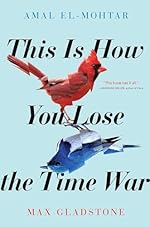
 This Is How You Lose the Time War cover

It’s that time again.

I’m awaiting the arrival of Interzone 282, not least to find out if I’ll have two reviews in it. It seems ages ago I sent off my review of The City in the Middle of the Night by Charlie Jane Anders, and I did the same for Beneath the World, A Sea by Chris Beckett not long after.

Still a new book has arrived for review (to appear in Interzone 283?)

This is a collaboration between Amal El-Mohtar and Max Gladstone and is titled This Is How You Lose the Time War.

Should be fun.

free hit counter script