Archives » Interzone 265

Two Years Eight Months and Twenty-Eight Nights by Salman Rushdie

Vintage, 2016, 296 p. Reviewed for Interzone 265, Jul-Aug 2016.
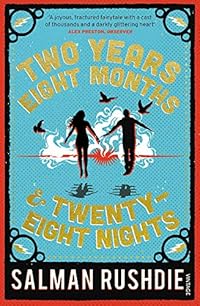
 Two Years Eight Months and Twenty-Eight Nights cover

The title is an indicator, clearly alluding to a famous collection of tales of wonder, promising (as it then does) exotic happenings, digressions, meanderings and stories within stories. Yet it is also somehow unmistakably Rushdian. Exotic but recognisable, aslant but accessible. In any case, I doubt any other present day author would invite comparison to such a well-known set of stories as the Arabian Nights. But the conceit doesn’t come from nowhere. If he perhaps hasn’t addressed the supernatural quite as directly in most of his previous novels there has nearly always been more than a hint of the strange, brushes with the uncanny, in Rushdie’s work. So here we have jinn (not genies, no, we don’t use that word any more) the Grand Ifrits, Zumurrud the Great, Zabardast the Sorcerer, Shining Ruby the Possessor of Souls – so slender he disappears when he turns sideways – Ra’im the Blood-Drinker, the source of all the world’s vampire stories, and the jinnia Dunia, otherwise known as Aasmaan Peri, aka the Sky Fairy and the Lightning Princess of Mount Qâf.

The narrative is couched as a looking back at the legendary time when the seals between the worlds eroded, a great storm struck the Earth and the Strangenesses began. Yet the story begins over 800 years earlier, in 1195, with the arrival at the house of the philosopher Ibn Rushd (Averroes) of a young homeless girl. This was Dunia, indulging her fascination with human men and her capacity for love. For two years eight months and twenty-eight nights they lived as man and wife and produced numerous offspring, whose descendants, all characterised by their lobeless ears, became the Duniazát. Not named after him as, “To be the Rushdi would send them into history with a mark upon their brow.” Ibn Rushd’s dispute with the philosophy of a predecessor, Ghazali, “Only fear will move sinful man towards God,” and who stated that things happen only because God wills them, provides us with disquisitions on God’s nature, “God is a creation of human beings; the clap-hands-if-you-believe-in-fairies principle.” These differences are played out on a grander scale during the war between the worlds that followed the Strangenesses.

During that time rationality crumbled. Some found their feet didn’t touch the ground and might float away so high that they died, others were weighed down so that they became crushed. A baby born during the storm caused outbreaks of sores on anyone corrupt or dishonest into whose vicinity she came. The irrational became commonplace. The Duniazát had inherited some of Dunia’s jinn powers and were invaluable in the final confrontations with the Grand Ifrits. The whole time of Strangeness lasted, of course, two years, eight months and twenty-eight nights.

Lines like, “If I get hurt in this putative affray of yours then I’m not an innocent bystander?” to a policeman from a musician at risk from the incitements of a rabid preacher show that the events of Rushdie’s life so far have contributed mightily to this – as, I assume, theirs must necessarily do for all but hack authors. Yet while the novel contains all Rushdie’s strengths, it also manifests and perhaps magnifies his faults. There is not much restraint here, there is a lot of telling, the treatment is, as ever, consciously literary and full of word play (Lebanonymous; “all the gold, men, in your sacks will not save you.”) Yet the retrospective narrator defuses any tension in the reader as to the eventual outcome. Rushdie also feels it necessary to define FTL despite name-checking eleven masters of the golden age of science fiction.

However, the book is mainly a meditation on the nature of story. “All our stories contain the stories of others and are themselves contained within larger, grander narratives.” “The first thing to know about made-up stories is that they are all untrue in the same way,” (which feels Tolstoyan but is certainly debatable.) “To tell a story about the past is to tell a story about the present.” That stories tell us what we are; we tell them in order to understand ourselves. Quite where the incursion of the supernatural leaves us with that one is rather problematic. “To recount a fantasy is to tell a tale about the actual.” Well, maybe. “If good and evil were external to Man, it became impossible to define what an ethical man might be,” is closer to the mark.

In general Rushdie is at his best when his flights of fancy are tethered more firmly to earthly events, more centred on his human characters which here are too thinly delineated. Two Years Eight Months and Twenty-Eight Nights is pyrotechnic, impressive even, undoubtedly worth reading, but, ultimately, curiously lacking in heart.

The following did not appear in the published review.
Pedant’s corner:- St Sebestian (Sebastian?) Nietzche (later rendered correctly as Nietzsche,) “when the princes’ attention was elsewhere” (yes it was princes, plural, ergo it should be attentions were,) bsattling (battling,) Rossonero, (Rossoneri.) In name (In the name,) one less sad angel face (one fewer – but it was narrated in tight third person,) waitstaff (that’s just a horrible conflation, waiting staff is entirely adequate,) knobkerry (I’ve only ever seen the spelling knobkerrie before,) scent to the lower world (sent.)
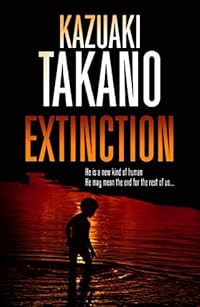
Extinction by Kazuaki Takano

Mulholland Books, 2016, 512 p. Translated from the Japanese ジェノサイド (Jenosaido) by Philip Gabriel. Reviewed for Interzone 265, Jul-Aug 2016.

 Extinction cover

Jonathan Yeager has just finished a tour working for a private defence contractor, protecting VIPs visiting Baghdad – in plainer terms, a mercenary – when he is recruited for a secret mission in Africa. Operation Guardian is to seek out and kill a group who may be infected by a deadly virus but its members are also given the strange instruction to kill on sight a “living creature you’ve never seen before,” a creature which becomes immediately clear is the operation’s real target.

Kento Koga is a pharmaceutical research worker whose father, a virologist, has just died. He receives an email from his dead father asking him to look in a certain book and not to tell anyone. In there he finds an ATM card and a memo informing him about a hidden laptop of which he is never to relinquish control, an address to go to and to expect all his communications to be monitored. The building contains equipment for carrying out Organic Chemistry reactions and he is tasked with researching and synthesising an agonist for a mutant form of the protein GPR769,l to be completed within one month.

Unfortunately the prologue, which describes a meeting in the White House, dissipates any sense of mystery about the reasons for Operation Guardian as it reveals the existence of a new life form (an evolved human, or more precisely a Pygmy born into the Kanga band of Mbuti.) This may lead to the extinction of the human race and of course is seen as a threat to the US. The President here is named as Gregor S Burns but reads as an extremely thinly disguised version of George W Bush, as he ordered an invasion of Iraq and Afghanistan and declared victory before the war was won.

The US security apparatus is also concerned about leaks to human rights organisations concerning extraordinary rendition (a procedure which Takano feels the need to explain to us at length.) A secondary purpose of Operation Guardian is to kill the leaker, Warren Garrett, one of its members, who wishes to intimidate President Burns into stopping rendition/torture by revealing the evidence to threaten him with a war crimes tribunal. We all know this could never really happen and like the text’s attempts to soften Yeager and the other members of the operation is rather limp. These are killers after all.

And the relationship between the two strands? Yeager’s son Justin suffers from pulmonary alveolar epithelial cell sclerosis, or PAECS, which is the fatal disease caused by mutant GPR769. There are occasional passages from other points of view which are only visited the once.

Takano has characters hark on violence’s inevitability. “We project our true colours onto our enemies, fear them, and attack them. And in using violence against others, the nation and religion are the support systems that pardon our actions.” Maybe so; but, “‘War is just another form of cannibalism. Humans use their intelligence to try to hide their instinct for cannibalism,’” Really? Again, “‘Good deeds are seen as virtuous precisely because they run counter to human nature,’” which is definitely arguable. The point is in any case somewhat undermined by Koga’s determination to succeed and the members of Operation Guardian ending up protecting the creature – a three-year old named Akili.

The descriptions of the mechanics involved in undertaking Organic Chemistry are also not convincing. And a month to synthesise a chemical’s agonist from scratch – even with the help of an advanced computer programme – is more than a tall order. The violent scenes, in addition to being curiously perfunctory, read more like reportage at a remove. Then there is the skating over of the ethics of administering an untested drug (actually two drugs; an allosteric agent is also required) on human patients.

Extinction is an uneasy mix of military fiction and thriller. A work of pure SF would surely focus more on the evolved human. Granted, Akili has an undeveloped pharynx and is therefore incapable of speech (though can two-finger type.) He can factorise large numbers into their prime components so compromising the security of encrypted data and communication between computers but otherwise his agency is limited. Not so Koga’s mysterious telephonic prompter, a further link between the two main narratives.

Whether it is a consequence of translation is difficult to determine but the writing is plodding. It is also full of redundancies and meanderings of various sorts such as a disquisition on the lack of remuneration scientists receive for their endeavours. The slightest action is described, information dumping is intrusive, often ad hoc and frequently unnecessary. One phrase read, “Yeager, who’d had reconnoitring training.” Haven’t all soldiers?

As SF, Extinction is nugatory. Action thriller devotees may wish to take a look.

The following remarks did not appear in the published review.

Pedant’s corner:- “the number of US war dead and Burns’s rising popularity were both trending upward” (the word rising does rather imply an upward trend doesn’t it?) “the formal internment of his father’s bones” (interment,) CO2 (CO2,) “a core structure of carbon, oxygen and nitrogen molecules” (a core structure of atoms: oxygen and nitrogen molecules are discrete entities not bonded to other things; ditto a carbon molecule – which would also be a sliver of diamond, graphite, Buckminster Fullerene or graphene,) “he hovered his laser pointer over at the middle of the map” (at it; or over it?) one faction …. are (a faction is,) “we have more of a metallic bond. We’re just atoms moving in a group” (atoms moving in a group? Electrons roaming the structure, not strictly bound to any one atom, is more my conception of metallic bonding,) coversationalists (conversationalists,) homology (homologue,) “lining up the cans of juice he’d just bought on the tatami mat” (he’d bought them on the tatami mat?) “someone was going to force his way in here and grab the laptop away” (grab the laptop,) “he knew right way what they’d done” (right away,) “still had something he wanted ask Sugai” (wanted to ask,) semispherical (usually that’s hemispherical,) lingua francas (the noun here is lingua not franca so linguae – or in English, linguas; plus in Latin the adjective also takes its noun’s case, hence linguae francae,) president (President,) “like an inverted triangle” (triangles have a correct orientation?) dumfounded (dumbfounded,) ecstatic.e (ecstatic,) “the river was hundred metres wide” (a hundred metres,) “the jostling crowd…. were dressed” (the crowd was dressed,) “Yeager looked at this watch” (his watch,) thisnk (think,) “a long thin structure with two benzene rings and one heterocyclic compound” (heterocyclic component; again a compound would be separate.) “Although the allosteric drug used together with it was of a different composition and structure, it was also made up of three cyclic compounds” (three cyclic compounds would again be separate and not part of the same drug,) was mowed down (mown,) half the vocabulary … are foreign words (half is,) if worse came to worst (if the worst came to the worst.)

Interzone 265 Jul-Aug 2016

Interzone 265 cover

Jo L Walton’s Editorial welcomes the arrival of the Sputnik AwardsTM. Jonathan McCalmont rightly eviscerates Becky Chambers’s1 the long way to a small angry planet (its title is not capitalised on the cover) for its self-satisfaction and its lack of challenge. Nina Allan’s Timepiece argues that the canon (both SF and the wider literary one) ought not to be restrictive. In the Book Zone Lisa Tuttle is interviewed, I review Extinction by Kazuaki Takano and Two Years Eight Months and Twenty-Eight Nights by Salman Rushdie while Sofia Samatar’s The Winged Histories, James Lovegrove’s World of Water and Guy Gavriel Kay’s Children of Earth and Sky gain approval.

As to the fiction:-
All Your Cities I Will Burn2 by John Schoffstall is set in the aftermath of a 2042 meteor strike on Earth. Humanity has just about survived. Then strange creatures arise from the sea. This story contains fine speculation about the implications for life on Earth from meteor-borne organisms.
The Eye of Job3 by Dan Reade. An alien tower twenty miles high and ten in diameter “covers most of Omaha.” An air force psychologist is still trying to come to terms with the ramifications.
Belong4 by Suzanne Palmer sees gwenna Thirty-Seven rejected for Placement in QuangEngXorp’s exploitation team despite always achieving the highest marks in training.
The title and subject matter of Ken Hinckley’s on the techno-erotic potential of Donald Trump under conditions of partially induced psychosis does of course invite comparisons with a certain J G Ballard short story. Its setting in a high-rise, its harping on the diesel fumes emanating from lorries on a motorway junction below, not to mention a vehicle crash and the matching style of its attendant author information appendix only add to this temptation. As you might expect it is estranged stuff but, to take up the invitation, Mr Hinckley is no Ballard. (Then again, who is?)
The Inside Out5 by Andrew Kozma. The eponymous structure (aka IO) is an abandoned Dyson sphere to which the remnants of humanity have been transported.
A Man of Modest Means6 by Robert Reed relates the encounter between a woman and a man who are both not what the reader first assumes.

Pedant’s corner:- All the fiction was written in USian. 1McCalmont has Chambers’. 2at loose ends (at a loose end?) “I would expatiate my guilt and despair” (expiate, expatiate means something else entirely,) not thrall to his own fears (in thrall.) 3“covers most of Omaha” (granted the tower would dominate the countryside but I’m sure Omaha is more than ten miles across,) Amos’ (Amos’s,) “behind him are a trio of radio towers” (is a trio,) “None of us do.” (None of us does.) 4“in the line from her shoulder down near her wrist” (to near her wrist?) “the enemies lay there peacefully” (lie there,) 5humongous (more usually humungous?) 6wack job (is usually spelt whack job,) “How would describe that gesture” (missing an “I” after would?) a double “the” in the author information.

For Interzone 265

 Extinction cover
 City of Blades cover

Extinction by Japanese author Kazuaki Takano has landed on my doormat. This is for review in Interzone; to appear in issue 265, Jul-Aug 2016. Mr Takano is another author new to me.

Attentive readers may have noticed I have not yet blogged about City of Blades by Robert Jackson Bennett which I read in February. This is because a shortish review will be published in Interzone’s issue 264 (May-Jun 2016) along with the more usual length review of Ken Liu’s The Paper Menagerie.

free hit counter script