Archives » Interzone 264

City of Blades by Robert Jackson Bennett

Jo Fletcher, 2016, 450 p. Reviewed for Interzone 264, May-Jun 2016.

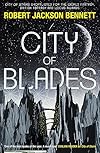
 City of Blades cover

In this sequel (of sorts) to Bennett’s City of Stairs the action of the book is set round the Continental city of Voortyashtan, quite a few years after the events of the previous novel. The Continentals are still resentful of the rule of Saypur and, in Voortyashtan, especially of the cannons threatening its citizens from the ramparts of Fort Thinadeshi.

Saypuri General Turyin Mulaghesh has been recalled from retirement by Shara Komayd, now Prime Minster of Saypur, to investigate the strange goings-on in Voortyashtan to do with a mysterious powdery ore (at first described as a new element) which can greatly enhance electrical conductivity. Komayd’s previous investigator, Sumitra Choudhry, has disappeared and a series of strange ritualistic murders is taking place in Voortyashtan’s hinterland. Examination of the crime scenes rouses Mulaghesh’s guilt at what she did on the Yellow March during Saypur’s war with the Continent.

Voortyashtan was formerly the Continent’s main port but most of the city has been destroyed, sliding into its waters in the event known as the Blink which ended the war. Voortyashtan’s harbour and river are now being cleared by a consortium of Dreyling, the people from the Northern Isles. This project is being managed by Signe Harkvaldsson. The suspicion nags that the Dreyling are only there so that Sigrud from the earlier novel can be dragged into the tale. Bennet has made an effort here to humanise Sigrud a little (Signe is his estranged daughter) but he’s still quite cartoonish; and, while we’re casting aspersions, Thinadeskite is a strangely Wellsian name for the mysterious ore.

Despite its suspicious nature, on close examination the Saypurians can find no trace in Thinadeskite of influence of the Divine who used to rule the Continent. This is as it should be, as all these old Gods are supposed to be dead, killed either in the war or the Battle of Bulikov which ended City of Stairs. Yet the spirit of the Continental Saint Zhurgut still somehow manages to manifest in a guard who handles the gift of a sword meant for Mulaghesh and cuts a swath through Saypuri soldiers and Voortyashtani citizenry alike before Mulaghesh can bring him down.

Mulaghesh’s investigations lead to a scene where the blood – why does it always have to be blood? – of killers (herself, Sigrud and, more surprisingly, Signe) is required to transport her to the Voortyashtani nether world and its City of Blades where she believes Choudhry has gone. There, she uncovers the mystery of Thinadeskite but is too late to prevent an army of the dead from which the ore derives its potency setting out to devastate Voortyashtan. Her trip does provide her the means with which to confront them though.

Mulaghesh has something of a rose-tinted view of the trade of soldiering as a noble enterprise whose standards she fell below during the Yellow March but still strives to uphold. General Biswal, her commander during that march and now in charge of security at Fort Thinadeshi, represents what is perhaps a more realistic tradition of single-minded self-righteousness.

Its treatment of such themes of personal responsibility and the importance of relationships makes City of Blades very readable stuff.

The following remarks did not appear in the published review.
Pedant’s corner:- to not say so (not to say so. Please?) Secret (Bennett meant secrete,) “none of them produce anything” (none produces anything; repeat instances of “none” with a plural verb,) “the figure’s head….. [is] oddly swollen as if their skull is far too large” (only one figure, therefore its, not their, skull. Bennett repeats this use of plural possessive pronouns relating to singular nouns several times,) routing (routeing,) Olvos’ (Olvos’s,) off of (just off, no “of” necessary, multiple instances,) Mulaghesh’js (Mulaghesh’s,) a gazing pool (is a usage I had not come across before; it seems to mean a pool which reflects light,) each of which resemble (each resembles,) “the surface of the waters are dotted with shapes, long and thin and curiously shaped” (the surface is dotted [and shapes/shaped is clumsy],) “the ship is shook” (shaken,) putting the lives … in incredible risk (it’s usually “at incredible risk”,) “he lunges at her piling riposte upon riposte as she just barely manages to parry” (a riposte is a return thrust, not an attack; barely also appeared two lines above,) “the endless line toil up” (a line toils.)
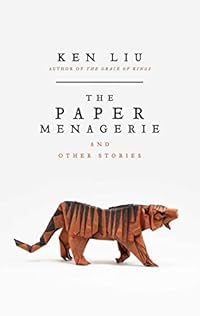
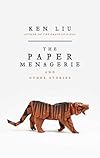
The Paper Menagerie and other stories by Ken Liu

Head of Zeus, 2016, 460 p. £14.99 Reviewed for Interzone 264, May-Jun 2016.

 The Paper Menagerie cover

In the preface to this collection Liu says he doesn’t pay much attention to the distinction between fantasy and science fiction – or, indeed, between genre and mainstream. For him fiction is about prizing the logic of metaphors over (an irreducibly random and senseless) reality; some stories simply literalise their metaphors a bit more explicitly. His position is borne out by this collection’s contents as many of the stories straddle those boundaries. Most are informed and coloured by the author’s Chinese heritage but the first few are more conventional fare.

The Bookmaking Habits of Selected Species is not about gambling but rather the ways in which different species (every sentient species it would seem) produce and consume books. In State Change Rina goes through life keeping her soul frozen in case she loses it – and her life with it. The Perfect Match reads a bit like a 1984 for the digital age. Tilly’s algorithm makes suggestions for you, finds partners for you, remembers for you. Its parent company Centillion’s mission statement is “to arrange the world’s information to ennoble the human race.” Tilly, however, doesn’t switch off.

The only story in the book with no real fantastical content is The Literomancer, who is a Mr Kan, and can tell fortunes via calligraphy. He befriends Lilly, the daughter of a US secret service operative. In 1950s Taiwan that turns out to be dangerous.

Good Hunting is set in late 19th century China, and comes over as a fantasy and steampunk cross wherein a werevixen and her former hunter’s lives become intermittently intertwined. The inventor of the titular technology in Simulacrum disgusts his daughter by using his invention in a debauched way. After their estrangement he keeps a copy of her childhood self, which despite her mother’s entreaties she still finds off-putting. The Regular sees us in gumshoe territory. Police investigators have software to inhibit their emotions and, to access their data for use in blackmail, a serial killer is targeting only those upmarket call-girls who have had security cameras built into their eyes. The police aren’t interested and (the rather programmatically named) ex-cop Ruth Law takes the case.

Multiple award winner The Paper Menagerie gains its title from the collection of origami animals the protagonist’s mother, a mail-order bride from China, made and breathed life into. As he grows, her lack of integration to life in the US embarrasses him so that he neglects his Chinese roots. Partly written in the second person An Advanced Reader’s Picture Book of Comparative Cognition deals with a project to use the gravitational lensing of the sun to search for extraterrestrial signals. This necessitates sending the receiver (and the humans to operate it, one of whom is “your” mother) to a point 550 AU away. The Waves is a strange beast wherein the occupants of a generation starship face a dilemma when life-prolonging technology becomes accessible. This on its own would have been enough for most authors but Liu goes further. When the ship reaches 61 Virginis the rest of humanity has got there before them and its members are so changed new choices must be made. The Japanese narrator of Mono No Aware (Japanese for the sense of the transience of all things) is faced with a threat to the solar sails of the generation starship carrying the last remnants of humanity fleeing from the destruction of Earth.

The longest story in the collection, All The Flavours, has little fantastical content bar the traditional Chinese tales with which it is interspersed in its account of the incoming of Chinese workers to 19th century Idaho and their (ultimately successful) attempts at fitting in. Boasting a Formosan narrator, A Brief History of the Trans-Pacific Tunnel is an alternative history wherein Japan proposed the project in response to the 1930s Great Depression. This being mainly an endeavour of Shōwa era Japan, regrettable incidents occur during its construction.

The Litigation Master and the Monkey King features a peasant lawyer (or vexatious litigant according to taste) who can see and converse with the demon spirit Monkey King. His coming into knowledge of a suppressed book describing the atrocities of the Yangzhou massacre a century before constricts his options. In The Man Who Ended History: A Documentary the discovery of quantum-entangled Bohm-Kirino particles allows the past to be witnessed but the process of doing so destroys the evidence. Its inventor wants to demonstrate to the world the realities of Unit 731, the site of Japanese medical experiments on prisoners during World War 2 in Harbin province. Politics remains politics though.

Liu’s stories are never less than well-crafted, he has an excellent range, and a clear eye for the subtleties of human relationships. You will read worse.

The following remarks did not appear in the published review.

Pedant’s corner:- a team trace out (a team traces out,) “Eliot could not have written, and the world would have understood, Four Quartets without the scent of Eliot’s soul,” (either “not” is missing before “have understood” or the tense is awry – “nor the world understood” instead?) “so much of their lives are lived in..” (so much is lived in…,) over this shoulder (his shoulder,) to not ask (not to ask,) “the jade from which the cups were made had an inner glow to them” (the jade had an inner glow to it,) “all you’ve said simply show” (all you’ve said simply shows,) one of the older man (men,) of of (just “of”,) accused with murder (accused of murder,) Femal (Female? But this was in an extract of a poem in olde style language,) sprung (sprang,) “the flight of neutrons are determined” (the flight is,) “about ten years in age” (of age,) sheepherding (okay; shepherding has a different ring to it,) “a 120 miles per hour” (120 means one hundred and twenty; there is no need to preface it with “a”,) United Stat es (United States,) “more and more evidence … have come to life” (has come to life,) “reformed through ‘re-education’, They were released” (they.)

Interzone 264 May-Jun 2016

Interzone 264 cover

Jonathan McAlmont1 discusses Claire Vaye Watkins’s Good Fame Citrus on the way to concluding that capitalism is similar to a cult. Nina Allan examines film adaptations of J G Ballard novels. In the Bookzone I review Ken Liu’s collection The Paper Menagerie and City of Blades by Robert Jackson Bennett.
In the fiction:-
Starlings2 by Tyler Keevil is couched in the form of a recorded message from a mother to her child, Colum, who is one of the special children designed to leave an Earth doomed to a runaway greenhouse effect by the malfunction of the supposed remedy, the Hadron-Karensky Reactor, for a new start on another planet. Elegiac and
From the (almost) sublime to the hard to credit. Breadcrumbs3 by Malcolm Devlin posits an apartment block and a city suddenly overwhelmed by plant outgrowths and people beginning to change into animals. All of these could merely be the imaginings of viewpoint character Ellie, though.
James van Pelt’s Mars, Aphids, and Your Cheating Heart4 is told from the perspective of a God, who is addressed as “you.” Otherwise the only science-fictional elements it contains are mentions of an ice sheet on Pluto and the movement of a dust grain on Mars (with subsequent avalanche). The story is about a private eye who warms to the subject of his investigation.
Lifeboat5 by Rich Larson. Like many others before it the planet Lazy Susan is threatened with destruction by “synthetics”. A man who helps “rescue” inhabitants from these situations (for money) is faced with a dilemma over rescuing a woman carrying an unusual hybrid fœtus.
The Tower Princesses6 by Gwendolyn Kiste. The titular princesses – whose means of selection are obscure, the process is said to happen overnight – are caged (in materials of various sorts) and have to negotiate life within their restriction. Narrator Mary falls for one of them. The metaphor here is a little overstrained.

Pedant’s corner:- 1Watkins’ (Watkins’s,) “a group of activists are trying to convince” (is trying,) “the group positions itself on the edge of the dune sea and rearrange their vehicles” (“group” agrees with the first verb and not the second, “itself” is not in agreement with “their” so; rearranges its vehicles.) 2birth is used as a verb, anaesthiologist (that would be an anaesthetist, then.) Less respiratory problems (fewer,) “He told me ‘It doesn’t matter now’.” (That should be “He told me, ‘It doesn’t matter now.’”,) phased (fazed.) “He had not wept or showed any sign of emotions (nor shown.) 3”from the where she had lain” (no “the” required,) jimmy open (jemmy,) 4Written in USian – ladybug, sidewalk, skeptical, on the weekends, check (for cheque,) behavior – plus a “soundless avalanche” on Mars (Mars has an atmosphere; there will be sound,) “He must been shot” (must have been,) Tiggs’ (Tiggs’s,) cracks the entire length (cracks [along] its entire length.) 5Written in USian; “poofy” in the sense of voluminous (a usage I had never come across before. It’s not the first meaning that occurs to a Briton.) “That thing is not going to breach right.” (In the context of a birth; so “breech”?) ‘I’m smelling alkaline and vomit’ (alkaline is an adjective [cf acidic,] the noun is alkali.) 6Written in USian.

Latest Interzone Stuff

 The Paper Menagerie cover
 Two Years Eight Months and Twenty-Eight Nights cover

On Monday morning Interzone’s issue 264 dropped through the letter box. This one contains two of my reviews, a normal length one of Ken Liu’s collection The Paper Menagerie and other stories and a shorter one of City of Blades by Robert Jackson Bennett.

Meanwhile, waiting for me on my return from the continent was a copy of Salman Rushdie’s Two Years Eight Months and Twenty-Eight Nights, review to be delivered by the end of the month.

For Interzone 265

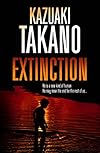
 Extinction cover
 City of Blades cover

Extinction by Japanese author Kazuaki Takano has landed on my doormat. This is for review in Interzone; to appear in issue 265, Jul-Aug 2016. Mr Takano is another author new to me.

Attentive readers may have noticed I have not yet blogged about City of Blades by Robert Jackson Bennett which I read in February. This is because a shortish review will be published in Interzone’s issue 264 (May-Jun 2016) along with the more usual length review of Ken Liu’s The Paper Menagerie.

free hit counter script