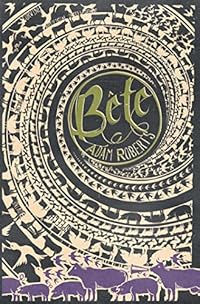
Gollancz, 2014, 320 p. Reviewed for Interzone 255, Nov-Dec 2014.
We know from the epigraph, “You? Better. You? Bête” – attributed to Pete Townshend but given Roberts’s own slant – that we are in for a tale full of word play and allusion; everything from Led Zeppelin lyrics to the riddle of the Sphinx, with nods to previous SF (at one point there is the shout, “Butlerian Jihad!”) as well as Animal Farm.
The novel begins with dairy farmer Graham Penhaligon, who has also trained to butcher his own livestock, having a verbal disagreement with a “canny” cow which does not wish to be slaughtered. This is shortly before such Loquacious Beasts (as the Act has it) are to be legally protected. The encounter makes Graham famous, after a fashion. The advent of speaking animals had come with green activists, “creeping around farms in the dead of night, injecting chips into the craniums (sic) of farm animals.” These bêtes at first spouted authentic sounding phrases, responses of animal rights propaganda, but quickly the chips, by now AIs, develop into something more integrated with their hosts.
It is tempting to find faint echoes in this set-up of Wells’s Dr Moreau but the comparison is too stretched to be truly viable. No vivisection is involved; the chips only have to be ingested to make their way into the host’s brain. Graham reflects that Moore’s Law made this sort of augmentation inevitable but he never believes that the animals are really expressing themselves; it is the computers in their heads doing so. Soon enough bêtes become legal citizens competing with humans for jobs. Along with the almost simultaneous development of synthetic Vitameat, one of the ramifications is that Graham’s farm is no longer viable.
He resorts to a nomadic existence, taking the odd slaughtering job, living (poorly) off the land, his peregrinations bringing him into irregular but recurring contact with Anne Grigson, with whom he falls in love. She has a canny cat, Cincinnatus, which loves its mistress but also exhibits a peculiar interest in Graham.
Graham is prickly from the outset. “Don’t call me Graham,” he tells the argumentative cow – and nearly everyone else whom he meets thereafter. He is especially so with the bêtes he encounters. These internet enabled, wifi-ed animals recognise him instantly, but there is always a hint of menace in it. A shambling incoherent human appears to know Graham but has been chipped; with “higher” animals schizophrenia is the unerring result of such a merger. Dogs, cows, horses are much more suitable.
This scenario gives Roberts scope to comment on humanity’s collective relationship with the biosphere, sometimes through his minor characters, ‘“Animals have feelings and thoughts – it’s just that only now have they been able to bring them out,”’ otherwise through Graham’s thoughts, “Speciesism is more deeply entrenched within us than sexism, and that is deep enough,” “Nature: it’s not nice, it was never nice. Niceness is what we humans built to insulate ourselves from – all that.” Cincinnatus provides the barbed observation, “Misrecognition. It’s what humans are best at.”
At times Bête takes on some of the characteristics of the post-disaster stories associated with British SF of the fifties and early sixties. Also stalking the land and causing AIDS-like panic is the disease, Sclerotic Charagmitis, where mucous membranes scar over, leading to death. The countryside is abandoned to the animals, people huddle together in the larger towns, the regime becomes repressive, but shuts off the wifi too late. There are tales of inter-species war in the north, animals immolated on pyres by the army. In his isolation, Graham does not witness any of this, though.
He makes much of language and his relish of it and notes his is a very English tale. Language is a field, he tells us, and farmers are used to working with fields. A strange aspect of the narrative, though, is its frequent use of archaisms. “And you have brought it me,” wroth, thrice. Sadly, this last appeared only twice.
But Anne dies from cancer, and Graham reflects that the loss of love brings resentment, bitterness, anger, envy. Fair enough, but I don’t quite buy his contention that, for adults, crying is always a performance, intended for an audience. The crux of the novel comes at Graham’s delayed meeting with the leader of the bêtes in the south, an AI in the brain of a very old ewe known (in a piece of somewhat heavy-handed symbolism) as The Lamb, which makes him an offer.
While the essential motor of the plot is that this is a love story, Graham’s relationship with Anne does not come over like a grand passion. Everything is a touch too intellectual; described, not experienced. Bête is good stuff, though, probably enough to ensure Roberts’s usual award nomination.
The following did not appear in the final review.:-
There is reference to a film scene which, though it can be parsed, will only make immediate sense if you’ve actually seen the film. The proof copy I read was absolutely littered with typos, easily averaging one a page. The best of these was “imagining I was in the gondolier of some balloon.” That “gondolier” conveys quite a different image from the one that “gondola” would. We also had “ruptures of the Achilles tension” and riveta for Ryvita. Plus:- lay for lie, apothegms for apophthegms, liquorish (the sweet stuff; not anything to do with alcohol,) and a span.