Archives » Icelandic Fiction

Independent People by Halldór Laxness

An Epic.

Vintage International, 1997, 486 p, plus xii p Introduction by Brad Leithauser. Translated from the Icelandic, Sjállfstaett fólk, by J A Thompson. First published 1946.
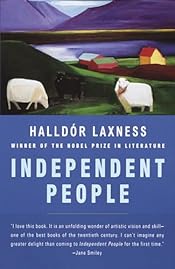
This is the book which established Laxness as the most important contributor to Icelandic literature since the sagas and paved the way for his Nobel Prize. It is the story of the life of Bjartur of Summerhouses, (Gudbjartur Jonsson,) a traditional poet, dedicated to both internal and external rhyming – unlike the new-fangled modern stuff with its simpler structures – and his interactions with family, neighbours, local merchants and the authorities in his determination to be an independent man. His most important relationship though is with his sheep. He is obsessed by them: so much so that he even looks a gift cow in the mouth. Independent People is in part a threnody to a lost way of living, an intense attachment to the land, a frugal kind of existence (in turf-roofed huts with no furniture unless built-in and rotting tables nailed to window ledges) that had lasted over a thousand years.

There is also a crossover element of fantasy as Summerhouses is thought (by all but Bjartur) to be haunted by the legendary fiend Kolumkilli, and his handmaiden Gunnvor or Gudvor. On the way to Summerhouses from Utirausthmyri there is a cairn to Gunnvor where the credulous leave a stone in propitiation. About halfway through the book there is an apparently supernatural act of violence upon Bjartur’s flock. Laxness does not resolve the nature of the culprit one way or the other though there is the later thought that “Supernatural phenomena are most unpleasant for this reason: that having reduced to chaos all that ordered knowledge of the world about him which is the foundation a man stands on, they leave the soul floating in mid-air, where it does not rightly belong.”

The book proper starts with Bjartur, after serving out his time at Utirausthmyri, bringing home his young bride, Rosa, from where she had been in service to the Bailiff. She demands to stop at Gunnvor’s cairn but Bjartur will have none of it. Rosa’s existence at Summerhouses is miserable, not helped by Bjartur’s suspicions that her pregnancy predates their marriage and that therefore he cannot be the father of her child. Rosa’s secret killing of a ewe to provide her with the sustenance which Bjartur does not, precipitates a tragedy and the novel’s central relationship. Bjartur goes out looking for his lost ewe (he knows every single one) and strays too far in a winter storm. When he gets back Rosa is dead and her new born child all but; kept alive only by Bjartur’s dog having kept her warm. He names the girl Asta Sollilja and brings her up as his own.

At the funeral someone recites a version of the Lord’s Prayer which sounds remarkably Scottish in tone, “Our Father, which art in Heaven, yes, so infinitely far away that no-one knows where You are, almost nowhere, give us this day just a few crumbs to eat in the name of Thy Glory, and forgive us if we can’t pay the dealer and our creditors and let us not, above all, be tempted to be happy, for Thine is the Kingdom.” The assembled company converses about the state of Iceland and the loss of youth “to a land even more remote, America, which is farther than death.”

Bjartur marries again and has children of his own but the relationship between himself and Asta Sollilja is strong, endangered only once when on a trip to the nearest town they stay over in the communal sleeping quarters. Asta Sollilja’s fear of the other is such that she huddles close to Bjartur and he nearly succumbs to the temptation of her flesh. His sudden withdrawal and departure to fetch their horse leaves Asta Sollilja wondering what she has done wrong.

Bjartur is so set on independent ways that he will have no truck with the new-fangled co-operative societies and keeps his trust in the merchants he has always used even though they may be fleecing him.

Bjartur’s son Nonni thinks to himself of the adult topics of conversation, “everyone competing with everyone else to get a word in somehow, so as to get at least a little attention, everyone grumbling about parish paupers and the burdens of old folk, who never seemed to die off at a respectable age. And the taxes these days, man alive! They complained bitterly of the extravagant habits of young women, the migration of youth to the towns, the difficult times, the high price of corn ….” It was ever thus. Bjartur himself, “disliked tears, had never understood them, and had sometimes lost his temper over them.”

To these Icelanders the Great War comes as “the most bountiful blessing that God has sent our country since the Napoleonic Wars saved the nation from the consequences of the Great Eruption and raised our culture from the ruins with an increased demand for fish and whale-oil.” The price of sheep and wool increased. Good times arrived.

So much so that Bjartur builds a new house – a project which turns out to be with fraught with problems, doors too small to allow furniture in, no hinges for them in any case, a lack of insulation so that they all freeze in the winter. Such are the trials which assail the man who strives to be independent.

In among all this I was struck by the apparent central importance of coffee to Icelandic hospitality.

The good times pass and a starving man about to take part in a protest tells Bjartur, “Capitalism punishes people much more for not stealing than for stealing,” and Bjartur himself goes on to think “The lone worker will never escape from his life of poverty. He will go on existing in affliction as long as man is not man’s protector, but his worst enemy,” and that, “In its own way misery no less than revelry is varied in form and worthy of note wherever there lurks a spark of life in the world.” In a consideration of life’s inequity we have, “it is utterly pointless to make anyone a generous offer unless he is a rich man. … To be poor is simply the peculiar human condition of not being able to take advantage of a generous offer.”

In a reflection of Bjartur’s times we are given his thought that “Housekeepers differ from married women in this respect: that they insist on doing as they please, whereas married women are required to do what they are told. Housekeepers are continually demanding things, whereas married women may think themselves lucky for getting nothing at all. Most things are considered by housekeepers as being beneath their dignity, but who bothers listening to a married woman if she starts grumbling? No one is any the worse for it but her … and it’s hard, surely, to have to marry a woman just to be able to tell her to keep her trap shut.”

The novel’s title is of course ironic. Bjartur’s story is that of a man who sowed his enemy’s field his whole life. In its relentless unfolding of that life it is a story that will linger in the memory.

Aside: the text somewhat jarringly mentions dollars, a dime, a quarter, even two quarters, terms which jarred with me. I wondered; why not use the names of coins circulating in Iceland (which, being a dependency, actually used Danish currency till 1914)? Usage of Scottish words – bigging, kennings, muckle – made me wonder if the translator was Scottish. I discovered he was born in Berwick. Close enough. Such terms are perhaps appropriate. I have perceived before the similarities between the Icelandic and Scottish experience as expressed in the fiction they produce. In particular description of landscape as here is one of the notable features of the Scottish novel.

Sensitivity note: reference is made to the Negroes of Darkest Africa.

Pedant’s corner:-  quartrain (quatrain,) apothegm (apophthegm,) “waked up” (woken up. Thompson invariably uses ‘waked’ for ‘woken’,) plus points though for ‘homœopath’, insured (ensured,) Guthvor (misprint? Or another variant spelling of Gunnvor/Gudvor?) “Jesus’ names” (Jesus’s,) “this new motive” (motif? It was embedded in a musical metaphor.) “Many a little makes a mickle, as the saying goes” (the saying – in Scotland anyway – is ‘mony a mickle maks a muckle,) “a house build of stone” (built of.)

Paradise Reclaimed by Halldór Laxness

Vintage, 2002, 304 p, plus ii p Translator’s Notes on pronunciation, vi p Introduction by Jane Smiley and iv p Notes. Translated from the Icelandic Paradísarheimt (Helgafell, Reykjavík, 1960) by Magnus Magnusson.

This novel by Icelander Laxness is told in an unusual register almost like a fable or as if it were being recited. But I suppose that’s not surprising given Iceland’s heritage of oral literature in the sagas.

Set in the time of King Kristian Wilhelmsson of Denmark it is the story of a man called Steinar who had a farm at Hlíðar in the district known as Steinahlíðar where stones regularly fell from the mountains and had to be removed from the farmland. Steinar was married and had a daughter and a son. One day a miraculous pony is born to a scrawny mare and it becomes the apple of his daughter’s eye. Nevertheless, he takes it off to where the king is holding a meeting on his only journey to Iceland as a gift to his monarch. The king promises to reward him in a suitable way. On his way home Steinar comes upon a Mormon preaching. This is an Icelandic convert, Bishop Þjóðrekur. From then on the two’s existences are entwined.

As conveyed by Laxness, Icelanders’ attitudes in those days seem very like Scotland’s. “Dancing was the devil’s work.” This sentence is leavened a little by the next, “It was not considered seemly for young unmarried people to tramp on one another’s toes except at most, perhaps, in order to have illegitimate children,” which would have definitely been disapproved of by Scots but the similarity between the two countries is reasserted by the observation that “All life had to serve some useful purpose and the glory of God.”

Just the same, “Love as we now call it had not yet been imported to Iceland.” Not that that was an insuperable barrier. “But nature got its way nonetheless.” Even if potential young partners studiously avoided looking at one another.

Steinar later makes a mahogany box which can only be opened by reciting a poem and resolves to take this to Denmark as another gift to the king but not before unwisely offering Björn of Leirur the use of his farm to pasture a horse. In Denmark he meets Þjóðrekur again and agrees to travel to the US to sample Mormon life for himself, making bricks and changing his name to Stone P Sandford.

On the farm he had left behind his family gets by as best they can until Björn of Leirur brings a whole troop of horses to graze on the land. At that time in Iceland it was apparently the tradition for a woman of the house to help a male visitor remove his clothes before bed. Steinar’s daughter performs the duty but falls asleep in his bed and finds a gold coin on the window sill in the morning. On later nights the coin is silver and, later still, copper. (A girl only receives a gold coin once, you see.) This is an attempt at light-heartedness by Laxness as the girl denies all knowledge of how it happened when the inevitable consequence ensues. The local sheriff is bemused by her adamant refusal to admit anything untoward as she says she was always asleep. Eventually the farm becomes unmanageable and the family, told by Þjóðrekur that Steinar is in Utah, decide to travel to the US. On the ship the girl (her name is never given) has another fantastical sexual interaction after observing that “human virtues do not all reside in the face.”

Since this is in effect a told story (probably better suited to be an audio book these days,) the usual nuances of characterisation are not to be expected. By and large the people on these pages are broadly brushed, their encounters tinged with magical realism. It is a reminder of past times, an exploration of faith and belief, an examination of Mormonism from a skewed angle. It is still a memorable experience.

Pedant’s corner:- “out with the official programme” (that ‘out with’ would be the Scottish word ‘outwith’, no doubt altered by a non-Scottish editor,) a missing comma before a piece of direct speech, aa missing start quotation mark when a chapter begins with a piece of direct speech, “furor” (furore,) “took of his hat” (took off.)

The Atom Station by Halldór Laxness

Vintage , 2003, 186 p. Translated from the Icelandic Atómstöðin (Helgafell, Reykjavik, 1948,) by Magnus Magnusson.

It is a time of political dispute in Iceland. The US has proposed to lease some land for what is always referred to in the text as an Atom Station. Opponents of this plan regard the potential base as a possible target for nuclear annihilation and in any case a sellout of Iceland’s seven-hundred-year struggle for independence. Our narrator Ugla is a country girl from the north who has come to Reykjavík to work as a maid in the house of her Member of Parliament, Búi Árland. She finds him, baldness and all, strangely attractive, his voice alone enough to make Ugla weak at the knees, though she does not express this outwardly. His overbearing wife treats her more or less dismissively. (The domestic environment here for some reason reminded me a little of those in the Norwegian TV drama State of Happiness shown on BBC Four in 2020.) Ugla also has ambitions to learn to play the harmonium and so goes to the teacher’s house to do so. There she meets various people with various parts to play later in the novel.

The Atom Station is a satire (mostly on politics) with heightened descriptions and characters named Brilliantine, the unselfconscious policeman, the organist, Cleopatra, and Two Hundred Thousand Pliers. There is also a strand involving a historical character known as the Nation’s Darling and the prospect of the return of his bones from Copenhagen to be re-interred in Iceland. (When they are it is in two crates – either of which may contain the real bones, or not.)

Ugla’s rich employers vilify Communists, but nevertheless she attends cell-meetings and agrees with the desire of the comrades for Day Nurseries for the nation’s poor. These, of course are derided by the moneyed classes who fail to see why they should pay for the education of the poor.

Ugla remembers, “When we children were little we were forbidden to laugh – out loud; that was wicked.” Furthermore “all cheerfulness which went beyond moderation was of the devil.” To talk about feelings would be “idle chatter,” unseemly. Tears were shameful. Yet later, after Búi Árland has procured his fourteen-year-old daughter an abortion, Ugla, while comforting, her notes her weeping and reflects, “Anyone who weeps does not die; weeping is a sign of life; weep and your life is worth something again.” In this respect rural Iceland is very similar to Scotland. Despite her exposure to a more comfortable existence fripperies are still strange to her. “What is the point of making a picture which is meant to be like Nature, when everyone knows that this is the one thing which a picture cannot be and should not and must not be?”

The text is scattered with sly observations on life. In one of Ugla’s conversations with the organist he says, “‘The reason a man talks is to hide his thoughts,’” and she goes on to tell us, “A man who says what he is thinking about is absurd; at least to a woman.” When someone says he has plenty of money, her reply is, “‘Plenty,’ I echoed. ‘If there is plenty, then it has quite certainly not been well come by.’” The organist has many comments to make, among them, “Nations are not very important on the whole.” He goes on to add that the Roman Empire was not a country, and, “China has never been a country, Christendom of the Middle Ages was not a country, Capitalism and Communism are not countries, East and West are not countries. Iceland is a country only in a geographical definition.” He is astringent on societal arrangements and the abuse of power, “If someone wants to steal in a thieves’ community he must steal according to the laws; and he should preferably have taken part in making the laws himself.”

In a campaign called over the question of the Atom Station Ugla is cynical as electioneering politicians swore they would not give part of the country over to foreigners – “they swore it on the country, on the nation and on history, swore it on all the gods and sacred relics they claimed to believe in, swore it on their mothers; but first and foremost they swore it on their honour. And then I knew that now it had been done.”

She is a strikingly free-thinking woman who, even after becoming pregnant by the unselfconscious policeman and a birth for which she had to go back to a more accepting home, wishes to be an independent person, “neither an unpaid bondswoman like the wives of the poor nor a bought madam like the wives of the rich; much less a paid mistress; nor the prisoner of a child which society has disowned.” “I know it’s laughable, comtemptible, disgraceful and revolutionary that a woman should not wish to be some sort of slave or harlot; but that’s the way I’m made.” She rejects the largesse which Búi Árland offers, “I want money which I have earned for myself because I am a person.”

In the end The Atom Station is not really about politics, and not about Iceland. It is about human relationships and their infinite variety.

Pedant’s corner:- In a footnote; calender (calendar.) Otherwise; a missing comma before a piece of direct speech, fifty minks (I have always understood the plural of mink [the animal] to be ‘mink’, minks would be the plural for the stoles made from their fur,) “I had to muster all my strength not lose touch” (not to lose touch,) “it is an an attack” (only one ‘an’ needed.)

The Fish Can Sing by Halldór Laxness

Harvill Panther, 2001, 252 p, including i p note on pronunciation and ii p map of Iceland. Translated from the Icelandic, Brekkukanstannáll, (Helgafell, Iceland, 1957,) by Magnus Magnusson.

 The Fish Can Sing  cover

There is something almost mythic, or fabular, about the origins of narrator Álfgrímur Hanson, born in the mid-loft of Brekkukot, a dimly lit turf-roofed shack on the outskirts of what would become Reykjavík, and who never saw his mother again, as she was in transit to the US, sponsored by the Mormons or some such. Instead he was brought up by the pair who lived in Brekkukot, whom he called grandfather and grandmother even though they were no relation at all. Grandfather Björn is a lumpfisherman, wedded to the old ways, plying his trade by hand. He never changes the price of his fish; neither when a surplus lowers others’ nor when a shortage makes his catch more valuable. Brekkukot is also a way-station for those with nowhere else to go, packed with adults sleeping in the same cramped space, always available to house those needing a bed. Such is the atmosphere that surrounds him, though, that Álfgrímur does not realise he could be considered poor until almost into adulthood. Not that he ever thought about it, he simply didn’t question Brekkukot’s place in the world.

His grandfather has a firm sense of what is right and proper with his “conviction that the money which people considered theirs by right was unlawfully accumulated, or counterfeit, if it exceeded the average income of a working man; and therefore that all great wealth was inconsistent with common sense.”

In many ways, perhaps due to similarly inclement climates, Icelanders’ attitudes to the world as shown here have something of the Scots sense of endurance about them. Álfgrímur tells us, “I could swear on oath that growing up I never heard the word ‘happiness’ except on the lips of a crazy woman who lodged in the mid-loft with us for a time.” He instances many Icelandic phrases with this kind of sentiment. ‘They have plenty of salt fish,’ = they’re doing all right, ‘Oh, he’s fat enough,’ = he’s well, ‘Oh, you can see it on him’, = he’s unwell, ‘He’s a bit low,’ = he’s more dead than alive, ‘He’s off his food these days,’ = dying of old age, ‘he’s packing his bags now, poor fellow,’ = on his deathbed. When a married couple separated, ‘Yes, there’s something wrong there I believe,’ was said. Or is this stoicism simply due to Álfgrímur’s particular circumstances? “At Brekkukot every word was precious, even the little words.”

The book is set at a time when change is coming to the country yet still before Iceland had gained independence from Denmark. The prickly relationship between the island and its then ruler is alluded to often in unflattering mentions of the Danish king and brought into sharper focus by the sentence, “The only insult that can really rile an Icelander is to be called a Dane.” And Icelanders had apparently always considered what the Pope said about religious faith laughable.

A lot of the novel is taken up with the saga of Garðar Hólm, of Hríngjarabær, close to Berkkukot. He is apparently the only world-renowned Icelander, a singer, known to crowned heads and the Pope. His returns to the island are eagerly awaited, promoted in the newspaper, the Ísafold, but often found to be only rumour or called off at the last minute. Yet he makes unheralded appearances in Reykjavík and the odd visit to Brekkukot. He and Álfgrímur strike up a relationship of sorts, especially after Álfgrímur is employed by Pastor Jóhann as a singer at funerals and learns of the concept of the one pure note. On one occasion he and Álfgrímur even exchange footwear. Yet Álfgrímur notes Garðar Hólm’s rather dressed down appearance. The singer is said to be unmarried (a very minor sub-plot has the daughter of the owner of Gúðmúndsen’s Store – an institution in Reykjavík – hankering after him) but there are also tales of a woman with two children in a hut in Jutland. Garðar Hólm exerts a large influence on Álfgrímur. In one of their conversations, he tells Álfgrímur in relation to wealth that, “The man who is worth anything never gets a jewel,” in another that in encyclopaedias, “murderers, particularly multiple murderers, command much more space than the greatest geniuses and men of intellect.” There are heavy allusions to the possibility that Garðar Hólm’s fame is nothing of the sort and is a sort of trick pulled off by Gúðmúndsen to bolster Icelanders’ thoughts of themselves.

Perhaps it is Álfgrímur’s almost naïve acceptance of things but there is in all this a dislocation almost like that encountered when reading fiction by South American writers. It can’t though be said to be magic realism because the writing is resolutely realistic throughout. There are things undoubtedly lost in translation and others that perhaps only Icelanders could fully understand. But the point of reading translated fiction is to help expand your view of the world. Laxness’s writing fulfils that function very well.

Pedant’s corner:- “the kind of audience he attracted there were” (the kind of audience… was,) “for a long rime now” (a long time, I think,) “‘And for that reason she does not want you not to drown in the Soga Stream’” (omit that second ‘not’,) galoshes (galoshes, x 2,) “a horde of fat men comes running over waving cheque books and hire him” (plus points for ‘comes’ but it then also ought to be ‘hires’.)

free hit counter script