A Thousand Ships by Natalie Haynes
Posted in Other fiction, Reading Reviewed at 12:00 on 28 June 2026
Mantle, 2019, 348 p plus 5 p List of characters, 5p Afterword and 2 p Acknowledgements.
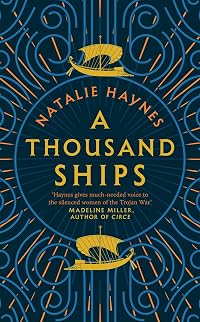
This novel’s title is not particularly apposite – though it does allude to its subject, those Greek tales of the Trojan War – as it barely mentions the legendary ships at all. Instead, its focus is on the women caught up in that conflict and more or less sidelined in all the years since they were first written about. And not simply, like Pat Barker’s Women of Troy sequence, on the Trojan women, but also on the those the Greeks left behind and the Muses and Goddesses said to have influenced affairs.
Thus we have the muse Calliope irritated by the importunings of “the poet” for her to sing for him of the events he wishes to describe (Haynes thereby echoing the usual translation of the Iliad’s opening line, “Sing, Muse, of the wrath of Achilles.”) Creusa, woken by the tumult of the city’s fall, fearing for her five-year-old son and wondering where her husband Aeneas has got to. The captured Trojan women on the shore by the Greek camp, their travails only beginning but intermittently returned to through the narrative. Penthesilea the Amazon, fighting for Troy against the Greeks to atone for being responsible for the death of her sister. Penelope, writing increasingly tetchy letters to her husband Odysseus as his long absence is exacerbated by failure to return promptly on the war’s end and then prolonged on – and on and on – (the poet’s missives suggesting he will use any excuse not to come home.) Chryseis, the daughter of Apollo’s priest, who is befriended by Briseis in shared adversity. The sea-nymph Thetis, mother of Achilles, bemoaning her forced marriage to a mortal and her son’s own mortality. Laodamia begging her husband Protesilaus not to be the first onto the beach at Troy, though she knew he would be. Iphigenia, tricked by her father Agamemnon’s promise of marriage to Achilles into being sacrificed for a favourable wind to set sail for Troy. Aphrodite, Hera and Athene using wiles and false promises to trick Paris into his famous judgement. Oenone, who rescued Paris as a baby after he was abandoned due to the prophecy that he would cause Troy’s downfall. Eris, goddess of strife, setting up the business with the golden apple. Hecabe, Queen of Troy, struggling to accept her new diminished status but still able to revenge at least one of her dead sons. Her daughter Polyxena, accepting her fate with stoic dignity. Cassandra, cursed to see the future as the present and not to have her visions believed. The goddess Gaia resenting the ravages humans wreak on the Earth. Clytemnestra nursing her fury at Iphigenia’s death and preparing her vengeance for it for ten long years. The three Fates spinning the threads of mortals’ lives. Andromache slowly coming to terms with her new life as a slave.
Not a straightforward linear narrative, then, and the many viewpoints and scenes mean the whole thing comes across as fractured and a bit scattershot. This stands in contrast to Haynes’s previous novel The Children of Jocasta which was more tightly focused. The lack of linearity of the storyline works, though, and Haynes clearly has a deep knowledge of her source material.
Her main point, that the sufferings and endurance of the women of these wars (and by extension the women of any war) are as – or even more – heroic than any acts carried out by warriors is certainly worth considering.
Pedant’s corner:- “Odysseus’ nurse” (Odysseus’s,) “Aeneas’ heart” (Aeneas’s,) Briseis’ back” (Briseis’s,) Chryses’ character (Chryses’s,) all names ending in ‘s’ are given s’ rather than s’s for their possessives, “to staunch your bleeding” (stanch,) “each head will open its gaping maw” (stomachs are not usually located on heads,) “‘that Hector deserved to die.’ she said” (‘that Hector deserved to die,’ she said’,) “not known to have expressed regret for any cruelty he had perpetuated against anyone” (he had perpetrated against anyone.)

