Archives » English Fiction

Jamaica Inn by Daphne du Maurier 

In Four Great Cornish Novels, Gollancz, 1984, 185 p.  (First published in 1936.)
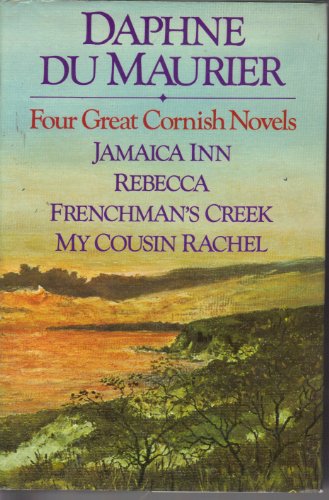
In its set-up this could almost be a children’s story. Protagonist Mary Yellan’s mother has died after seventeen years of widowhood stoically looking after both Mary and the family farm at Helford. With no parents Mary might be footloose and fancy free – as the protagonists of children’s stories tend to be – but her mother’s dying wish was for Mary to go to live with her Aunt Patience at Jamaica Inn. Her sojourn there makes for a deep, dark experience.

The foreboding starts with the driver of the coach taking her there warning of the inn’s ill reputation. She immediately finds Patience’s husband Joss Merlyn to be a boorish, overbearing drunkard and the Inn itself an inhospitable place, taking as it does no customers and having no visitors except those occasional ones Jess warns Mary not to pay any attention to, indeed to hide away from. Not so much “Watch the wall my darling” as cover your face. Mary wants to flee back to Helford and only her concern for Aunt Patience persuades her to stay.

Gradually, during which time Mary explores the countryside around, Jess’s true malevolence manifests itself through drunken confessions – not just a smuggler but a wrecker and murderer to boot.

du Maurier obviously had a love and an eye for the Cornish landscape, which is described in generous, admiring terms. These passages reminded me of Charlotte Brontë’s Jane Eyre, especially when Mary got lost on the moors and was rescued by a clergyman, (here the vicar of Auchtarnun, Mr Davey.) du Maurier’s affection for that work is usually noted in relation to her later novel, Rebecca, a more obvious reworking of Jane Eyre, but the writing in Rebecca does not carry the same visual stimulus.

There is a coyness to Mary’s interactions with Jess’s brother Jem, and a scarcely believable reticence to the way in which she is treated by Jess’s smuggling associates; but the book was first published in the 1930s – which does make it a little surprising that the villain of the piece (who in truth from his first appearance was not difficult to decipher as such) tells Mary that he found “Christianity to be built upon hatred, and jealousy, and greed …. while the old pagan barbarism was naked and clean.”

Notwithstanding my observations on du Maurier’s treatment of landscape above there were times when I found the novel – for a so-called classic – to be a touch overwritten.

Pedant’s corner:- the text repeatedly refers to Jamaica Inn’s tall chimneys. The illustration at the story’s start has small chimneys. Otherwise; “when the first cock crew” (crowed,) waggons (many times. I know it’s an acceptable alternative but since the first time I saw the word it was spelled ‘wagons’ I have always persisted in the belief it should have only one ‘g’,) “‘for my husband sake’” (husband’s sake,) to-morrow (nowadays unhyphenated,) havered (not used in the Scottish sense of talking nonsense but more like ‘tarried’.)

Passing On by Penelope Lively

Penguin, 1990, 214 p.

 Passing On cover

Helen and Edward Glover have into middle age lived with their overbearing mother Dorothy (from whose clutches their younger sister Louise had long since escaped by marriage) in a crumbling pile called Greystones which has an accompanying area of land known as the Britches. The novel starts at Dorothy’s funeral with Helen reflecting, “Eternal life is an appalling idea, especially in mother’s case,” and thereafter traces the lives of Helen and Edward in the following weeks. Helen has a part-time job at the local library, Edward teaches at a nearby girls’ school but it is their inner lives which foreground the book.

In its initial stages the novel is deceptively light in tone, like a cross between The Shell Seekers and The New Moon with the Old, but as it progresses it develops an accumulation of detail which underpins its seriousness.

The terms of Dorothy’s will come as a shock. She has left Greystones to Louise’s teenage son Phil, now in that rebellious stage, adorned by a black crest of hair streaked with green, but with Helen and Edward having the right to live in the house until death. Only the Britches has been left to the Glovers. This is in one sense suitable as Edward has always felt more at home with nature than people (“the natural world thinks nothing and neither laughs nor cries,”) awkward at dealing with the world, and Helen is increasingly brought into the company of solicitor Giles Carnaby through dealing with the probate. She finds herself falling for him. She still sometimes sees her mother in the house and hears Dorothy’s voice in her head commenting on her foolishness. Dorothy’s classification of girls had been, “Pretty was best, clever was worst.” Her disparagement of any friend – especially male – Helen might bring home made sure she stopped doing so. While clearing out a cupboard Helen finds that Dorothy many years ago, by accident or design (but the narrative leaves little room for doubt which,) prevented an attachment developing by not passing over a letter Helen had received from Peter Datchett. Running in and out of the narrative is local builder Ron Paget, whose yard neighbours Greystones, and who is always out for the main chance and has perennially had his eyes on the Britches as ripe for development.

The interactions of the characters can verge on the seemingly mundane, Helen’s almost adolescent infatuation, her does-he doesn’t-he should-I-contact-him thoughts, Giles’s slipperiness, the hints at and revelation of Edward’s true nature, Louise’s battles with Phil, his blossoming at Greystones when he comes to get away from mum for a bit, Ron Paget’s persistent unsubtle attempts to wheedle the Britches out from under the Glovers, but the picture they build becomes more and more compelling.

I would say this does not quite achieve the heights of excellence which the same author’s Moon Tiger did but is another demonstration that quiet lives lived (more or less) quietly still have their dramas and deserve recording.

Pedant’s corner:- frequently commas were missing before pieces of direct speech, Windowlene (for the glass cleaner. It’s spelled ‘Windolene’,) a mack (this abbreviation for mackintosh is usually spelled mac,) “from whence” (whence means ‘from where’ so ‘from whence’ would mean ‘from from where’. I know the two words appear as such consecutively in the text of a hymn but that doesn’t make it correct.)

Sense and Sensibility by Jane Austen

Guild Publishing, 1980, 280 p. First published in 1811.

Expectations count. When you’re told something is good – excellent even – your anticipation is heightened, but perhaps also tinged with the thought, ‘Well go on. Impress me then.’

So what do you say about an acknowledged classic of English literature? Well, the first thing is that the past was different. This was written over two hundred years ago. They did things – and wrote – differently there. There is a prolixity to the prose here also present in Walter Scott’s novels (an only slightly later vintage) – though Austen is by far the better stylist and aphorist – yet to begin with I found this more of a slog than Scott and the similarly vintaged Mary Shelley stories I have read in the past few years were a smooth read by comparison. I don’t suppose my familiarity with Sense and Sensibility’s plot due to TV series and film adaptations helped with this.

For expectations count. I had been told that Austen’s dialogue was exquisite, but what I found in the first few pages was very little in the way of dialogue but instead, screeds of exposition, a large amount of telling rather than showing; backgrounding if you like, but still.

I don’t give up on books though. Not even poor ones. And this is by no means a poor book. It just didn’t grab me overmuch.

People don’t change, but social circumstances do. The constraints Austen’s characters – and the author herself in the writing of them – were under are/were formidable. She was writing for her time and a degree of prolixity would have been welcome back then.

Sense and Sensibility demonstrates behaviours recognisable today – Mrs John Dashwood’s selfishness disguised as concern for her offspring, well-meaning but overbearing neighbours, imputations derived from the slimmest of evidence, money driving people’s motivations. The centre of the main plot, though, Marianne Dashwood, is seen through her sister, Elinor’s, eyes and is shadowy as a result, Colonel Brandon, nearly always off-stage, seemed more of an absence than an agonist in the book, Willoughby’s attempts/protests at self-exculpation, though underlining his cupidity, are an unlikely ploy.

I’m not giving up on Austen, though. My expectations tempered, my exposure to her style as a prime, I’ll need to see what I make of the rest of her œuvre in the light of those.

Pedant’s corner:- There are some 1811 spellings – ‘dropt’ ‘wrapt’ ‘farewel’ ‘stopt’ ‘befal’ ‘seisure’ sooth for soothe etc, sprung for sprang and sunk for sank, but some which may be exclusively Austen’s, ‘chuse’ (but ‘choose’ also appears,) ‘scissars’ ‘wo’nt’ (but ‘won’t’ elsewhere) ‘stilish’ ‘expence’ (yet expenses for the plural, and, later, expense for the singular,) ‘extatic’ (but ‘ecstasy’ and ‘ecstacy’ later.). Otherwise; the Miss Dashwoods, the Miss Careys, the Miss Steeles (the Misses Dashwood, the Misses Carey, the Misses Steele,) “carried away be her fancy” (by her fancy,) “the whole party were assembled” (was assembled,) “in whatever shop the party were engaged” (the party was engaged,) “these kind of scrutinies” (these kinds of scrutinies,) a missing comma before a piece of direct speech, “in her way to the carriage” (on her way sounds more natural to me.)

free hit counter script