Archives » Elena Ferrante

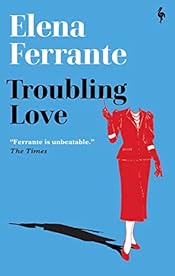
Troubling Love by Elena Ferrante 

Europa Editions, 2022, 135 p. Translated from the Italian L’Amore molesto (Edizioni e/o 1999) by Ann Goldstein.

Troubling Love was Ferrante’s first novel. It is narrated by Delia, whose parents’ marriage had always been troubled by her father’s jealousy of her mother Amalia’s attractiveness to men, in particular to a man named Caserta who acted as selling agent for the cheap pictures, mainly of gypsies, which Delia’s father painted for a living.

The events of the novel range over decades taking in Delia’s memories of her life growing up but mainly describe the aftermath of Amalia’s death by drowning – apparently suicide – clad in only a new bra. This aspect puzzles Delia since her mother had not been one for indulging in new clothing; make do and mend was one of her characteristics.

A cache of new clothes (possibly bought for her by Caserta) in her mother’s apartment is all the more puzzling because they seem to have been intended for Delia to wear but show signs of Amalia having at least tried them on.

All this sends Delia off on a quest to find Caserta; and the truth about her mother and father’s life. There are foreshadowings here of Ferrante’s later and more famous Neapolitan Quartet (see reviews, here, here, here and here.) A certain claustrophobia in the setting, dark goings on in normally deserted parts of buildings, an interest in older men but in this one Ferrante displays more of a lack of squeamishness about bodily secretions. There are visceral details about Delia’s unusual bodily reactions to stress.

Unlike in the Quartet though, Troubling Love is about the difficulties of shaking off the influence – and inheritance – of parents. For a first novel it is very accomplished indeed.

Pedant’s corner:-  Translated into USian, “sawed off” (sawn off.) “I let each stitch become unsewed” (unsewn.)

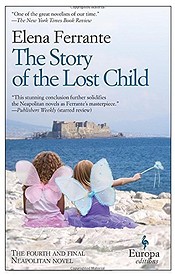
The Story of the Lost Child by Elena Ferrante

Europa Editions, 2015, 462 p, including v p List of Characters.

Book Four, The Neapolitan Novels Maturity, Old Age. Translated from the Italian Storia della bambina perduta (Edizione E/O, Rome) by Ann Goldstein.

This is the last of the author’s Neapolitan Quartet chronicling the divergent lives of two schoolfriends, Lena and Lila, both of whom had literary talent but only our narrator, Lena (Elena Greco,) had the encouragement to take her education beyond elementary school and so make a career for herself as an author. The first instalment, My Brilliant Friend, I found too bogged down in minutiae, the second and third were less irritating on that score but in this one I felt we were again at times provided with too much detail: paradoxically so as the time-scale covered here is more elongated, ranging from the main characters’ maturity into older age. While many incidents are described minutely much of the material is told to us rather than shown. Had all the cardinal incidents been presented in the way that Ferrante obviously thinks were the important ones though, the book would have been far too unwieldy.

The Neapolitan Quartet is not just a portrait of a friendship, or of a mother’s guilt at not always being present for her children in order to advance her career, a guilt which Elena certainly feels; it is also a comment on the times Elena lived through, the struggles women have to be recognised as worthy. “To assert myself I had always sought to be male in intelligence – I felt I had been invented by men, colonised by their imagination.” Yet Lila’s success in her computer business is entirely of her own making. (In a demonstration of how much things have changed over the years the books span Lila at one point shows Lena how to use a word processing programme. A magical experience. Elena describes the miraculous transformation of thought into words appearing on a computer screen, so unlike typewriting. A miracle now absolutely taken for granted.)

Ferrante also gives us a reason, beyond perhaps writing what she knows, for setting her quartet in what, since we do not know her real identity, we must assume is her home city. “Naples was the great European metropolis, where faith in technology, in science, in economic development, in the kindness of nature, in history that leads of necessity to improvement, in democracy, was revealed, most clearly and far in advance, to be completely without foundation. To be born in that city …. is useful for only one thing: to have always known, almost instinctively, what today, with endless fine distinctions, everyone is beginning to claim: that the dream of unlimited progress is in reality a nightmare of savagery and death.” Lila is particularly clear-sighted about this but it takes Elena longer to come to it.

Elena has a further realisation that the politics which had seemed so important to the characters’ youth and which continue to thread the background of the book have become passé. “The old skills … suddenly seemed senseless. Anarchist, Marxist, Gramscian, Communist, Leninist, Trotskyist, Maoist, worker, were quickly becoming obsolete labels or, worse, a mark of brutality.”

Most brutal in this context though, was the triumph of the opposite political mode of thought, “The exploitation of man by man and the logic of maximum profit, which before had been considered an abomination, had returned to become the linchpins of freedom and democracy everywhere.”

In one of their conversations Lila offers Elena a way to ease her mother’s anguish at the thought of death and being unable to look out for her children any more,
“‘Comfort her.’
‘How?’
She smiled.
‘With lies. Lies are better than tranquillisers.’”

Elena’s relationship with the love of her life, the object of her adolescent infatuation, Nino Sarratore, for whom she leaves her husband, is the fractured core of that life, the source of a mostly unspoken friction between Lila and herself, his inveterate womanising made unmistakably plain when Elena comes upon him in the act with their much older housekeeper/nanny. Then again, “love and sex are unreasonable and brutal.”

Maturity brings Elena an insight she perhaps ought to have had earlier – certainly Lila did, as she evinces knowledge of male weakness or is at least less blind to the tendency, or more likely simply protecting her friend from hurt (in which of course she fails.) “Even the most brilliant men sooner or later turned out to be disillusioned, raging at a cruel fate, witty and yet subtly malicious.” This doesn’t stop Elena continuing to have relationships with them however; late in the book she mentions her latest lover.

How Elena’s daughters Dede and Elsa (both of whom she had with her husband) and Nino’s child Imma, fare is one of her eternal preoccupations, juggling their welfare with her commitments to writing and binding her more closely to Lila.

The central event of the book, though, the one which gives it its title, the one which marks Lila ever after and which heightens her observations of dissolving boundaries, her sense of marginalisation, comes suddenly and is never resolved. And while Elena clearly thinks the dissolving boundaries are important (or else why mention them?) she never delves into exactly what Lila means or whether there may be an explanation for them.

But Elena reflects, “Unlike stories, real life when it has passed, inclines toward obscurity, not clarity.”

Pedant’s corner:- Translated into USian. “she wanted to know how far my knowledge when it came to meaning of the words I had uttered” (is missing ‘went’ after knowledge and ‘the’ before meaning,) “had showed me” (xb2, shown,) “leading him into a mad love for her, for him” (I have no idea why that ‘for him’ is there,) “‘I also know you you’re with’” (know who you’re with,)
Those Who Leave and Those Who Stay by Elena Ferrante

Book Three of The Neapolitan Novels. Middle Time.

Europa Editions, 2015, 411 p, including vii p Index of Characters and Notes on the Events of the Earlier Volumes. Translated from the Italian Storia di chi fugge e di di chi resta, (Edizioni E/O, 2013,) by Ann Goldstein.

This book carries on the tale of the life of Elena Greco, friend to Lila Cerullo, here following Elena into marriage and motherhood and illuminating Italian life in the late sixties/early seventies. Her husband is Pietro Airota, from a relatively well to do and influential family. The contrast between his background and hers, his atheism (which Elena shares) and her family’s traditionalism is illustrated when they visit Naples pre-marriage. On this visit, an acquaintance in Naples makes references to the dirty pages in her novel, whose publication came in the previous book, as being brave (but also true.) The novel itself, even the fact she left, would be enough to make her different but those pages mark her out, stamp her in the eyes of some of those she left behind as unworthy, tainted, all but a whore. Then a piece on industrial conditions in the sausage factory where Lila works is accepted by the newspaper L’Unità and brings her more attention/notoriety.

Married sex is a revelation for Elena. Though not a virgin, she had not had sex with her husband before the wedding and he is, to say the least, an unsympathetic lover. The birth of her first daughter, Adele, later pet-named Dede, brings the crushing responsibility of motherhood; the baby is unable to feed properly, her husband retreats into his work. Elena’s inability, and his reluctance, to cope requires the employment of a housekeeper/nanny. The novel Elena cobbles together in these circumstances is unpublishable, the lifeless articles she submits to L’Unità rejected. A second baby, another daughter, Elisa, is less trouble.

This was a turbulent time in Italy, with political violence referenced many times here. (As it also was in Europe; Rudi Dutschke and Daniel Cohn-Bendit are given a mention.) I did wonder how the political discussions and attitudes here (not to mention the atheism though that is more skated over) went down with Ferrante’s US readers as the left-wing leanings of most of Elena’s circle are fairly pronounced. Perhaps it is outdone by the feminism she comes to feel – both practical in her marriage situation and theoretical in the discussions she has with other women – especially in her writing, “no-one knew better than I did what it meant to make your own head masculine so that it would be accepted by the culture of men: I had done it, I was doing it,” which would certainly strike a chord.

Ferrrante’s Neapolitan Quartet has been widely discussed as a dissection of female friendship yet for many pages at the start of this instalment Lila is all but unmentioned. However, Elena is called to her side when Lila becomes ill (worn down by working at the sausage factory) and immediately goes to succour her and the blanks in Lila’s life in the interim are filled in. From then on, apart from a crucial incident where a decision by Lila reveals her in her complexity as almost unknowable, certainly unpredictable, they communicate mainly by telephone. Lila and Enzo, the man she lives with, teach themselves computing and begin to make a niche for themselves in the nascent computer industry. The dissolving margins which Lila once mentioned to Elena, when she feels people round her becoming insubstantial (and which may be the key to her personality) are here referred to only once.

As in the foregoing Neapolitan novels there is a density here of apparently lived experience, a proliferation of detail, a fecundity of (re)construction, a layering of a life apparently recollected. As if to comment on this Lila tells Elena after her confusion over that decision of Lila’s, “But when do people ever speak truthfully and when do things ever happen unexpectedly? You know better than I that it’s all a fraud and that one thing follows another and then another.”

The ambiguity of the friendship (of all friendships?) is addressed when Elena herself tells us at the book’s crux, “I had wanted to become something – here was the point – only because I was afraid that Lila would become someone and I would stay behind ….. I had to start again to become, but for myself, as an adult, outside of her.” The relevance of Nino Sarratore – with whom Elena has been besotted since her teenage years but who had an affair with Lila in Book Two – to this epiphany is not unravelled by the book’s ending which mercifully has less of the cliffhanger element the first two instalments had but which still leaves Elena’s life situation unresolved.

Pedant’s corner:- Marirosa (elsewhere always Mariarosa,) legitimatized (legitimised,) “and thought, She was once a pretty girl” (context suggests ‘and I thought, She was once a pretty girl’,) missing question marks at the end of sentences which are questions, “rather than aiming Stefano and his money” (aiming at Stefano.) “And at least Enzo in front of him, in the factory, women worn out by the work, by humiliations, by domestic obligations no less than Lila was.” (as a sentence that is missing something which would make it clear what it was meant to be saying,) “secretary of the union local” (in English ‘of the local union’ is more idiomatic,) “as if” three times in four lines, Vesuvio (x 2, usually ‘Vesuvius’,) waked (woken,) insured (ensured,) “men with drooping mustaches [sic] and a cloth cap on their head” (and cloth caps on their heads,) parallelopipeds (my dictionary categorises this variant spelling of parallelepipeds as ‘improper’.)

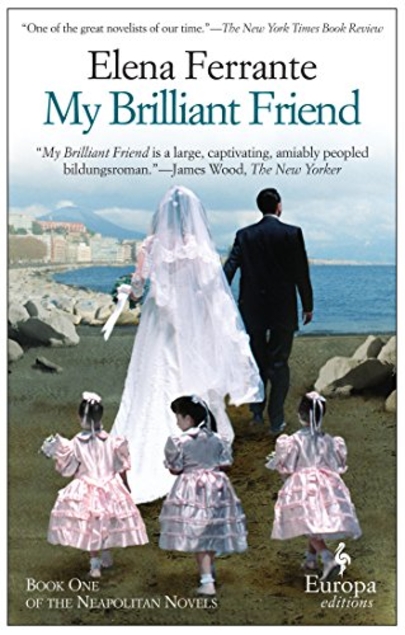
My Brilliant Friend by Elena Ferrante

Europa, 2012, 328 p. Translated from the Italian L’amica geniale by Ann Goldstein.

Book One: Childhood, Adolescence.

My Brilliant Friend cover

Ferrante’s writing – especially her Neapolitan Quartet, of which this is the first – has been attracting a lot of attention if not hype. The mystery surrounding her identity – Ferrante is a pseudonym whose real-life counterpart has not revealed herself – is one of the elements in that I’m sure.

This volume is the tale of two childhood friends growing up in the back streets of Naples – not quite two children dressing in rags but poor certainly. Our narrator is Elena Greco, daughter of a porter, her friend is Lila Cerullo, the shoemaker’s daughter. Lila is gifted intellectually – at least according to Elena – but does not progress at school, as she decides not to. (Not that her parents would have allowed her to.) Elena is given every opportunity by her teacher who persuades her parents to allow her to continue her education beyond the normal for her milieu.

While still young Lila reveals to Elena the conspiracy of silence about before, before the war, before they were born, seeing all her elders as complicit. Elena realises, “Without knowing it, they continued it, they were immersed in the things of before, and we kept them inside us, too.”

Through Elena, Ferrante is good on the absurdities and embarrassments of puberty, the lack of control over the body and of how others perceive you. In time and in contrast to Elena, Lila begins to exert a magnetic attraction on all males. She is well able to defend herself (and Elena) against any unwanted advances however. She throws herself and her talents into designing shoes but her father has no faith in their ability to sell and scorns the possibility. Elena’s continuing education and the necessary separation as the new higher schools are across the city gradually puts a distance between the pair.

An element of fantasy – undeveloped in this volume – appeared when on New Year’s Eve 1959 Lila experienced what she will later describe to Elena as dissolving margins. To her the outlines of people suddenly dissolved, disappeared. How much this contributes to Ferrante’s overall story arc I can’t say but her story-telling in general I found irritating. There was too much telling not enough showing, too much concentration on boring minutiae – every test score Elena ever got seems to be included. In addition there were many cases in which the characterisation was lacking. There is an index of characters – inserted before the novel proper – so that you can tell them apart by name but many of them, the young males especially, do not stand out from each other on the page. I felt too that there was a stretching towards significance in phrases like, “there are no gestures, words, or sighs that do not contain the sum of all the crimes that human beings have committed and commit,” and “‘When there is no love, not only the life of the people becomes sterile but the life of cities,’” which actually don’t bear scrutiny. Moreover the book ends on a point of imminent conflict. Yes, there are three more instalments of Ferrante’s quartet to go but this still felt like a breach of the contract between writer and reader.

I would agree that as a social document of a time and a place, of certain attitudes, My Brilliant Friend is interesting enough but despite that “cliffhanger” I wasn’t moved to seek out further instalments with any alacrity.

Pedant’s corner:- The text has been translated into USian. Otherwise; “an anti-gas mask” (this may be a literal translation of the Italian, but the English term is simply, gas mask.) “To not be second.” (Not to be second,) pubis (is the pubic bone not the pubic area,) knickers (conveys a different meaning to a British reader than the knickerbockers or plus-fours I took it was intended,) an useful (technically correct I suppose, but not a common usage,) Aeneas’ (Aeneas’s,) a missing comma before a piece of direct speech.

free hit counter script