Mrs Osmond by John Banville
Posted in Other fiction, Reading Reviewed at 20:10 on 1 August 2023
Penguin, 2018, 380 p.
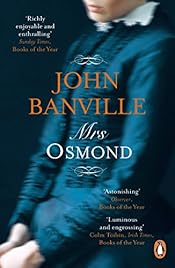 Against her husband’s express wishes Mrs Isabel Osmond has travelled from her home in Rome to the death bed of her cousin at Gardencourt in England, thus shaming Mr Osmond (in his eyes) before the world. He is accustomed to being the controlling power in the marriage – and in life indeed, brooking no gainsaying of his opinions. His overbearing nature even affects his sister, Countess Gemini, though she is married herself. The cousin concerned, Ralph Touchett, had bestowed half his fortune on Isabel, a bequest his part in which up until recently she had not been aware. It was that fortune, though, which had caused Gilbert Osmond to court and marry her.
For Isabel the marriage is now over. On the point of her leaving Italy, Countess Gemini had revealed to her the true relationship between Gilbert and Selena Merle, the woman who had introduced them to each other, and the murky circumstances surrounding the death of Gilbert’s first wife and the birth of his daughter Pansy. Now she means to make her own way in the world with the benefit of her bequest.
I usually like Banville’s novels but there was something about the telling of this one which did not appeal to me. It seemed overwritten, executed with a sort of fussy precision, as if he had not merely set his book in late-Victorian/Edwardian times but was trying to replicate the style of an author from that era; Edith Wharton perhaps, or Henry James (neither of whom I have read – though I have seen some film adaptations.) Then I remembered the epigraph is from James – The Portrait of a Lady to be precise. It was not until after I had finished this novel that I checked and indeed Banville has here written a sequel to that book, presumably in James’s style, since he has said James is one of his influences.
Knowledge of The Portrait of a Lady is not required in order to read Mrs Osmond, (after all I had none.) Banville’s novel can stand perfectly well on its own. His depiction of character is superb as usual, his evocation of the times convincing, but I am left to wonder how much of what is unveiled here was in James’s book and how much is due to Banville’s fertile author’s mind. I will say, though, that the experience will not make me rush to read from James’s oeuvre.
From the thought Isabel had of crowds in the Louvre “scurrying from one masterpiece to the next” giving her “the impression of one of those grand lycées of which the French were so self-satisfiedly proud, wherein on the morning of yet another national insurrection, the pupils had murdered their monitors,” I gather that Banville, too, has noticed the French penchant for revolution, for taking to the streets. (I call it their national sport.)
Pedant’s corner:- “‘That would be young Mr Touchett. Henrietta spoke of him to me’” (Mr Touchett had already been referred to earlier in the same conversation, so the latter sentence is superfluous,) “my frail bark struck upon the rocks” (barque, that would be,) quitted (several times, quit; though of course Isabel is USian so no doubt would have said or thought ‘quitted’,) tête-a-têtes (the plural of head-to-head surely ought to be heads-to-head? têtes-a-tête.)
