Archives » Dundee United

Dundee United 2-1 Dumbarton

SPFL Tier 2, Tannadice Park, 22/10/16.

This was an unusual occurence. The last time I was at Tannadice to see the Sons (or at all) was over thirty years ago. (We did play there in the 1995-6 season but I didn’t go. A combination of the fact that that was during the time where we went a whole year without a win and my family was quite young.)

The end result was the same. We still haven’t won in Dundee since 1958.

They had a beginning flurry – Alan Martin with a superb double save – then we had a great chance, Garry Fleming stabbing the ball from close in but the keeper made a great save. Then Robert Thomson sent a header towards the post area which the keeper again clawed away and David Smith couldn’t connect properly with a ball that came to him after a corner. Martin again did the needful to keep out a free-kick.

The best bit about the first half was the seethe from the home support at their forwards continually being flagged offside. With their pace there was no need to even be close to an offside position.

At half-time I was slightly disappointed that we weren’t ahead.

The blows came equally spaced around the hour mark. Mark Docherty misjudged a header from a corner and it flew into the net. Their second was also from a corner. Our players were slightly late to react to Willo Flood running up from his halfway line. His free header across goal was turned goalwards but Alan Martin saved it. Unfortunately the rebound fell to one of them who couldn’t miss.

Despite a two goal lead they still couldn’t make any impact on us from open play. We did though, sub Andy Stirling’s cross deflecting to a perfectly placed Robert Thomson to bundle the ball below the keeper. They looked a bit nervous after that but we couldn’t make any more clear chances. Even so Sam Stanton was obviously held back when going through but no free-kick was forthcoming. Not the only odd decision by the ref in the game.

So our players scored two goals, theirs one. We scored from open play they didn’t. The team performance was good but we shouldn’t beat a team like Dundee United at their place. Still, it felt like at least a point lost.

St Johnstone 2-0 Dundee United

Scottish Cup Final, Celtic Park, 17/5/14.

Congratulations to St Johnstone on winning their first ever cup final. I watched the game on TV and they were worth the win – though had the Dundee United effort that came off the post in the first half at 0-0 gone in the story might have been different. It didn’t, though, and Dundee United didn’t really create much else, or rather, they weren’t allowed to.

Not being a regular spectator of football in the Scottish top Division – I mostly abjure the highlights shown on Sunday nights and never look at league games – I was pleasantly surprised by the standard of play on display.

My younger son has just moved from Perth and told me that in the run-up to the final Perth town centre shops were all done up in blue – apart from one barber’s shop in tangerine. You could even buy blue beer!

The party will doubtless still be going on.

Bully Boys?

On Saturday, in the Scottish Cup, Rangers (the new Rangers) have been drawn to play Dundee United in Dundee.

Rangers chief executive has refused to accept their ticket allocation for the game, apparently agreeing with fans that Dundee United as a club was more involved than others in denying Rangers a continuing place in the SPL over the summer.

Set aside the fact that the only club to blame for the new club’s predicament is actually the old Rangers, but isn’t this the sort of throwing its weight about that so many associate with the old Rangers, the seignorial attitude to other clubs which in no small part led to them being cut little, if any, slack when they went belly up? (It is also a kind of cutting off your nose to spite your face as surely Rangers will find it more difficult to get a result in the game if their fans are absent.)

Reading between the lines it seems there are other clubs whom Rangers fans similarly blame for their present plight, so is this stance to be repeated on every away game if – when – Rangers gain promotion to the top flight?

If it is, perhaps the words of the “traditional” and now controversial Rangers supporters’ song ought to be changed to, “Hello! Hello! We are the bully boys.”

Hell Mend Them?

At the time of writing Rangers Newco are set to play in Div 3 of the SFL this coming season. (A welcome aspect of the SFL decision for me was that Dumbarton voted for that outcome.)

Whether that will be the situation by the end of tomorrow’s meeting of the SPL is another matter.

There has been talk of financial meltdown in the SPL with St Mirren, Motherwell, Inverness Caledonian Thistle, Dundee United and Kilmarnock said to be in danger of going into administration should “Rangers” be absent for the SPL for more than one year.

If the fact of Rangers (note, there, the lack of inverted commas) being liquidated were not enough to show the SPL business model as being a busted flush then surely this would be. Not one of those clubs’ finances ought to have been dependent on the presence in their league of another club – nor on the uncertain largesse of any television company. Yet that is what appears to be the situation. As I have said before I have no wish too see any club go to the wall but if they do they have only themselves to blame.

They also seem to have the outright gall to put the blame for this on the SFL clubs’ decision on Friday. If they could not survive without the presence of a phantom club (for that is what “Rangers” now are) why on Earth did they vote to expel that club from their league?

That league was set up in the belief that the so-called big clubs did not need those lower down – that the smaller clubs were in fact a drag on them.

It now turns out that the opposite is the case. By and large SFL clubs have cut their coat according to their cloth; some have even thrived! Indeed, the SFL may well be the refuge for those in trouble higher up.

A time of crisis now no doubt faces the whole of Scottish football. That it will emerge from it leaner and fitter is only to be hoped. If it does so it might be in the absence of some of those who thought themselves above the rest. Some might say, “Hell mend them.”

Administering Rangers

Whatever the temptations to paraphrase Oscar Wilde’s comment about the death of Little Nell in Charles Dickens’s The Old Curiosity Shop (“One would have to have a heart of stone….(not to)…dissolv(e)…into tears…of laughter.”) when thinking about the administration of Rangers FC I nevertheless do feel for the genuine fans of that club. Not the hangers-on, not the glory hunters who desert at the first sign of adversity on the field, but those who have a long and deep connection – perhaps going back generations in their family.

There does, however, have to be a tinge of schadenfreude. After all, this is a club that, along with its great rival, has parleyed their mutual financial muscle into an effectively unchallenged dual hegemony, ruthlessly bought promising players from their competitors in the SPL (and before that the Scottish League as was) and buried them in their reserves to prevent any threat to their domination, pushed through changes that ensured they would receive much more than the lion’s share of any monies coming into Scottish football, perenially exercised undue influence on the governing body and (without even a nod and a wink nor anything direct, merely by their outsized prominence) on the referees who supervise their games. That such a club has been brought low by financial problems (in a misguided attempt to match those whom they regarded as their peers but were in fact always their superiors) could be regarded as karma.

I have no sympathy whatever for those in charge of the club – now and in the past – who ought to have known better: none of whom I hope will derive any financial benefit from the present state of affairs. Compounding their failures in regard to their own club – what amounted to in effect cheating their opponents – £80,000 is said to be owing to Dunfermline Athletic for tickets sold by Rangers on their behalf for Saturday’s upcoming game with a similar amount due to Dundee United for a previous away match, with Inverness Caledonian Thistle also unpaid. Hearts are owed £700,000 for a transfer fee. These are moneys the Pars in particular and Hearts with their recent difficulties could well be doing with. (Not to mention us all by way of the taxman.)

That Scottish football as a whole would be better off (in a competitive sense) without the Old Firm is probably the case but it would be in an even direr state than now were only one of these giants to remain.

And yet…. I do not wish to see the demise of anyone’s football club – even such an overblown leviathan as Rangers; even if I cannot feel that followers of Rangers know what it truly means to be a supporter (of which they may have the merest inkling now.)

The best outcome would be for the club to survive, to live within its means, and for its management (at board level) and fans not to be so greedy (for money/honours respectively.)

That’s never going to happen.

PS. I was amused that Celtic took umbrage at First Minister Alex Salmond’s comment about them finding it difficult to prosper if Rangers were to go under. Chip on the shoulder or what? Without the rivalry to sustain them wouldn’t Celtic’s fans soon grow tired of an endless series of mismatches? They might well drift away. At least at the moment there are four domestic games every season where there may be the possibility of referees being biased against them. (That last sentence was sarcasm by the way.)

A Personal History of Dumbarton FC

A slightly shorter version of this post appeared as “Dumbarton FC, The Sons of the Rock” in The Bayview, Official East Fife Matchday Magazine, Issue 5, Saturday 27th August 2011.

Just what collection of players to wear their team’s colours fans will look back on with fondness must to a large extent depend on their age. Though someone of my years and long experience of following Dumbarton might say we rather lucked into it, young(ish) Dumbarton supporters will no doubt regard the promotion winning team of 2008-9 – none of whom now remain at the club only two short years later – with a rosy glow; albeit forever tinged with sadness at the tragic death of captain Gordon Lennon only a few weeks after lifting the trophy. And that side does have to its credit not only a 3rd Division championship but the longest consecutive playing time without conceding a goal in the club’s history; over 350 mins.

But no-one alive will remember what must be Dumbarton’s greatest achievements; a single Scottish Cup (in 1883) – a time when we were in the forefront of tactical innovation in using the 2-3-5 formation – and twice winning the top division, in 1891 (shared) and 1892.

In my memory Dumbarton have won promotion a total of six times; – a seventh lies in the distant mists of 1913 when we were elected upwards – from sixth position! (In those days promotion wasn’t automatic. A Second Division Championship in 1911 still saw us in Division 2 for 1911-12.)

My father’s generation had much less to celebrate. It was fifty long years from relegation in 1922 till the Sons finally lifted themselves back into the top Division, with only the (Festival of Britain) St Mungo Quaich win of 1951 to lighten the darkness. There was, though, a tendency to romanticise the nearly men of the mid to late 1950s; a team that flirted with promotion but always fell short. It featured Tim Whalen and Hughie Gallacher (the club’s all time record scorer with 205 goals overall) whose stays overlapped with those of the long-standing full back partnership of Tommy Govan and Andy Jardine (250 and 299 appearances respectively, according to a website I consulted, most of them together.) I actually remember seeing those guys play but it was the fact that Hughie Gallacher took over in goal one game – no substitutes at all, never mind goalies, in those days – that really sticks in my mind. He was pretty good at stopping them as I recall, but we still lost that game.

One of the promotions was the elevation to the Premier Division in 1984, an adventure that lasted only the one season. A final taste of the elite alas, as we have never made it back. That team featured Bolton manager (and ex-Son) Owen Coyle’s two brothers in its midfield and leant heavily on the goals of Kenny Ashwood.

The Second Division winners of 1991-2, when Charlie Gibson and John McQuade starred, scored the single best Dumbarton team goal I can remember. Cowdenbeath had just equalised in a crucial top of the table clash at Boghead. From the kick-off the ball circulated round the team in a great passing move before, over a minute later, and without an opposition player touching the ball, John McQuade planted it in the net. Promotion was secured on the penultimate day of the season as Cowdenbeath and Alloa, the other contenders, both one point behind, only had each other to play. The Championship was duly sealed in a draw with Arbroath.

League reconstruction (as in 1922!) saw us demoted for 1994-5, placed in the new third tier. With Murdo McLeod as manager the side needed to win at Stirling – who themselves only needed to draw with us – in the last game to be promoted as runners-up. A 2-0 win sent Dumbarton fans into delirium. What happened in the next three seasons, though, was dire. Two successive relegations, including a period of over a year when we did not win a single game, ended up with us bottom of the whole pile in 1998. The following four seemingly endless years of Division 3 football saw our tenure at Boghead, at the time the longest occupancy of a single site in British football, come to an end. In this forum, though, I’d better not dwell on the result of the final game there.

Another runners-up promotion swiftly arrived in 2002. The prolific if frustrating Paddy Flannery (77 goals for the club in 175 games) was the spearhead of that side, with the less heralded Andy Brown a willing side-kick. The promotion hero, though, was goalkeeper John Wight who saved a penalty in the last minute of the last game to make sure we could not be overtaken.

For me, though, the one that sends the memory banks into raptures is 1972. That year it all came together. The club’s centenary season, 50 years since top flight football, the town’s 900th anniversary of Royal Burgh status. Kenny Wilson had an astonishing 38 goals in 36 league games, some of them in vital 1-0 wins. Mid-season he made it onto the scoresheet in a record twelve consecutive matches, and he scored all five in a 5-0 rout of Raith Rovers. And that 38 doesn’t include the free-kicks and penalties he won for Charlie Gallacher to bang in. But big Roy McCormack scored the peach. At Love Street on Christmas Day 1971 he walloped a volley from out near the touchline about fifteen yards into St Mirren’s half. It flew over the keeper’s head, hit the stanchion full on and bounced out beyond the penalty spot. It was astounding. The ref thought it had hit the bar but the linesman gave it. Roy thumped two others not quite so good in the games either side against Alloa the previous week and Clydebank the next. Sweet, sweet.

Other highlights are Jumbo Muir’s waltz all the way from our penalty area through half of the Clyde team at Shawfield before finally putting the ball in the net, Lee Sharp’s belter at Almondvale in 1996, the 5-2 win at Tynecastle in 1982* against a Hearts side desperate for promotion (we were up the park three times in the second half and scored each one) and the 0-0 draw in 1970 in the League Cup semi-final against the Celtic team that made the European Cup Final that season. The replay was 2-2, then in extra time a (Lou Macari?) cross was flagged by the linesman as out of play until Wilson headed it in. The flag mysteriously went down. (Bitter? Me? No. It’s only been forty one years.) We did have a bit of revenge. Celtic had scored another and started to play keep-ball. When we got it back we played keep-ball too. Except we suddenly switched to a quick passing move up the left, put in a great cross and scored. In subsequent seasons we had 3-3 and 2-2 draws at Parkhead in the league. After our second equaliser in the latter of those the ref was looking round desperately for someone to give him a reason to chalk it off. The linesman didn’t help that time.

Yet the real emotion wasn’t for these or any promotion. Somehow the crucial last day relegation avoiders in 1973, 4-1 against Dundee Utd, and 2003, 4-1 again, Raith the victims, have meant much, much more. Perhaps it’s the release of the fear that makes sure it’s so. The hope fulfilled. We non-glory hunters who follow lower league sides don’t get that very often.

Addendum:-
*It seems I have misremembered this game slightly. Big Rab’s blog a week or so ago featured a newspaper clipping which says we were 2-1 down at half time that day. So we were up the park not 3, but 4 times in the second half; and scored each one. Even better.

In his afterword to the article the programme editor says that in addition to being a long-term Sons fan, “Jack Deighton lives in Kirkcaldy and has taught in Cowdenbeath and Dunfermline. Jack knows all about pain.”
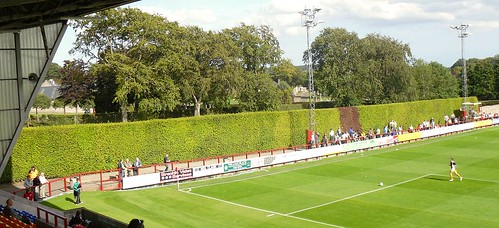
Glebe Park, Brechin

Brechin City’s ground is one of the tightest in senior football. They have recently been threatened with fines if they do not increase the pitch’s area, apparently because it is not large enough to meet UEFA‘s standards.

One of the reasons for this is that a beech hedge runs along behind the terracing on one side of the ground. You can see it in this photo I took on Saturday.

Beech Hedge, Glebe Park, Brechin

There is no scope to move this as Brechin do not own the land behind the hedge. The hedge is, in any case, one of the joys of attending a match at Glebe Park. To remove it would be a sacrilege.

And when are Brechin likely to play in a European tie anyway? And, if they did, why can they not use Dundee’s stadium, or Dundee United’s, both of which are compliant?

It’s nonsensical. The hedge must stay and Brechin not be fined.

This is the David Will stand, behind one of the goals. It is reputed to be able to seat more people than actually live in Brechin! In his time David Will became one of the top administrators of football; ironically eventually a UEFA official.

David Will Stand, Glebe Park, Brechin

You can, by the way, view Dumbarton’s new home strip in the above photo in which I can see six of our players. It’s basically an all gold effort with trimmings.

Here’s a panorama of the ground from the stand. A stitch of three photos.

Panorama of Glebe Park, Brechin

There are two more beech hedges, on the right as you look at the above, split by the smaller stand which houses the changing rooms.

Here’s a close-up of the nearer one.

The other beech hedge

All in all it’s a lovely wee ground.

Not Any Time Soon

While looking up Eddie Turnbull’s career for my post on his death I noticed something remarkable.

Hibs won the league three times during Turnbull’s playing career; in 1948, 1951 and 1952. Not only that: in the seventeen years spanning their first win till Kilmarnock’s sole league title in 1965 no less than five different non-Old Firm sides won the league. Apart from Hibs and Kilmarnock, Hearts (1958, 1960,) Aberdeen (1955) and Dundee (1962) are on the roll of honour. That beats even the early years of the Scottish League when in its first 14 years Dumbarton – 1891 (shared with Rangers) and 1892 (outright) – Hearts (1895, 1897,) Hibs (1903) and Third Lanark (1904) all were champions of Scotland.

Can anyone imagine that sort of thing happening now?

The Old Firm duopoly is so entrenched that the mere thought is instantly dismissable.

The only team to upset the Old Firm domination of the league between the two World Wars of the last century was Motherwell, in 1932. (See here for the full list of winners.) The 28 year run from Third Lanark’s title in 1904 till Motherwell’s is the longest such period of unbroken Old Firm hegemony. So far.

At present it is 26 years since anyone but Rangers or Celtic won the league. (Aberdeen 1980, 1984 and 1985) and Dundee United (1983) are the only provincial sides to win a championship since the 1960s. Neither look likely to repeat the feat soon. Barring extraordinary circumstances, circumstances that are unforeseeable, to me at any rate, that 28 year record will be broken in 2014.

The Scottish Cup has always been a more likely prize for a “smaller” club to win but even so that 1950s and 60s period saw no fewer than seven non-Old Firm clubs lift the trophy. Aberdeen in 1947 (and 1970,) Motherwell (1952,) Clyde (1955 and 1958,) Hearts (1956,) Falkirk (1957,) St Mirren (1959) and Dunfermline Athletic (1961 and 1968.)

Of course, in those days the playing field was a bit more even as each club shared its gate money with the away team. Since the introduction of the system whereby each club keeps its own home gates the imbalance between the Old Firm and the rest has grown bigger. This is merely exacerbated by the Champions League money available to Celtic and Rangers nearly every season. (Though none of that stopped Rangers getting into substantial debt recently.)

The other clubs are simply not in a position to compete. It’s a sad and unhealthy situation.

free hit counter script