Archives » Dodie Smith

The New Moon with the Old by Dodie Smith

Corsair, 2012, 381 p. First published in 1963.
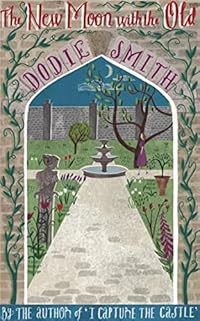
 The New Moon with the Old cover

In Book One we meet Jane Minton on her way to take up a post as secretary at Dome House, owned by Rupert Carrington to whom Jane had taken a slight fancy at her interview. Her encounter with Carrington’s children Drew, an aspiring writer, Richard, a composer, Clare, whose only ambition is to be a king’s mistress, and the fourteen-year old Merry who wishes to be an actress (this was first published in 1963; it was how female thespians were referred to in those days) plus their two live-in servants is entirely convivial and Jane settles in.

Her idyll is soon shattered, though, by the arrival at dead of night of Carrington, who informs her he is wanted by the police on suspicion of fraud and must flee the country, enjoining her to tell his family of this new circumstance. The five hundred pounds he has given her to tide the family over will not last long and all will have to fetch for themselves.

Here is where the novel’s structure begins to break down as the next four Books follow each of Carrington’s children in turn, first Merry, then Drew, then Clare and finally Richard, as all (except the last) set off into the wider world ,meet people only too willing to think the best of them, and manage to fall on their feet; Merry (in an actress’s alias disguising her true age) with an aristocratic family, Drew as an old lady’s companion, and Clare with an eccentric old gentleman with a secret. These “Books” are interluded by single chapters back “under the Dome.” They are in effect separate novellas having little to do with each other cobbled together under one umbrella.

As in Smith’s I Capture the Castle we have an upper-middle class family down on its luck being saved by happenstantial meetings. There, the narrative voice, being that of a young woman with not much experience of the world, was fresh and lively. Here, extended over five third person viewpoints, it became more wearing. There was also a relentless focus on matters of domestic detail, too much telling rather than showing, and a deal of introspection from the viewpoint characters.

It all felt very cosy. Too cosy.

Pedant’s corner:- a missing end quotation mark (x 3.) “Drew and Merry were in the hail” (in the hall,) ‘‘’One should think of it’ (has an errant apostrophe,) “‘you”re going to’” (you’re,) Glare (x 2, Clare,) grills (grilles,) “‘I wish I’d time for a test before dinner’” (a rest before dinner,) wisteria (wisteria,) “of the Whitecliff’ songs” (what that apostrophe is doing there goodness only knows,) Mr Sevem (Severn,) “three old ladles” (old ladies,) forgotren (forgotten,) doubifully (doubtfully,) a missing full stop, “‘but saintly no. l assure you.’” (‘but saintly no. I assure you’,) Aunt Winlfred (Winifred,) “all dosed” (all closed,) sudduely (suddenly.) “‘Is it a nervous trick’” (nervous tic?) “ their spines and comers bound” (their spines and corners,) “who had waked Mr Charles” (woken,) inlayed (inlaid,) “the ftont door” (front.) Mt Charles (Mr Charles,) cracking (crackling,) linancial (financial,) ex-girl friend (this makes her seem an ex-girl; ex-girlfriend,) “‘and I I’ll kiss you’” (doesn’t need that ‘I’,) “meant it as regard Lord Crestover” (as regards,) “the fall truth” (full truth,) presenfly (presently,) “he sat in the ball all morning” (in the hall,) a missing comma before a piece of direct speech, Rasouniovsky (elsewhere always Rasoumovsky.)
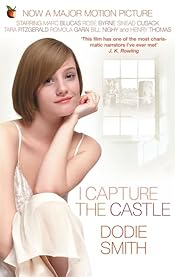
I Capture the Castle by Dodie Smith

Virago Modern Classics, 2003, 346 p plus vii p Introduction by Valerie Grove. First published 1949.

I Capture the Castle cover

This is the journal of Cassandra Mortmain, whose reclusive father – a writer of a succès d’estime called Jacob Wrestling but whose experimentation has been overtaken by others and now suffers from writer’s block – and whose family, sister Rose, step-mother Topaz (a former model given to roaming the local hill at midnight while naked) and brother Thomas along with lodger Stephen live in Godsend Castle in a fair degree of penury. Strictly speaking, since it is written in three sections, The Sixpenny Book, The Shilling Book and the Two-Guinea Book, these are the journals.

Much is made of Cassandra’s speed-writing – which helps to keep her secrets – and the journals do mostly read like the jottings of a girl on the cusp of adulthood (she writes, “‘I know all about the facts of life. And I don’t think much of them,’” and the introduction says one critic described Cassandra as a young girl ‘poised between childhood and adultery’ which to my mind is going a bit far; she seems too in control of herself for that,) but there are occasional subtle signs of true authorial interjection nudging the whole into the form of a structured story. Smith apparently laboured mightily over the details of the book.

The early parts reminded me strongly of the Sunday afternoon TV serial of long ago, giving it a kind of familiarity, we know there is going to be an element of star-crossed love somewhere; but that is to some extent misleading, I Capture the Castle is also undoubtedly its own thing. The title may derive from Cassandra’s early habit of stating she wishes to capture a particular character or other in prose but she (or Smith) soon gives up on the phraseology.

After the laying out of the family’s straitened circumstances, the daily grind of making do, things begin to change when half-brothers Neil and Simon Cotton from the US inherit nearby Scoatney Hall, to whose owners the rent of Godsend Castle is due. They come upon the Mortmains inadvertently and seem to be intrigued.

To be sure, what will then transpire appears to be laid on tram-lines and somewhat predictable, especially Cassandra’s lack of full awareness of the extent of Stephen’s regard for her. But that, I would assume, is precisely the point. Cassandra is supposed to be not yet worldly-wise. Smith, of course, isn’t unaware of it at all and does, to a degree, subvert the expectations.

To Cassandra’s and Rose’s minds Simon’s beard makes him resemble a devil but despite her initial desperate flirtation with him (she has already said she would do anything to escape poverty) he eventually becomes enamoured of Rose, giving the novel’s plot its drive. Both Simon and his mother are familiar with James’s novel and enquire as to his current work, thus sending him scuttling back to his study. Yet much to Topaz’s discomfiture Mrs Collins eventually manages to encourage James out of his writer’s block.

It is Simon, though, who brings Cassandra out of her rawness, playing her music she is unfamiliar with and telling her that, “art could state very little – that its whole business is to evoke responses.”

Evoking responses is something Smith does well here. This book must (have) be(en) irresistibly enchanting to adolescent girls but also has its recommendations to other readers.

Pedant’s corner:- on the cover blurb; dessicated (desiccated.) Otherwise; missing commas before quote marks at the start of a piece of direct speech (numerous instances,) “we were gloriously bloat” (nowadays that would more usually be rendered bloated.)

free hit counter script