Path to the Silent Country by Lynne Reid Banks
Posted in Other fiction, Reading Reviewed at 20:30 on 9 December 2023
Charlotte Brontë’s Years of Fame, Penguin, 1988, 238 p, plus i p Foreword and vi p Preface.
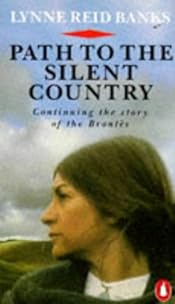 In this continuation of Charlotte Brontë’s story from Dark Quartet, she is in deep mourning for her late sisters and brother but left in effect to see to her father’s welfare on her own (except for the two servants.)
Her true identity has finally been unmasked though and on a visit to London she finds herself a celebrity but the unkinder reviews of Jane Eyre received distress her. In particular being brought up as the daughter of a cleric and steeped in that religion she is upset by the criticism that her book was unchristian. In Reid Banks’s account it was fellow writer and social theorist Harriet Martineau who explained to her people’s objections. Other literary luminaries of the time who pop up here include William Makepeace Thackeray, Harriet Martineau and Mrs Gaskell, the latter of whom she formed such a friendship with that she was entrusted to write Charlotte’s biography.
The main tension in the book, though, is her relationship with her father Patrick who acted very autocratically towards her and resented any time she spent away from him. (His main fear was that she would marry and thus fall prey to a then common fate, the rigours and dangers of child-bearing. How much of this is Reid Banks’s imagination or whether he was just being extremely selfish is moot.)
As told here a few men took Charlotte’s attention but none cast the same sort of spell on her as had her employer in Brussels, Constantin Héger. When Mr Nicholls, Patrick’s curate, expressed a romantic interest in her Patrick reacted violently and more or less banished him.
A commission to construct a book from her sister’s the papers brings her grief to the fore again but leads her to destroy the best of their remaining literary pieces, as being poems too personal to publish.
After the publication of Villette her writing ground to a halt, she had too much else on her mind and too much to do looking after her father.
It was her eventual marriage to Nicholls, after a promise never to leave her father reconciled him to the match, that would indeed prove disastrous as, despite perhaps thinking herself too old, she became pregnant and her body could not cope with the concomitant demands on it.
Attempting to fictionalise the lives of real people, especially ones about whom such a lot is known, can not be an easy endeavour. Reid Banks does it as well as can be expected.
Pedant’s corner:- has USian spellings throughout (color, honor, modelling, somber etc.) Otherwise; villain (villain – used later,) unperceivingness (unperceptiveness?)
 In her foreword Banks mentioned that when she was approached with the commission to write this book she was daunted – as who would not be given its subject is three of the best-known writers of the nineteenth century, plus their unfortunately less gifted brother? Much of course is known about the Brontë family (and even more written about them) but gaps remain. The fascination they hold for many is such that any exploration of their lives will attract readers eager to glean how such a hotbed of literary invention should arise within one family from a small village in the back of beyond.