Caledonia Dreamin’ edited by Hal Duncan and Chris Kelso
Posted in Fantasy, Reading Reviewed, Science Fiction at 12:00 on 28 October 2026
Strange Fiction of Scottish Descent, Eibonvale Press, 2013, 270 p, including 1 p Contents, 7 p Introductions (one by each editor,) 3 p Contributor Biographies and 1 p Editor Bios.
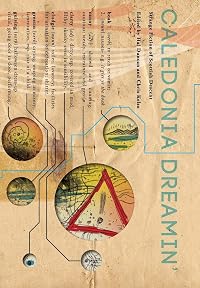
This is a book which celebrates the “Guid Scots Tongue” as Hal Duncan’s Introduction has it, with stories written by Scots or descendants of Scots, each inspired by a particular Scots word. Words such as wersh, clarty, maukit (twice,) sweirt, scroggy, laird, rammy, cludgie, ramscootrify, canny, murnie, thrawn, stravaigin, guising, greetin, boak. Most of the tales are in standard English with Scottish trimmings but two are in very broad Scots indeed.
Though most have a speculative bent the definition ‘strange’ in the book’s subtitle does not necessarily mean fantastic or science-fictional. Rob McClure Smith’s Palais 1930 (riffing on the word rammy) is a resolutely realist account of goings-on at a 1930s dance-hall.
On the whole this collection demonstrates that Scots is neither a dead nor dying language, can bristle with vitality and is a perfectly suitable medium for writing – in whatever genre or mode.
Pedant’s corner:- whacky (wacky,) dipthongs (diphthongs.) “The crowd have fallen silent” (The crowd has.) Chieftans’ (Cheiftains’,) “the prophesy” (the prophecy,) gasses (gases,) “let him breath again” (breathe,) a question without a question mark at its end, innoculation (inoculation,) focussed (focused,) a missing comma before a piece of direct speech (x 2,) carnapcious (carnaptious,) “a vertebrae” (a vertebra,) a full stop following a question mark at the end of a sentence, stotious (more usually spelled ‘stocious’,) colored (coloured,) “shadowed figures plod slow around and again” (????) hoi-poloi (usually spelled hoi-polloi,) miniscule (minuscule,) “the clean-cut, regular features, immaculate dress, and individuality” (clean cut; plus, such a list doesn’t usually have a comma before its last component,) Behaviorism (Behaviourism,) a missing comma at the end of a piece of direct speech (x 2.) “A tableful of weak smiles flutter into existence” (a tableful … flutters,) “‘there are no English words that have Xĩ in it’” (that have Xĩ in them,) practiced (practised,) an unindented new paragraph (x 2,) woolen (woollen,) trash cans (bins,) “a blaize football pitch” (blaes,) “took out a some cigarettes” (superfluous ‘a’,) “that that her gran” (a superfluous ‘that’,) a missing full stop, a closing parenthesis that ought to be an opening one, “a vertebra.!!!!” (doesn’t need the full stop before the exclamation marks,) “across the UK and Us” (across the UK and US.)
