MacMillan, 2009, 312p.
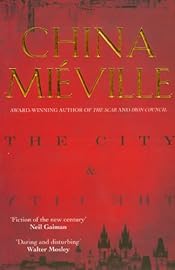 Another detective story! I thought I’d read this after The Night Sessions in case it got on the ballot for the BSFA award. (It has.) I had bought it on the strength of Miéville’s previous outings, Perdido Street Station, The Scar and Iron Council but didn’t know its content.
After an event known as Cleavage which happened a considerable time in the past, the city of Besźel, which is somewhere in Eastern Europe, is crosshatched with Ul Qoma. Cleavage has resulted in both cities coexisting independently of each other but in the same location, in some cases sharing the same buildings. Their inhabitants must unsee any manifestations of the other which they may notice, otherwise breach may occur. Areas within only one of the cities are known as total to its inhabitants and alter to the other’s.
This central conceit can, I suppose, be taken as a metaphor for divided cities or societies everywhere, or even a split personality, but here instances of intruding into the other city, ie breaching, whether by accident or design, will incur the attentions of Breach, a mysterious organisation which deals with such transgressions.
Aside: I wonder if Miéville ever toyed with the idea of calling his novel Split as in the Croatian city. Perhaps that would have localised things to too large a degree to the former Yugoslavia, though, or he may have considered it too obvious a pun.
In all other respects the novel’s world is ours (complete with MySpace pages.) The two are normal cities, they have hinterlands and they (or their countries) have diplomatic relations with the rest of the world; and with each other. There are rumours of a third city, Orcinny, interweaved with Besźel and Ul Qoma, but no-one is supposed to talk about that.
As to the plot, the body of a murdered American woman turns up in Besźel and the investigator, Tyador Borlú, swiftly comes to the conclusion the murder actually took place in Ul Qoma. However it transpires that the body was transported across the divide legally; in the only way that is possible. Breach is not invoked and Borlú has to go to Ul Qoma to aid the investigation there; where the murder victim had been part of an archælogical dig. The working through of the story thereafter is pretty standard conspiracy thriller stuff and not really speculative fiction at all, though the unusual background has a minor plot function.
Regarding the speculative nature of the book, to both cities’ inhabitants the observances of demarcation – the seemingly necessary unseeing, the unhearing – are only really a convention; they are not physically prevented from straying into the other reality, which in that sense is not, therefore, another reality, and while the consequences of breaching are implied to be dire, Miéville does not explore this aspect fully.
The unseen twinned city conceit is a good one but once again Miéville doesn’t really do anything with it. In the end it is no more than the backdrop to the thriller story which, with only minor tweaks, could equally well have been set in a truly divided city.
I was swithering about the classification I would assign to this book in my categories. I was leaning towards fantasy since crosshatching, the intrusion of another reality into the normal world, belongs in that tradition but I have decided on SF even if the only thing that makes THE CITY & YTIC EHT Science Fictional is the mention of Cleavage. There is/was a mechanism for the break, it was an event with a cause even if Miéville doesn’t go into detail as to how it happened.
These are not, though, major difficulties with the narrative. Miéville is in full command of his story and the prose flows freely. THE CITY & YTIC EHT is much easier to read than, for example, Iron Council which dragged rather. Give it a whirl if you have a penchant for detective thrillers or the mildly strange environment.
 This is Miéville’s first book for younger readers. It is also copiously (and well) illustrated by the author. In it Zanna and Deeba, two of a group of normal young teenagers in London, are beset by strange occurrences. They are attacked by smoke tendrils, freaked out by an ambulatory umbrella and Zanna is addressed as Shwazzy several times during different chance encounters in one of which she is given a card naming her as such.