Archives » Chelsea

Jimmy Greaves

One of the footballing greats has gone. Jimmy Greaves might be termed a pure goalscorer. His record of 357 goals in the top flight of English football may not ever be surpassed. He also scored nine in Serie A with A C Milan.

He began his career at Chelsea then moved to A C Milan in 1961. He did not settle there and was signed by Tottenham Hotspur for £99,999 (the £1 less than 100,000 supposedly to avoid the pressure of being the first £100,000 player. I doubt that would have bothered him.) He is the highest ever goal scorer for Spurs where he won several trophies. His League career ended at West Ham United.

He also scored 44 goals in 57 international appearances for England but missed out on a World Cup Final appearance in 1966 – and therefore his country’s greatest (only?) football triumph – due to being injured in a group game and the form of his replacement Geoff Hurst. This disappointment reportedly subsequently preyed on his mind. Sadly he became an alcoholic after his League career ended.

In later years, the alcoholism overcome, he became a Saturday lunchtime fixture in the TV prgramme Saint and Greavsie and earned himself a whole new legion of fans some of whom had never seen him play in his heyday.

Here are some of his goals for Spurs:-

James Peter (Jimmy) Greaves: 20/2/1940 – 19/9/2021. So it goes.

The Doc

So 2020 continued to be a miserable sod right till the end, when it took Tommy Docherty away from us.

The Doc was probably most famous for being manager of Manchester Uinted though he had previous spells at Chelsea and other clubs, plus as Scotland manager. After Man U he managed seven more clubs.

His senior playing career began at Celtic but he could not displace Parkhead legend Bobby Evans from the team and moved south to Preston North End and later Chelsea.

He played for Scotland 25 times including in the 1954 World Cup (but we’ll swiftly draw a veil over the 7-0 defeat to Uruguay – I read once of a player’s recollection that the Scotland team were in heavy woollen jerseys as if playing in winter rather than the heat of a Swiss summer and were shod in big old-fashioned boots – with the Uruguayans in more modern footwear he described as like slippers in comparison. We were lucky it was only seven was the verdict.)

It was as a manager that The Doc made the most impact, taking over a very declined Man United and not able to turn the club’s fortunes round till after a relegation but leading them to a swift – one season – return to the top flight and then to an FA Cup win against Liverpool (denying that club what would have been a first ever treble by any English side.) Who knows what might have transpired if The Doc had not had an affair with the wife of the club’s physio Laurie Brown and as a consequence got the sack? (I note from the obituaries that Docherty was still married to Mary Brown when he died.)

Despite plying his trade mostly in England Docherty, like most of his ilk, remained a proud Scot.

There was a tale told – I think it was of Joe Donnelly, Dumbarton’s perennial substitute in the 1971-1972 season (only one sub allowed in those days and that for injury) that the player had once been involved in an altercation with an English team mate who had called him a “Scottish b*****d.” Docherty, as their manager, took them into his office, got them to settle the matter reasonably amicably then let the Englishman leave the room. Whereon he immediately turned to Donnelly and said, “You didn’t hit him hard enough.”

A character, then.

Thomas Henderson (Tommy) Docherty (The Doc): 24/4/1928 – 31/12/2020. So it goes.

Poppy Watch 2017

It was one month and one day before Armistice Day this year (ie on October 10th) when I saw my first paper poppies beside a shop’s till. If you were to wear them for all that time they would have surely have deteriorated beyond use.

On Friday 20th Oct I saw one in the wild (as it were.) A young girl at the entrance to Kirkcaldy Library had just “dropped her flower.” She didn’t seem to know what it represented.

At least the politicians haven’t – quite – got round to it yet. Unless I’ve missed them.

My first sighting on TV this year was on Saturday night (21st Oct) and it was sported by an Italian! That is just bizarre. OK they were our allies in the Great War but in (most of) World War 2 we were enemies – even if their soldiers’ hearts weren’t really in it. (The Italian in question was Chelsea’s manager Antonio Conte. This just goes to show the unpleasant overtones of coercion associated with poppy wearing by public figures these days.)

Tonight came the first “normal” TV appearance – on the BBC’s Countryfile. Three weeks before Remembrance Day. And how long before it was the piece filmed?

I will make my contribution to the Earl Haig Fund as usual this year but reserve my right not to wear the poppy. I’ll say it again. The servicemen it commemorates died for my right not to be forced to wear one.

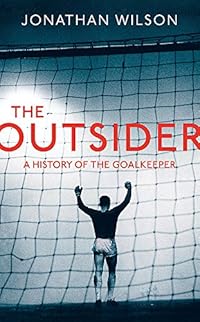
The Outsider: A History of the Goalkeeper by Jonathan Wilson

Orion, 2012, 351 p

If football is symbolic, if the ball is a substitute sun requiring to be buried (in the goal) to ensure fertility, what then are we to make of the one player in the team whose primary object is to prevent that desirable consummation? Such is the question with which Wilson starts his history of the goalkeeper, who in this context can be seen as the outsider, an anti-footballer.

While not denying the goalkeeper’s essential difference I immediately started thinking, what about the stopper centre half, the holding midfielder, the midfield destroyer? Aren’t their roles equally anti-football in that sense? Of course these players may advance into the opponents’ half, even score the odd goal or two, but the goalkeeper generally isn’t expected/permitted even to do that. Except what, then, to make of the Paraguayan great, Jose Luis Chilavert, who took penalties and free-kicks and scored 62 goals, 8 of them for Paraguay and all while playing as a goalkeeper? (Brazil’s Rogério Ceni has since overtaken Chilavert as the highest scoring keeper.) The South American attitude to goalkeepers has tended to be less restrictive, though. In Europe keepers generally only charge upfield in desperate circumstances.

In any case Wilson’s title partly goes against the thrust of the history. When football was first codified it started with all players able to handle the ball in certain circumstances. That dispensation quickly became restricted to the designated one, who was detached from the team – and made to stand out by virtue of wearing a different coloured jersey/shirt. A gradual process of goalkeepers playing beyond the penalty area – the change of rules in 1912 which forbade handling outside the box (up till then they had been allowed to anywhere in their own half) delayed this process – by intervening with their feet or initiating attacks has reduced this difference. Arguably the keeper’s reintegration into the team was finally more or less institutionalised by the back pass rule. (Even before that, though, the custodian was not totally estranged, was a vital component of retaining possession. I remember reading elsewhere that Liverpool’s long domination of the European Cup was predicated on passing the ball back to Bruce Grobbelaar as much as possible during away legs. The sweeper-keeper had evolved even prior to this, though.) In Jose Luis Chilavert’s case the reintegration of keeper with team was surely at its most complete.

Wilson mentions that the first ‘Prince of Goalkeepers’ was Dumbarton’s James McAulay. Another Sons keeper to be mentioned in the text is Joshua Wilkinson, whose father was convinced his death from peritonitis in 1921 was due to a blow he’d received in a game against Rangers the previous Saturday.

In the very early days it had been almost open season on goalkeepers. The famous William ‘Fatty’ Foulke – reputedly 28st (179 kilograms) when he played for Chelsea – often took his revenge on physical forwards, turning them upside down and depositing them on their heads. Despite the obvious dangers – Celtic’s John Thomson (to whom a section of Kirkcaldy’s newly refurbished museum is dedicated – he came from nearby Cardenden – there was also a tribute to him there before the modernisation) received an accidental but fatal knee to the head in 1931 also against Rangers; Sunderland’s Jim Thorpe died in 1936 after several blows in a physical game in 1936 prompted a reccurence of a diabetic condition – it was not until after Bert Trautman’s broken neck and several other injuries to keepers in FA Cup finals in the 1950s, though, that British goalkeepers began to receive extended protection from referees.

Goalkeeping is not, in the end, a simple business. He/she is not necessarily only a shot stopper; there is a difference between the reactive keeper and the proactive. The former expects to make saves (spectacular or mundane) the latter’s best game is the one in which she/he has no saves to make at all, because the way he/she has organised the defence ensures, in an ideal world, that no danger occurs.

There are even national differences in approach. Both Brazilian and Italian defences tend to play deeply and so breed reactive keepers. In other countries a higher line is adopted, a goalkeeper’s play has to be more attuned to that. In Russia, Soviet Russia in particular, goalkeepers have been the subject of a reverence that borders on love.

Africa is represented here by the Cameroonians Tommy Nkono (who inspired Gianluigi Buffon) and Joseph-Antoine Bell, the Spanish, German, Italian, English, Brazilian, Scottish and US traditions are covered in detail. From Asia only Ali Al-Habsi gets a mention and that in passing. Oceanian custodians escape Wilson’s purview completely. Maybe no notable keepers have as yet been bred there.

So many great goalkeepers seem to have had unfortunate debuts, on the end of drubbings of various sorts. What distinguishes them all is that they are liable to be remembered, their careers defined, not for their great performances but for one, or – in the case of David Seaman – two mistakes. (My abiding memory of Ray Clemence is of him allowing a soft one from Kenny Dalglish to evade him in a Scotland-England game at Hampden. Proof if any were needed that there is no national tendency to persistently outstanding goalkeeping.) Poor Moacyr Barbosa of Brazil was forever blighted by conceding the winning goal in the 1950 World Cup final. In 1970 a woman in a shop said to her young son, “Look! There’s the man who made all Brazil cry.” Barbosa himself later complained that in Brazil, “the maximum sentence is 30 years. My imprisonment has been for 50.” That loss to Uruguay was perhaps, though, the single most traumatic moment in Brazil’s history as a nation. It was only founded in 1889 and has never fought a war.* Brazilians apparently are not really football fans. It is winning they like.

Wilson makes the point that the existence of a highly proficient one or two goalkeepers from one country at one time is not evidence of strength in depth, nor any guarantee of continued excellence. The apparent decline of English goalkeeping is a case in point.

The author certainly knows his football history – there is even a digression into the treatments of the sport in literature and film, most of which lean heavily on the goalkeeper; a further nice touch is that the book’s back cover is decorated with a “1” – and he thinks deeply about the game. Having read the book I’ll observe goalkeeping in a different light.

One final note. Even if a book is about football it might be thought a touch insensitive to describe the Spanish Civil War as “perhaps the clásico to end them all” – even more insensitive when Wilson observes that Real Madrid didn’t become Franco’s team till the 1940s.

*Edited to add. I have since found out that this is only true of the Brazilian Republic and not of the Empire which preceded it.
End of an Era?

So the longest serving manager in European football is to retire.

(This apparently will leave Ronnie McFall of Portadown as the holder of that accolade, at least according to The Belfast Telegraph. There is nothing so good for a newspaper as a local slant to news.)

SrAlec’s tenure at Manchester United has certainly been a fruitful one. He has amassed a haul of trophies unlikely ever to be matched.

But how much of a turning point will this be for the club, though? Especially as he will be hanging around behind the scenes.

When Matt Busby stepped down to be replaced by Wilf McGuiness things were never the same again, probably partly becasue Busby was still hovering in the background.

It is of course an honourable thing for the club not to discard its loyal employees when their main use has been superseded but there are dangers here. United went into a sharp decline (which arguably had already started under Busby) and were relegated to the second tier a few years later, from which they quickly bounced back up.

However, it took till Fergie arrived over 20 years later for the really good times to roll around once more.

It seems David Moyes is the favoured replacement. Good timing, with him being out of contract at Everton in a few weeks.

Moyes has done an incredible job at Everton with little in the way of resources by comparison with Man U. If he is offered and accepts the job he is probably a strong enough character not to feel overshadowed by Ferguson but what if results should fall off? Will he be given the same slack from fans and board that Ferguson has enjoyed when first Arsenal and then Chelsea and lately Manchester City threatened to become top dog in English football?

It most likely won’t happen but I wonder what odds you’d get on United being in the Championship in four or so years time?

Bayern Munich 1-1 Chelsea (aet 1-1)

(pens 3-4)

Champions [sic] League [sic] Final, Allianz Arena, Munich, 19/5/12.

So a piss-poor team (who finished only 6th in their national championship) from a piss-poor league (whose top two were horsed in the knock-out stages of the Europa League [sic]) have become “Champions of Europe.”

If ever football at the top level showed itself as an emperor with no clothes this farrago did. Chelsea made very little effort to win this match. Had they done so they might have been worthy winners of the game, but what few attacking sorties they did make revealed them as capable of troubling the Munich defence if not of breaching it. But they had one attempt on target all game – and the keeper didn’t save it.

So it went to the travesty of penalties.

Frank Lampard at the end said, “We worked hard for this. We deserved it.”

No you didn’t deserve it, Frank. You finished second in your league last year. You shouldn’t have been in the competition at all.

And plenty people work hard and receive no reward for it.

Still Roberto De Matteo has worked wonders in the short time he’s been interim manager. If he gets the job full time though the problems with an ageing team and over-powerful players will remain. And they’ll all be a year older.

Chelsea 1-0 Barcelona

Champions (sic) League (sic) Semi-Final, first leg. Stamford Bridge, 18/4/12.

Paint drying.

(I only watched the second half, but still.)

free hit counter script