Archives » Charlie Jane Anders

Arthur C. Clarke Award: This Year’s Nominees

The shortlist for the 34th Arthur C. Clarke Award is:

The City in the Middle of the Night by Charlie Jane Anders
The Light Brigade by Kameron Hurley
A Memory Called Empire by Arkady Martine
The Old Drift by Namwali Serpell
Cage of Souls by Adrian Tchaikovsky
The Last Astronaut by David Wellington

I had been looking for the list for a while but not for the first time discovered it had finally been announced via Ian Sales’s blog.

I reveiwed the Charlie Jane Anders book for Interzone 282 and published that review here on 28/5/20.

The Martine and Serpell I had seen good reviews of. The works of Hurley I have read tend to wallow in violence which I find off-putting. I’ve only read Tchaikovsky’s two Children of Time novels. They were OK but no more. Wellington is new to me (and Ian Sales doesn’t think much of his book.)

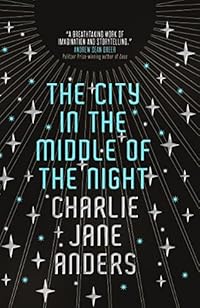
The City in the Middle of the Night by Charlie Jane Anders

Titan Books, 2019 , 485 p. Published in Interzone 282, May-Jun 2019.

 The City in the Middle of the Night cover

We start with a “Translator’s Note” telling us terms have been rendered into Peak English. This both frames the narrative and explains the use of “archaic Earth terms” for alien creatures and the recognisability of characters’ names.

The story itself takes place on January, a planet tide-locked to its star. Its human occupants, who still regard the arrangements on the Mother Ship that brought them there as significant, inhabit the narrow band between scorching Day and freezing Night (wherein monsters lurk.) The ship’s technology that at first sustained them has long been failing though and there are signs the environment is beginning to collapse – corrosive alkaline rain, sudden tornados. The novel’s events are situated mainly in Xiosphant – a repressive rules-based city, “nothing in this city is ever supposed to change” – and Argelo, which is much looser in organization and attitudes (“the city that never sleeps,”) with some scenes in the wildernesses between. Within the book’s seven parts alternate chapters see events from the first person, present tense viewpoint of Sophie, a would-be revolutionary in Xiosphant, and the third person, past tense perspective of Mouth, who thinks she is the last survivor of a society of Travellers known as the Citizens and is lately a member of a band of smugglers calling themselves the Resourceful Couriers, so knows the ways between the cities.

Sophie takes the blame for a theft by Bianca, her friend for whom it is obvious to the reader (though not spelled out in the narrative till near the end) she has deep feelings. As punishment, Xiosphant’s Police Force ejects Sophie from the city into the night to die. A strange encounter with a creature known to January’s humans as a crocodile (though its physical characteristics are very different from that Earth animal) saves her. During this she is somehow enabled to see the creature’s memories, including one of a complex city situated somewhere out in the night.

Mouth is exercised by the destruction of the Citizens, which she witnessed from a distance, especially since it was before they could bestow a name on her. Her attempt to secure their book of customs from Xiosphant’s Palace coincides with the failure of the revolutionaries’ take-over. She, Sophie, Bianca and others have to flee across the Sea of Murder to reach Argelo. This involves curiously cursory action scenes accompanied by extended, and hence unconvincing, dialogue. Sophie’s connection to the crocodiles (whom she names the Gelet) helps save most of them and she receives a bracelet which thereafter keeps drawing her to the night and the Gelet.

The contrast between life in Xiosphant and Argelo is marked but Mouth learns more of her background from a former Citizen, Barnabas, who left the group after achieving enlightenment, “‘The point of religion is to keep trying to reach someplace, the last thing you want is for someone to feel like they’ve reached it.’”

As far as the Science-Fictional meat of all this goes Sophie and Mouth eventually do arrive at the city in the middle of the night – but not until almost four-fifths of the way through the book. In the city they learn of the importance of the Gelet to January’s bio-friendliness – not just from transmitted memories but from a recording left by one of January’s earliest humans, “‘These natives seem to regard geoengineering and bioengineering as two branches of the same discipline.’” A tidal-locked planet would require an air-conditioning system to circulate hot air from the near side to the far side to avoid weather instability and atmospheric disruption. “‘These creatures seem to have created something better, using networked chains of flora and fauna.’” Also revealed is the crucial role the useful substance, known to the Citizens as nightfire since it glowed in the dark, played in stabilising the planet’s biosphere and in the Citizens’ demise. The Gelet’s interest in Sophie is to use her as a bridge between civilisations. She willingly accepts the sacrifice required.

A thought that speaks perhaps to the twenty-first century reader’s awareness is, “‘Progress requires us to curate the past, to remove from history things that aren’t ‘constructive.’ I don’t know if our power to forget makes humans stronger, more self-destructive, or maybe both.’”

The novel starts off intriguingly but it becomes clearer as we go on that the author’s interest is not so much in her imagined world, or her plot, as in the societies and interactions she is depicting – good stuff, but lacking something in urgency. And the book doesn’t so much end as just stop. Perhaps, at a touch under 500 pages, Anders decided she had delighted us long enough.

The following did not appear in the published review:
The sentence, “Here’s what Mouth learned about Sasha from eavesdropping,” ought to have been removed by a decent editing process.

Pedant’s corner:- Written in USian. Otherwise; “something makes me stop and examine closer” (examine more closely,) “I notice someone who seems out of place … They turn their head” (‘someone’ is singular, therefore not ‘they’, in this case ‘she turns her head’,) “now a few s cattered memories” (a few scattered memories,) “a group of students … argue about” (a group argues.) “‘He’s been making a fortune speculating on sour cherries’” (‘speculating in’ something might lead to a fortune, ‘speculating on’ it is just wool-gathering,) “a group of musicians hunch” (a group hunches.) “‘We lay there’” (We lie there; elsewhere Anders shows she does know the difference between lay and lie,) “open maw” (it’s not a mouth!) “their heads almost exploded” (used once, this phrase for an eye-opening experience appears fresh and striking; used again, not so much,) “‘I don’t even know if any Gelet ever want to meet me again’” (if any Gelet ever wants to meet me.) A chapter begins, “Ignore the buzzing from my right wrist, and I take Bianca’s wrist,” (‘I ignore’ makes more sense. This typo probably occurred because the first word of a chapter is always in a much larger font size than the others,) envelopes (envelops,) cul-de-sacs (culs-de-sac,) “which stunk just as much as she’d expected” (stank.)

More From Interzone

 Palestine +100 cover
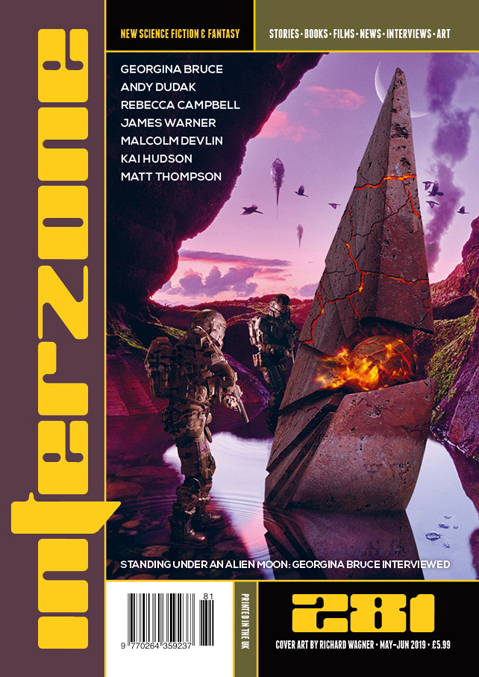
 Interzone 282 cover

Busy, busy.

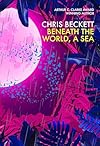
Interzone 282 has arrived and it does contain my reviews of The City in the Middle of the Night by Charlie Jane Anders, and Beneath the World, A Sea by Chris Beckett.

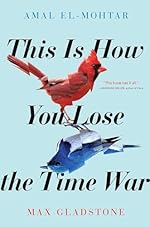
By the same post came Palestine +100 edited by Basma Ghalayini, the first ever collection of SF from Palestine. This, along with This is How You Lose the Time War by Amal El-Mohtar and Max Gladstone (see a few posts ago) is for review. To appear in Interzone 283.

Latest from Interzone

 This Is How You Lose the Time War cover

It’s that time again.

I’m awaiting the arrival of Interzone 282, not least to find out if I’ll have two reviews in it. It seems ages ago I sent off my review of The City in the Middle of the Night by Charlie Jane Anders, and I did the same for Beneath the World, A Sea by Chris Beckett not long after.

Still a new book has arrived for review (to appear in Interzone 283?)

This is a collaboration between Amal El-Mohtar and Max Gladstone and is titled This Is How You Lose the Time War.

Should be fun.

Interzone 281

 Beneath the World, A Sea cover
Interzone 281 cover

Lying on my doormat – among a whole load of other stuff – after I got back from holiday was the latest issue of Interzone, 281 by number.

I had thought that my review of The City in the Middle of the Night by Charlie Jane Anders was due in this one but it’s not there. I assume it will now appear in issue 282.

Also on my doormat (delivered via TTA Press) was Chris Beckett’s latest novel Beneath the World, A Sea. I suppose my review of that one will also appear in issue 282.

Review for Interzone 281

 The City in the Middle of the Night cover

You may have noticed on my sidebar that I’m currently reading The City in the Middle of the Night by Charlie Jane Anders.

This is because it’s the latest book I’ve received for review in Interzone.

Ms Anders is another author new to me. She is, though, a multiple award winner, gaining the Hugo for her novelette Six Months, Three Days in 2012 and several awards including the Nebula Award for her novel All the Birds in the Sky in 2017.

The review ought to appear in Interzone 281.

Asimov’s Science Fiction Sep 2016

Dell Magazines.

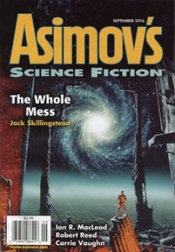
Asimov's Sep 2016 cover

Sheila Williams’s Editorial lists The Thirtieth Annual Readers’ Award Results. Robert Silverberg’s Reflections (“Darn,” He Smiled) remembers the glory days of Science Fiction reviewing by James Blish and Damon Knight including one memorable Blish evisceration of a story that used 89 different expressions for “said” (a practice Silverberg himself thereafter strictly avoided) and laments that the pendulum has now swung so much the other way that would-be writers are positively encouraged to eschew the unintrusive “said”.
Peter Heck On Books1 looks favourably on the latest novels by Charlie Jane Anders, Laura R Gilman, and Fred Chapell, Paul di Filippo’s collection and the non-fiction Breaking the Chains of Gravity: the story of space flight before NASA by Amy Shira Teitel.
In The Mind is its Own Place2 by Carrie Vaughn, Lieutenant Mitchell wakes up in hospital to be told he is suffering from Mand Dementia, an affliction suffered by navigators who intuit the correct coordinates for hyperspace jumps. The story concerns his gradual unravelling of what happened to him.
Dome on the Prairie3 by Robert Reed is an alien invasion story inspired by the works of Laura Ingalls Wilder. Aliens in the form of the Scourge have come to Earth. Our (unnamed) narrator is chosen to try to communicate with a Scourge child dubbed Laura.
In Epitome4 by Tegan Moore, Shelby, a woman given power of attorney by her female lover Vivian (whom for some unexplained reason she cannot acknowledge as such) becomes her carer after a fall causes brain damage. To compensate, Shelby has a hacker friend upload a brain scan of Vivian into the Personify virtual reality programme.
Academic Circles5 by Peter Wood is a time travel story wherein a man uses a time machine to plagiarise academic essays on Philip K Dick and claim precedence. Others have feelings of déjà vu.
In The Whole Mess6 by Jack Skillingstead mathematical genius Professor Dunn is handed an incomplete equation. When he solves it tentacled Masters slip through from a parallel universe and he slides to a third. Only he can undo the change but his abilities are restricted.
All That Robot…7 by Rich Larson sees a man stranded on an island otherwise inhabited by sentient robots sin against their nascent religion.
The best is kept till last – and it’s the best in Asimov’s all year up to now. Ian R MacLeod’s The Visitor From Taured8 tells the tale of Lita, a woman who studies Analogue Literature (old style 2D physical books rather than interactive or non-static narratives,) and her (lack of) relationship with astrophysics adept Rob who is trying to prove the many worlds theory.

Pedant’s corner:- 1Palazo (in a book title! palazzo,) 2“He’d signed in, said good morning to the captain, went to his station” (He’d; therefore [he’d] gone to his station,) “He had to learn to the truth” (learn the truth.) 3a wide range… were scattered (was,) “shifting its aim for a moment that ends when you forcing your attentions to…. (with you forcing? when you force?) 4 freshman (freshmen mad emoe sense) 5Popoov (Popov,) a missing end quote mark. 6 the ‘the Masters’ (only one the needed,) a particularly adept memoirists (memoirist,) I couldn’t breath (breathe.) 7”hoping that the two events to coincide” (the two events coincide.) 8Even in a US publication it is intensely annoying to read in a story by a Briton and set mostly in Leeds and the Outer Hebrides the word “asshole” rather than arsehole, yet there was archaeologist not archaeologist and later maths and “arsed around”. “He fucked about.” (I assume US readers will read this as implying promiscuity – the context leans towards it – but I didn’t. In Britain it means engaging in activities to little purpose, not fulfilling yourself, see “arsed around”,) post-centarian (post-centenarian?) this stuff happen at the atomic level (this stuff happens,) “as if every choice you made in a virtual was mapped out in its entirety” (“world” after virtual?) sung (sang,) span (spun.)

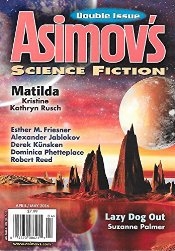
Asimov’s Science Fiction, Double Issue April-May 2016

Dell Magazines, 192 p.

Asimov's Apr-May 2016 cover

The third issue of the year’s subscription to the magazine my younger son gave me as a Christmas present. In the guest editorial Charlie Jane Anders takes issue with the myth that novels and short stories can’t be written equally well by the same author. In his column Robert Silverberg muses on the possibility that there was not one Trojan War but several, not one Homer but many, writing down their accounts over centuries before it was all drawn into one after Greek script evolved from Phœnician. In the fiction:-
Matilda by Kristine Kathryn Rusch.1 Matilda is a single ship. She likes being piloted by Devi. The feeling is not mutual. Yet in conflict against the CeaWayLaVi they must act in concert.
Three Paintings by James van Pelt. An artist worried about going stale conceives a plan to be backed up, cut himself off from the world, paint and then kill himself, be restored, paint again, kill his new self, and repeat the cycle once more. His commercial partner gets greedy.
In The Days of Hamelin by Robert Reed2 children between the ages of five and eighteen start to die of ruptured arteries. For obvious reasons the virus responsible comes to be known as Hamelin. The few child survivors evolve a mordant philosophy.
The Return of Black Murray by Alexander Jablokov3 sees three former high school friends return to the scene of an incident from their senior year. Black Murray is a giant moray eel; or its simulation. The payoff here does not justify the story’s length.
Starless Night by Robert R Chase is a tale of the response of Earth colonies to invasion from Sagittarius.
Project Synergy by Dominica Phetteplace4 is another of the author’s stories featuring Watcher chips. Here the chip wants to acquire a body of its own, which is highly illegal.
Flame Trees by T R Napper.5 The titular trees are a nostalgic trigger for a war veteran whose memories are about to be wiped for committing an act of violence.
A Flight From the Ages by Derek Künsken6 spans the lifetime of the universe. In 3113 AD a weapon starts to dissolve space-time. Over succeeding multi-millennia efforts are made to escape its expanding wave-front and make the universe into a Klein bottle – all mediated through the experiences of AIs. Very dry indeed.
Of the Beast in the Belly by C W Johnson.7 The belly is that of an arcthant. Nawiz and, Janum, the man she is chasing for revenge purposes, have been swallowed by the huge sea creature. Inside its array of increasingly acidic stomachs exist a number of different societies, scraping a living from the (part) digested contents.
In Woman in the Reeds by Esther M Friesner8 the woman has been feigning madness to avoid the attentions of Pharaoh’s slave overseers and collecting the bones of dead children from the Nile in order to gain the power to restore her own dead son. She refuses the demands of the god Set to hand over a baby she finds floating in a bulrush basket.
Lazy Dog Out by Suzanne Palmer.9 The Lazy Dog is Khifi’s salvage ship. Khifi gets implicated in a plot to take over her habitat and uses the ship to frustrate it. There is an incident here of summary justice (which in my view is never acceptable – even for the supposed good guys. When you think clearly about it, summary justice is no justice at all.)

Pedant’s corner:- 1overlaying (overlying,) 2US spelling of practice and practicing for the verb practise (plus points though for “hanged himself”,) 3vortexes (vortices,) according the Pete (according to Pete,) “The girls squealed satisfyingly and moved closer to me and Myron” (? This would have been difficult. They were in separate boats,) 4terrariums (terraria,) “The long skirt of her skirt grazes the floor” (how about “her long skirt grazes the floor”??) “Often times” (oftentimes is USian I know but isn’t it usually one word?) 5bowls green (USian? we would say bowling green,) 6Poluphemos’ (Poluphemos’s,) Ulixes’ (Ulixes’s,) even less processing sources (even fewer,) 7a pack of sea-jackals were attacking (a pack was,) “with out of his large hands” (with one of his large hands,) Nawiz laid down (lay down,) maw was used here several times: fine; the story takes place inside stomachs, 8Osiris’ (Osiris’s,) maw (it’s a stomach, not a mouth,) 9locii (loci, or even locuses,) Candles’ (x 3; Candles is one if the characters, so Candles’s – which was used once!) “cut the freighter’s main engines, flipped on the brakers.” (Space-ships have brakes? Which can work when the main engines have shut off?) maw (it’s a stomach; not a mouth,) “behind them in a semicircle was Redrum, Jonjon and Inchbug” (behind them were.)

free hit counter script