Radiance by Catherynne M Valente
Posted in Fantasy, Reading Reviewed, Science Fiction at 12:00 on 17 September 2017
Corsair, 2016, 430 p.
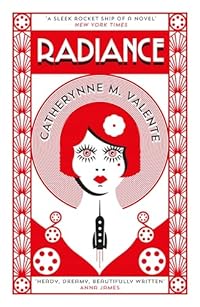
Radiance is set in a fantastical universe where the Moon and the planets have all been colonised and are unrecognisably exotic places. At times the appearance of the text mirrors this exuberance. There is a variety of typefaces, some offset on the page to the right, others to the left and some laid out as a film or play script – or even transcript.
We are first invited to “Come inside and meet the prologue.” In a comment on literary affectation she (the prologue) tells us she has been told often that she is wholly unnecessary, a growth upon the story the wise doctor must cut off.
Below each chapter’s title is a representation of a film strip with an astrological symbol in it relating to the planet or moon on which it is set. The meat of the novel deals with the life of Severin Unck, an actress since a very young child, her father a film director, her mother a camera (he was always pointing one at her) but herself in her film-making resolutely wedded to documentary, “Any story is a lie cunningly told to hide the real world from the bastards who can’t live in it.” Severin cannot tell that lie. “We think of ourselves as being in … not just a story, but a good story.” It turns out film in this universe occurred early but when talkies evolved Edison subsequently sat on the patent so that only silent movies acquired the cachet of being art.
The story is told through personal reminiscences, transcripts of both Severin’s own – now fragmentary – archive and her father’s. Her origins are shrouded in mystery, her real mother is unknown to her – and to the world except for her mother (who wishes to remain anonymous) and her father who keeps his counsel. Severin was delivered to his doorstep and he took her in and raised her without demur, casting her in his films from an early age. She had a succession of stepmothers all of whom seem to have treated her well enough, the most long-lasting being Mary Pellam. The timeline (helpfully given in a Chronology on pages 7-9) goes from 1858 to 1962.
Creatures known as callowhales feature heavily. They are massive denizens of the deeps of a water-covered Venus. Their nature is unknown except for being able to produce a universal food called callowmilk, which gets turned into ice-cream among other things.
Anchises St John grew up with Severin and has a strange disfigurement, an unhealing “mouth” on his hand procured due to him inadvertently touching a callowhale. At one point the novel threatens to turn into a detective story as Anchises is manœuvred into trying to ascertain what happened to Severin after she dropped out of the public eye. This does give Valente the opportunity to regale us with the aside, “In detective stories, women are usually dead before the curtain goes up. In fairy tales, they’re usually alive. Fairy tales are about survival. That’s all they’re about. The detective solves the woman, the knight saves her.”
There is something very odd about the celestial mechanics of the Solar System described in the text. In ours, Earth is not incommunicado for years when the sun passes between it and Pluto – or Neptune (stated in the text to be out of radio contact with Earth for 72 years.) Our Earth scoots completely round the Sun in only one year after all; so it will be on the same side as those planets again within six months at maximum (and in practice probably only obscured for a few days.) Arguably, though, this discrepancy is in agreement with the fantastical nature of the solar system of the book. When there is a bridge between Pluto and Charon and people can stroll about in the open air under the moons of Uranus what’s a little radio blackout?
In its settings Radiance is a whirling round of invention but these flourishes do make it difficult to read as Science Fiction – though as outright fantasy not a problem – and it is not until the very last pages that the genesis of this strange solar system is addressed in the text. (Even so those orbital mechanics are a bit hard to take.) Severin explains, “‘Because I am a nexus point connecting all possible realities and unrealities…. I exist in innumerable forms throughout the liquid structure of space/time, and neither self nor causality have any meaning for me.'” The significance of the callowhales is that they “exist throughout everything that has ever existed or will exist.” For, “There are a million million frames,” (in a movie) “each one of them only a little different, and callowhales move through those frames like a cigarette burn in the corner of the image. Each frame is a world, a universe.” These glosses were too late for me as by the time they came I had lost patience with the idea of the book as anything but a fantasy.
As an adjunct to the living in a good story theme we also have a character say, “‘I think we’re all Graeae… We all share one eye between us, the big, black camera iris. We wait for our turn to see what someone else saw on a screen. And then we pass it on.'”
In an aside on hiding in plain sight Mary Pellam tells another, “‘If you’ve married men twice, nobody asks what you think about when the night breeze comes sidling in.'”
The penultimate chapter, Goodbye, echoes the prologue – “There is no such thing as an ending. There are no answers.” And of course in another piece of comment on the art of fiction it is not the end of the book.
Despite Valente being from the US we have “arse”, “knitted” and “bum” used in the British sense – and even maths! – but hood for the bonnet of a vehicle. Odd. Her intention for the book may be that “the story of the Grail is one of failure and always has been.”
Radiance is pyrotechnic and contains some fine writing but its fantastical trappings distract more than a little from the human story it portrays.
Pedant’s corner:- parenthetical hyphens are not spaced from their content-as a result this reads oddly-put in the space please. Otherwise; sprung (sprang,) lay down (lie down,) ice flow (floe,) off of (off, just off, no of,) assaying a Charleston (essaying,) outside of (outside, just outside, no of,) “partnered in own his dance” (in his own dance?) Hades’ (Hades’s,) “Nous vous attendons pour vous” (if I remember my schoolboy French aright either the “vous” or the “pour vous” is superfluous – Nous vous attendons = we will await you; nous attendons pour vous = we will wait for you,) “‘In Xanadu did Kubla Khan his stately pleasure dome decree.’” (A stately pleasure dome, ) “and, and” (the first “and” is superfluous,) “a throng stampede” (earlier throng had been accorded a verb agreeing with its singular nature – so; a throng stampedes,) Franklyn Edison (elsewhere referred to as Freddy,) octopi (octopuses, at a pinch octopodes.)