Gordon & Cremonesi, 1978, 155 p
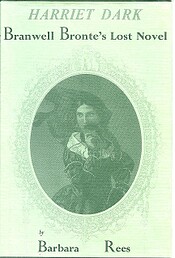 There is, of course, an ongoing fascination with the works of the Brontë sisters and their genesis, a fascination not restricted to the sisters themselves. Their brother, Branwell, apparently described to his friends a novel he had written but of which no trace was found in his papers after he died. This book is Barbara Rees’s construction of that novel. How much she had to go on, the form Branwell’s effort actually took, is not elaborated on in the surrounding blurb so the reader must just take what is presented to her/him as an example of a Victorian novel.
It consists of the reminiscences of a young girl taken home from Steepleton Horse Fair by Mr Robert Ogilvy to be brought up as a servant in his house, Thirleby Hall. He named her Harriet Dark. In this first-person account “Harriet” refers to herself as a foundling, but since she was four – or five, or six – years old at the time (and could speak well enough) that description is not entirely accurate. Orphan is more so. That such a child would not really remember her mother, nor realise till much later in the book that her mother had died is one of the factors which stretch credulity a little.
Under the unbending gaze and strictures of the cook, Mrs Duckham, Harriet develops a hatred for the household and of Mr Ogilvy but she eventually forms a friendship of sorts with the housekeeper, Mrs Minim, and in the fullness of time as she grows into adolescence, a yen for Mr Ogilvy himself. She finds more acceptance in the family of the local clergyman, Mr Ponsonby, whose wife helps her to read.
The later incursion of Nina Sanctuary, Mr Ogilvy’s intended, into Harriet’s life darkens her outlook. Sanctuary treats her harshly and, in a touch of Gothic, she conceives the thought of herself as in league with the devil against the world; going so far as to believe her wishes directly contribute to Sanctuary’s death in a riding accident, after which Ogilvy falls into what the Victorians called melancholy.
The book displays some of the infelicities of an inexperienced novelist. Whether this is intentional on the part of Rees in trying to replicate what Branwell Brontë might actually have written, or are her own, is impossible to determine. They do, though, lend an air of verisimilitude to proceedings.
Despite Ogilvy’s continuing indifference to Harriet Rees contrives, on Branwell Brontë’s behalf, a happy ending of sorts.
Pedant’s corner:- “‘So you’re back then are you,’ said Mrs Duckingham.” (ought to have a question mark after ‘you’,) “elbows akimbo” (elbows resting on hips and pointing outward?) “will-of-the-wisps” (wills-of-the-wisp, or, better, wills-o’-the-wisp,)


 In her foreword Banks mentioned that when she was approached with the commission to write this book she was daunted – as who would not be given its subject is three of the best-known writers of the nineteenth century, plus their unfortunately less gifted brother? Much of course is known about the Brontë family (and even more written about them) but gaps remain. The fascination they hold for many is such that any exploration of their lives will attract readers eager to glean how such a hotbed of literary invention should arise within one family from a small village in the back of beyond.