Posted in Eric Brown, Reading Reviewed, Science Fiction at 12:00 on 30 November 2014
Solaris, 2014, 384 p.
This book is dedicated to Jack and Katrina Stephen. Those of you who know me will realise how pleased that makes me.
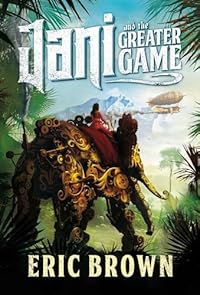
Janisha Chatterjee, daughter of an Indian Father and (deceased) English mother, is on her way back from England – where she is training in medicine – to her father’s deathbed when the airship in which she is travelling is brought down by Russian artillery fire. For this is India in 1925, and the Great Game is still afoot. Even though the Great War of our era does not seem to have happened the Russia contesting with the British Empire is Communist. China is also involved though only in the background here.
The Greater Game of the title concerns the prisoner on the airship, a creature known as a Morn, who saves Jani from the Russians mopping up after the attack. He gives her a coin and her entanglement in the plot follows. Other viewpoint characters are Durga Das, a priest of Kali, who is searching out the coin for reasons of his own, and Lieutenant Alfie Littlebody of the British Army, tasked by his superiors to spy upon Jani.
Echoes of Brown’s Bengal Station trilogy are never far away, this is India after all. But this is also steampunk. The wonder material Annapurnite not only powers superfast trains and airships but also weapons to keep the Russians and Chinese at bay; in a James Bond film-like touch Littlebody is given a photon blade and a Visual Camouflage Amplifier, both of which come in handy. There is also a mind-reading device. Oh and a Mechanical Man and even bigger mechanical elephant. And this is before we get beyond steampunk to the parallel worlds and the threat to humanity from the Khell.
The pleasure of this is in the journey. The author piles on the jeopardy and the intrigue and handles the politics of the British presence in India well – from both sides. Despite the steampunk trappings this comes out as a very Eric Brown type of story, if not quite reaching the heights of his The Kings of Eternity then less pulpy then the Bengal Station series. If Littlebody is a bit of a twit and Jani’s childhood companion Anand perhaps too cloying, Jani is engaging enough. And there is ample scope for a sequel (which I understand is in the works.) I’ll look forward to it.
No Comments »
Posted in Eric Brown, Reading Reviewed, Science Fiction at 12:00 on 30 August 2012
Newcon Press, 2009, 103p.
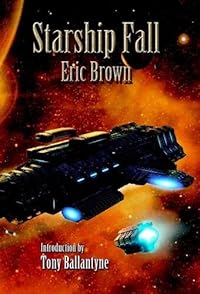
This is a novella, second in Brown’s “Starship” sequence, in homage to Michael G Coney, and begun with Starship Summer. In its telling, though, it is more reminiscent of Brown’s “Bengal Station” trilogy than Coney.
In Starship Fall the former holo star Carlotta Chakravorti-Luna has come to Delta Pavonis IV and disturbed the quiet life of narrator David Conway.
The novella’s title refers to something which is not directly involved with the story we experience in Starship Fall but, rather, kicked it off. A nice Brown touch, though, is naming the holoes Carlotta starred in after Coney novels.
Once again in a Brown story religion makes an appearance; the alien natives undergo a ritual wherein they might die (or not) but see their destiny. David’s friend Hawk’s girlfriend is a native whose partaking in the ritual triggers the crucial events.
Seasoned Brown (and Coney) readers know not to expect everything to turn out perfectly but here Brown still manages to confound at least one of the possible expectations.
On the whole well-written and agreeably character based Starship Fall bears out the theory that the novella is an ideal length for a rounded SF story. Brown does however overuse the formulation [“time interval” later] whether that time interval is hours, minutes or seconds.
No Comments »
Posted in Eric Brown, Reading Reviewed, Science Fiction at 13:00 on 8 June 2011
Tor, 2008. 358p.
After the events in the first of Brown’s Bengal Station series, Necropath, Jeff Vaughan hung up his telepathic implant and married Sukara. Two years later he has an undemanding but low paid job plus a baby on the way. A former colleague invites him to join her detective agency for good pay using the new improved, and hence less mentally debilitating, implants. For the sake of his wife and child Vaughan does not need much persuading. The subsequent investigation, farmed out by an overstretched police force, centres on the trademark murder of three people by laser.
A young orphaned girl, Pham, witnessed the latest killing and underwent a strange experience immediately afterwards. She now has a voice in her head which promises to protect her, a voice which is the consciousness of an alien.
As well as Vaughan and Sukara, the self-serving Dr Rao from Necropath also appears in this sequel. Perhaps it is the familiarity established from the previous book but here the characterisation seemed fuller – although there is too much emphasis on how Pham resembles Sukara’s dead younger sister Tiger.
As in Necropath, Vaughan leaves Earth – this time for the planet Mallory, where again the encounters he has are somewhat in the tradition of pulp SF. (A xenopath turns out to be a telepathic alien.) Vaughan’s departure has left Sukara in danger, though. The working through of the various plot lines and the tying together of the strands are effected efficiently.
Brown has something here. The Bengal Station setting is a grand conceit, a macrocosm whose levels Brown has barely touched and which could support many more stories; not all about telepaths. The society on Bengal Station seems to be modelled on India but the construction as a whole is really only glimpsed, and sometimes brings to mind memories of Babylon 5. I did wonder, though, whether relationships and attitudes in such a new environment would be quite so close a mirror of the old. But human nature is unchanging, I suppose.
No Comments »