Archives » Barrington Bayley

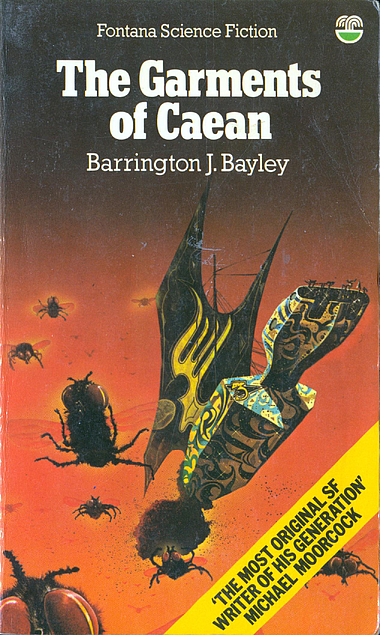
The Garments of Caean by Barrington Bayley

Pan, 1989, 241p.

In the part of the galaxy known as the Tzist Arm, a human culture known as Caean has perfected the art of clothes making. The suits their sartorialists make change the behaviour of their wearers in all sorts of ways and influence those they meet. The government of the Ziode Cluster sees this as a form of attack but a black market exists for the products. A Caean freighter has crashed on an isolated planet and an expedition has been mounted to secure samples. One of its members, Peder Forbarth, gains for himself the ultimate expression of the sartorialists’€™ art, a Frachonard Suit. The novel mainly consists of the subsequent adventures into which Forbarth is drawn as a result of the influence of the suit and the material Prossim from which it is made.

The sartorialist concept is another typically bizarre piece of Bayley imagining, which, however, means the characterisation is made rudimentary by it. The notion barely stands up to a moment’s scrutiny yet somehow, in the novel, has a perverse logic of its own. Bayley can do that to your brain.

Not vintage stuff, then; but diverting.

The cover shown above is from the 1978 Fontana edition.
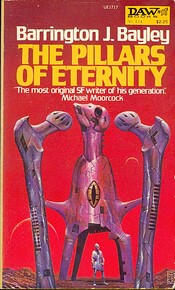
The Pillars Of Eternity by Barrington Bayley

Pan, 1989. 172p. (The cover shown is the Daw Edition.)

Joachim Boaz was a deformed orphan before the Colonnaders took him and reshaped his body with ‘€œsilicon bones.’€ It was only after this radical surgery and to forget his past that he renamed himself after the two pillars of eternity at the ends of the universe, Joachim and Boaz. The enhancements mean he is susceptible to torments (and later, pleasures) to an intense degree and also that he is more or less incapable without his spaceship in close proximity.

He sets off to the elusive planet Meirjain, which takes a complex orbit in and around the closely knit stars of the Brilliancy Cluster, where time gems allow the past or future to be observed. Unfortunately such gems are contraband.

It is a measure of Bayley’€™s eclecticism that these meanderings, which many an SF writer would have explored minutely and at great length, are not the main focus of the book.

There are, though, musings on the cyclical nature of the universe and on whether Joachim will suffer his torments over and over again, all in Bayley’€™s somewhat dry style – which involves a lot of info dumping and telling rather than showing.

It would almost be absurd to complain that this tends to be at the expense of characterisation as Bayley’€™s intent is more to expound ideas but it does make for a less engaging reading experience.

Unfortunately, there is, too, a degree of casual sexism which may have gone unremarked on first publication over thirty years ago but jars badly nowadays and, towards the end of the book, the least enticing sex scene I’€™ve ever read.

This is probably one for Bayley completists only.

The Fall Of Chronopolis by Barrington Bayley

Fontana, 1980


Since his recent death I thought I’€™d take a look at some of Bayley’€™s work which I never got round to at the time.

In this one time travel has been discovered and is possible through the substratum (which members of the Time Service call the strat) between the 6 nodes which advance through historical time. As a result there are three kinds of time; nodal time, historical time and orthogonal time.

Chronopolis is the capital of the Chronotic Empire where travel to times between the nodes is strictly forbidden and requires a device known as an orthophase to stabilise the wearer’€™s presence between nodes. However members of the royal family can make such travel with impunity. (One such scion has ventured internodally to meet, seduce and bring back his future self to live with him. With characteristic wit Bayley names this identical pair Narcis1 and Narcis2.)

The Empire is heavily dominated by a church founded by the discoverer of time travel and relies for advice on an enigmatic machine oracle wherein previous Emperors’ memories are stored and which is called the Imperator. Could this possibly be where Douglas Adams got the idea for his Deep Thought?

There is also a war with the Hegemony, a culture at the furthest node. Their use of a time distorter device causes ripple effects through the Empire’€™s domains, wiping out entire histories and leaving no memory of them. The activities of an heretical sect, the Traumatics, feature strongly. Temporal paradoxes abound.

Oh, and the strat is a dangerous place, exposure leading to mental disturbance, and may harbour a devil of sorts.

This all utterly bonkers, of course, but it is a measure of Bayley’€™s ability that it does make a kind of sense when you’€™re reading it.

Unfortunately, this story is twenty years old and it shows. The characterisation is minimal. The book verges on being sexist since there are only three female characters (one of whom is a corpse, another is peripheral at best and the third seems to be there primarily for members of the Traumatics to abuse her and to provide a punchline at the end.) Many of the names are ridiculous. Mond Aton? Inpris Sorce? Absol Humbardt? San Hevatar?

It was however a pleasure to read an adult SF book that didn’€™t require a weightlifter’€™s muscles to do so.

191 pages of small print. That’s the way to do it.

Barrington J Bayley

Barrington J Bayley has died.*

He wrote some bizarre and entertaining stuff, sometimes even at the same time. His story “Love In Backspace” in New Worlds 4, 1994, is a perfect example.

He was one of the most undeservedly unsung SF authors of the 20th century. I well remember Angus McAllister singing his praises on a panel at some convention or other. It might have been one of the Glasgow Eastercons.

The Locus obituary is here.

*Thanks to Jim Steel for the link.

free hit counter script