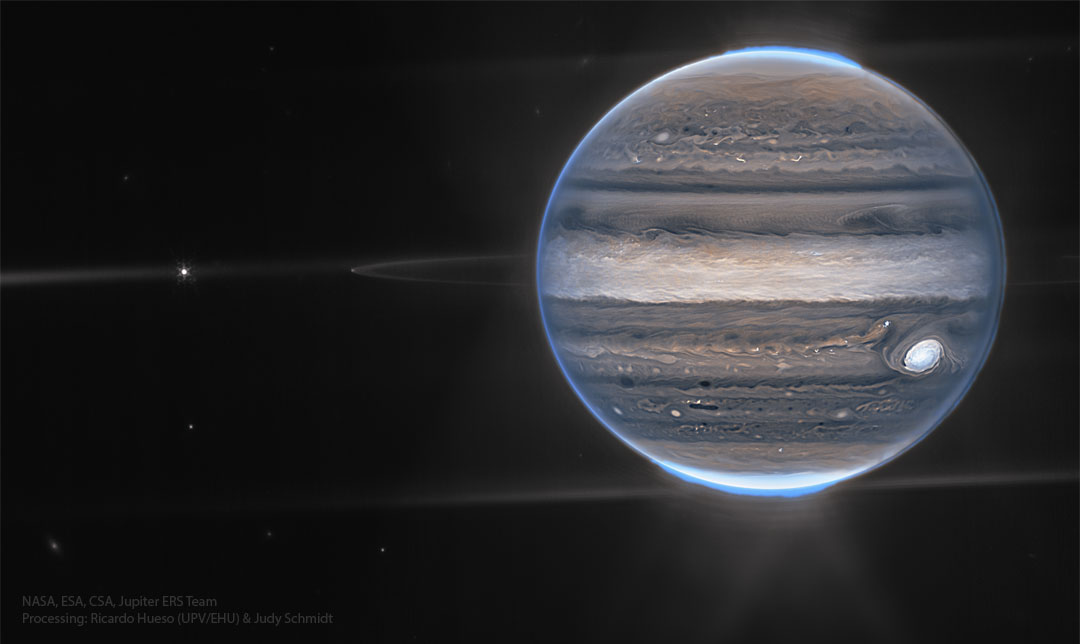
This is quite obviously an image of Jupiter, the large spot to the lower right of the planet is ummistakable. But it is also not the normal view of the planet. The colours are different for a start – and the spot isn’t red (really a rust colour.) Notable, too, are the bright polar aurorae.
Also visible is Jupiter’s ring system with the satellite Adrastea at their leftmost edge and Amalthea further out.
From Astronomy Picture of the Day (APOD) for 17/10/25. I’ve only just caught uop with this as the APOD website was down during the recent US government shutdown.
This is the asteroid 243 Ida. To its right in the picture can be seen its moon Dactyl. Ida was the first asteroid to have a moon to be discovered.
A view from the International Space Station of an uncommon type of lightning called Giant Jet Lightning. This arises from thunderstorms and moves upwards into the ionosphere.
The picture shows a nebula spreading out from star IRAS 04302+2247 . The butterfly shape apparently indicates a planet-forming system. (There’s a nice spiral galaxy to the bottom left of the image as well.)
The Crab Nebula as seen in visible light from the Hubble Space Telescope (purple,) X-ray light as imaged by the Chandra X-ray observatory (blue) and infra-red from the Spitzer Space Telescope (red.) The Crab Pulsar is the bright spot in the swirl’s centre:-
The ice mountains of Norgay Montes on left, with Hillary Montes along the horizon and Sputnik Planum to right. Clouds in the thin atmosphere appear to the top.
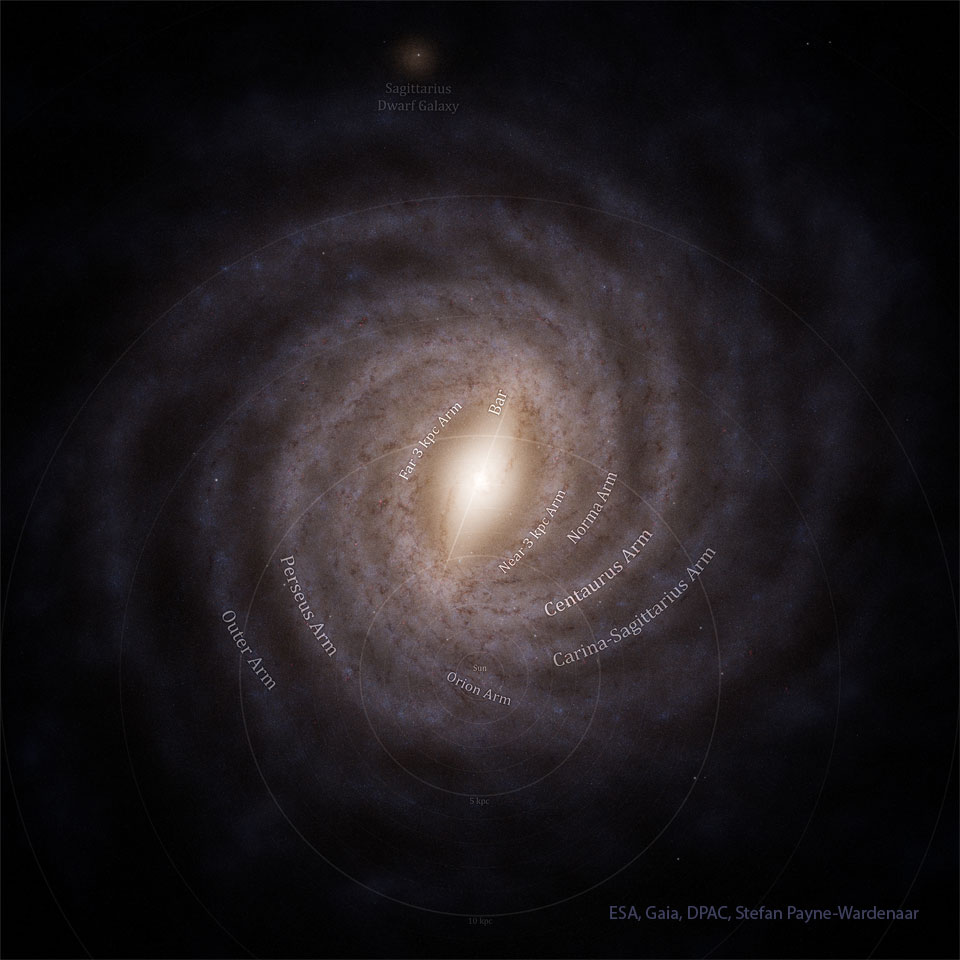
Recently (12/5/25 and 13/5/25) Astronomy Picture of the Day published two reconstructions (one each on consecutive days from data collected by the European Space Agency’s Gaia spacecraft) of how our home galaxy The Milky Way looks from the side and from above.
Side view:-
From above. Our sun is circled below within the galaxy’s Orion Arm:-
Well there is one if only you have the right viewpoint, such as SOHO (the Solar & Heliospheric Observatory) has.
This picture of Comet ATLAS (see Astronomy Picture of the Day for 20/1/25) was taken by SOHO as the comet passed closest to the sun and shows at least six tails in four different colours. The dark circle to the lower edge is of course due to SOHO’s sun obscuring barrier.