Archives » Any Human Heart

Bookshelf Travelling for Insane Times – William Boyd

Another entry for the meme started by Judith and now collated by Katrina. The weekend comes around so fast.

This week I’m featuring books by William Boyd. His Wiki page describes him as a Scottish writer (but Fantastic Fiction has him as British. By parentage (and part of his education) he is Scottish but his writing is more akin to that from south of the border so I have always had a slight reservation. I do have his books shelved on my “Scottish” bookcase, though, but only after the “W”s and Kurt Wittig‘s critical work.

Books Written by William Boyd

Standouts here are The New Confessions, Brazzaville Beach, Any Human Heart, and the spoof biography Nat Tate, an American Artist.

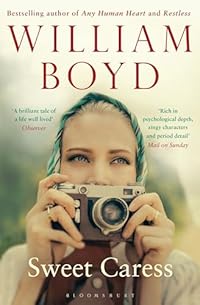
Sweet Caress by William Boyd

The Many Lives of Amory Clay. Bloomsbury, 2015, 451 p. Borrowed from a threatened library.

 Sweet Caress cover

While the subtitle might suggest a novel along the lines of The First Fifteen Lives of Harry August or Life After Life this is a much more conventional tale of a life recollected from old age, if not quite tranquillity. Pioneer woman photographer Amory Clay’s first person narrative more or less follows a chronological order but there are the occasional interpolated scenes telling of her present day existence on the island of Barrandale (with its “bridge over the Atlantic” to the mainland) at the supposed time of writing in 1977. What renders the book unusual is the inclusion of reproductions of photographs illustrating Amory’s life (most of which are attributed to Amory.)

Sweet Caress is another of those books describing the life of someone through the Twentieth Century and in which they keep encountering significant events. It is of the essence then that war impacts on Amory. Her father was disturbed so much by his experiences in WW1 that he tries to commit suicide by driving himself – and Amory – into a lake, the man she marries has a dreadful memory of a post-Rhine crossing incident in WW2 with which he cannot come to terms, a later lover disappears presumed killed while she and he are in Vietnam. However, Amory’s contact with the great and the good is minimal – one glimpse each of the Prince of Wales (as Edward VIII was at the time) and Marlene Dietrich – more reflective of a normal life.

I note that the choice of name for his protagonist does allow Boyd to essay the pun “roman à Clay” about a book one of her lovers subsequently writes about their relationship. Similar games are played with subsidiary characters in the novel whose names nod to women who were relatively successful in their fields in the times he is writing about.

All her experiences lead Amory to feel, “not to be born is the best for man – only that way can you avoid all of life’s complications.” Later, “Any life of any reasonable length throws up all manner of complications ….. but it’s the complications that have engaged me and made me feel alive.” Through Amory, Boyd makes much of the ability of a photograph to stop time for a moment. She is also of the opinion that black and white photographs are art and colour photography somehow less true.

It’s all beautifully done – and the final chapter does supply a reason why Amory is writing her story – but Sweet Caress nevertheless kept bringing to mind the same author’s The New Confessions and (though less so) Any Human Heart, though in this regard the woman protagonist did make a difference.

Pedant’s corner:- Amory uses the word robot in 1924. Boyd just scrapes by here; but only by a couple of years at most. The location of Barrandale is unambiguously close to Oban – part of the estate of her now deceased husband. The house where they spent their married life is, though, supposed to be near enough Mallaig that school there might have been an option for their twin daughters had he not been an aristocrat yet their groceries were delivered from Oban. Fort William makes much more sense for proximity to Mallaig than Oban, which is hours away by road even now.
Otherwise we had:- vol-au-vents (surely the plural is vols-aux-vents?) Achilles’ (Achilles’s, not that it makes any difference to the pronunciation,) gin and tonics (gins and tonic – which does appear later!) take it on board (in the 1930s?) the Royal Air Force (during the war in conversation people said the RAF – they still do,) a missing “?” at the end of a question, the Palais’ (the Palais’s, again this appears later,) the church of St Modans a few pages later becomes St Monad’s and may have been an unlikely location for a divorcé to be remarried in those times,) the girls had “just done their A levels” (in 1965 Scotland? Highers, I think – unless private schools put their pupils in for English exams,) dark matter and dark energy are mentioned in 1977 (the first had been by that time, but dark energy was not named as such till 1998.)

Ordinary Thunderstorms by William Boyd

Bloomsbury, 2010. 403p.

This is the latest in Boyd’s apparent taking up of genre fiction. Okay, An Ice-cream War was a historical novel as were The New Confessions and Any Human Heart but he is not generally considered a writer of genre. Yet having most recently tackled the spy novel in Restless, he now ventures into thriller territory. (I doubt he’ll be trying SF though.)

Returning a briefcase left at a restaurant where he was eating to a man with whom he had struck up a conversation, Adam Kindred stumbles into a murder scene. The victim is still barely alive and asks Adam to remove the knife from his body. Disoriented, Adam does so and the victim promptly dies. Suspecting the murderer is in the next room, Adam flees with the briefcase and thus becomes the prime suspect. So far, so very The Thirty Nine Steps. What follows deviates from that template but is still pretty much a standard thriller where Adam sleeps rough, takes up begging, attends the Church of John Christ, changes his name, links up with a prostitute and her son, then later with the policewoman who was first on the murder scene! – all the while pursued by the murderer at the behest of a big pharmaceutical company with a secret to hide. The secret is of course in the briefcase.

Put like that this sounds ridiculous. Not very literary is it? Admittedly the novel doesn’t touch the heights of earlier Boyd offerings like Brazzaville Beach, Any Human Heart or even Restless but it is very readable, rollicking along at a fine pace – and the characterisation is good.

It is also a signal reminder of how easy it can be to stay lost in modern society. Use no banks, mobile phones nor credit cards and you are virtually invisible; certainly hard to trace. Whether the novel much enlightens the human condition is something different, though.

The story is told from the viewpoints of several of the characters and Boyd does that mainstream thing of giving their histories. I know it’s supposed to add to roundness and provide motivation but it struck me that really – especially if this knowledge is essential to the plot – it’s just another species of information dumping.

Inevitably with multiple viewpoints some of the narrators are less engaging than others. I was at first irritated by that of the chairman of the research company Calenture-Deutz but it is a sign of Boyd’s skill that he is able to elicit sympathy and even compassion towards him.

The writing appears effortless, very little jars (but see below) and the stupidity of Adam Kindred at the start apart – don’t touch the knife! – is psychologically convincing. If you like thrillers with a bit of character meat to them give it a try.

Small rant alert:-
Within, we have the old homonym “vocal chords.” These are cords; as in small pliable cylindrical pieces of living tissue. They vibrate as air passes over them and so produce sound. They are not a set of musical notes sounded simultaneously. Does no-one proof read any more?

free hit counter script