Archives » Anne Brontë

Dark Quartet by Lynne Reid Banks

The Story of the Brontës, Penguin, 1986, 409 p including ii p Foreword and ii p Postscript First published 1976.

In her foreword Banks mentioned that when she was approached with the commission to write this book she was daunted – as who would not be given its subject is three of the best-known writers of the nineteenth century, plus their unfortunately less gifted brother? Much of course is known about the Brontë family (and even more written about them) but gaps remain. The fascination they hold for many is such that any exploration of their lives will attract readers eager to glean how such a hotbed of literary invention should arise within one family from a small village in the back of beyond.

So does Dark Quartet illuminate much? A novel is likely to be more accessible than a drier academic piece but has a different purpose and as a novel Dark Quartet suffers from a lack of focus. Here, four main characters are too many, attention to each too diffused.

A lot, especially in the book’s initial stages, is told rather than shown, making any differences between Emily and Charlotte (not so much Anne, as she was younger) haze over. It is only in the latter stages where Emily’s fierce – and thwarted – desire to remain incognito distinguish them. Branwell, praised as he was within the family and over-indulged by his father, did not have the self-possession to rise above that estimation – though surely he secretly must have known, or at least suspected, that his talents were minimal, something which no doubt contributed to his descent into dissolution. It is his learning by accident (for the others had taken pains to keep it from him) that his sisters had attained the validation of publication that precipitates his final crisis. Emily and Anne succumb to consumption, the former by apparently willing it, the latter with forbearance. The unhealthiness at the time of Haworth as a village, the one with the worst death rate in England, the Brontës’ home sited just above the packed cemetery whose decaying contents seeped into its surroundings during any rainfall, running under the church and into the village, goes unremarked here.

Mention is made of the young Brontë siblings’ inventions of imaginary worlds, their notebooks filled with tiny writing, but only on the odd occasion does anyone take to the fabled moors – for inspiration or otherwise. Anne’s (actually not well evidenced) falling in love with her father’s curate Mr Weightman, who was soon to die of cholera, is stated rather than shown but Anne is depicted as being undemonstrative. Similarly Charlotte’s formative sojourn in Brussels at the Pensionnat Heger is treated somewhat cursorily.

As an introduction to the family’s history Dark Quartet is an admirable endeavour but perhaps inevitably it fails to conjure up the inner nature of these remarkable people, fails to render them whole. Maybe the novel as a form needs its authors to have free reign, its characters not to be too slaved to historical individuals, to convince completely. Or is it that in this case the task is simply too great?

Pedant’s corner:- Miss Evans’ (Miss Evans’s,) “one of the Miss Woolers” (one of the Misses Wooler,) whiskey (several times; whisky,) Mr Williams’ (Mr Williams’s,) Mr Nicholls’ (Mr Nicholls’s.)

 

The Tenant of Wildfell Hall by Anne Brontë

Penguin Classics, 1996, 536 p (including 3 p Preface to the Second Edition, 34p Notes on the Text and 2 p Select Bibliography) plus xix p Introduction by Stevie Davis. Originally published in 1848.

This novel is effectively two different stories in one. The enveloping narrative is a series of letters addressed to J Halford Esq by one Gilbert Markham of Linden-Car. Enclosed within it, but much the most substantial part, is a personal testament via diary entries of the woman he comes to love, telling her life story up till she met him. She is, of course, the tenant of Wildfell Hall of the title, Mrs Helen Graham.

The arrival of this widow at the dilapidated Hall, only part of which is now inhabitable, causes much comment in the village, as do her secretive ways. Gilbert first espies her in the local church where he is more interested in her than the sermon. He eventually sets out to the Hall and meets her via an incident involving her young son Arthur, of whom she seems overly protective but whom Markham soon befriends.

Their relationship builds slowly, mediated through Markham’s friendship with Arthur. Mrs Graham has very few dealings with the locals – she will not go anywhere without Arthur and as he cannot walk far extended trips are impractical – but does visit the Markhams’ house where in one conversation he says to her, “When a lady does consent to listen to an argument against her own opinions, she is always predetermined to withstand it – to listen only with her bodily ears, keeping the mental organs resolutely closed against the strong reasoning.”

Slowly rumour and innuendo grow in the village around Helen’s past until Markham confronts her about the tittle-tattle whereupon she gives him her diary to read so that he can learn the truth about her. She is not a widow, but still married, to an Arthur Huntingdon, to whose attractions she had succumbed against her aunt’s better judgement. Her husband is of course a very bad lot indeed and his behaviour was such that she felt forced to flee taking their son with her to avoid his father contaminating his upbringing, her only recourse since divorce was impossible for a woman and as a wife she was in effect a non-person, with no legal rights.

The novel is implicitly feminist therefore not only in that Helen is portrayed as wronged but that she is a stronger, more moral and upright human being than her husband or any of his cronies. Indeed, she is more morally upstanding than Markham since his treatment of Mr Lawrence – who unbeknown to him till later in the book, is Helen’s brother – is thoroughly reprehensible (as well as criminal.) In fact Helen is almost saintly in her forbearance and her actions towards her husband when she discovers he has fallen ill.

It would not be hard to deduce from this book that the author was a daughter of the parsonage. It is saturated with Biblical allusions and quotations. Helen derives most of her consolations from her religious beliefs.

In human affairs things don’t really change that much. Despite complaints from reviewers at the original time of publication that the upper classes no longer behaved in the debauched manner of Huntingdon’s friends as Brontë portrayed them, their activities reminded me of nothing so much as the Bullingdon Club. The book’s feminism most likely also formed the grounds for the unappreciative nature of the original reviews, though Anne’s sister Charlotte also thought the work reprehensible.

To modern eyes the novel is perhaps overwritten and overwrought but Brontë was exposing an ongoing injustice. A degree of fire and venom is understandable.

Pedant’s corner:- window’s weeds (widow’s weeds,) a missing end quote mark, “‘that he is a sensible sober respectable?’” (needs no ‘a’,) ““till the gentleman come. ‘What gentlemen?’” (it was to be a group of men therefore ‘gentlemen’, for ‘gentleman’,) “‘might seem contradict that opinion’” (might seem to contradict that opinion,) plaguy (plaguey?) “in behalf of” (is this an early nineteenth century usage? – on behalf of,) an extra open quote mark in the middle of a piece of direct speech. In the Notes; Jesus’ (x2, Jesus’s,) paeon (paean,) Dives’ (Dives’s,) Mephistophilis (said to be in Marlowe. He spelled it Mephastophilis.)

Agnes Grey by Anne Brontë

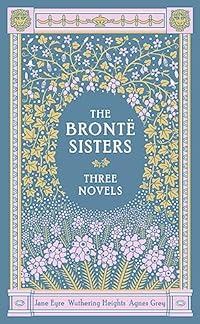
In “The Brontë Sisters: Three Novels,” Barnes and Noble, 2012, 164 p (plus iii p Introduction to the three novels.) Agnes Grey was first published 1847.

 The Brontë Sisters: Three Novels cover

Narrator Agnes Grey is the daughter of a poor-ish clergyman on whose infirmity she decides to find work as a governess to help out her family financially, albeit in a small way. The novel is a more or less straightforward account of her experiences first of all in a family where the children fail to do as they are asked, over-indulged as they are by their parents, a thankless endeavour not soon enough brought to an end, then in another – the Murrays – where she is in charge of two much older daughters, both of whom are headstrong in various degrees. The influence of Brontë’s own life in providing a milieu for her heroine is therefore obvious.

Agnes Grey is God-fearing, thoughtful and mindful of her place in the scheme of things and of her obligations to be compassionate. That others of higher social standing than herself may not be so minded, is something she becomes acutely aware of.

The hypocritical minister, the more truly Christian curate, the calculating mother prepared to sacrifice her daughter’s future happiness to a title, the scheming young girl callously set on snaring a man’s heart while never intending to gratify that desire, all make an appearance here. This fits neatly into the template of the Georgian or Victorian novel. It is all over rather quickly and it is relatively obvious from the moment of the appearance of the curate, Mr Weston, in Agnes Grey’s life where it will end. Everything seemed rather rushed, though, more like sketches for a novel than the complete article.

Pedant’s corner:- In the Introduction; a repeated full stop. Otherwise; no start quote mark when a chapter begins with a piece of dialogue, “it would be with different, feelings” (why the comma?) opportunityl (opportunity,) visiter(s) (several instances, visitor(s),) by-the-bye (previously – on the same page! – by-the-by.) “‘What do your mean, sir?’” (you,) secresy (an old spelling?) “None of the Murrays were disposed to….” (None … was disposed to,) visa versa (nowadays always vice versa,) wofully, woful (now spelled woefully, woeful,) “the congregation were departing” (the congregation was departing,) “not to shabby or mean” (not to appear shabby or mean,) worky-day (now spelled workaday,) “said be” (said he.)

free hit counter script